
Lens Power Calculation for Vision Correction
This problem requires calculating the power of a lens needed to correct vision so that a person can read a book placed at 25 cm, given their minimum distance of distinct vision is 50 cm.
Understanding the Vision Problem
- The person's near point (minimum distance of distinct vision) is 50 cm. This means they can see objects clearly only if they are at or beyond 50 cm.
- The goal is to read a book at 25 cm.
- A corrective lens is needed to make the book at 25 cm appear as if it is at 50 cm, allowing the person to see it clearly. This means the lens must form a virtual image of the object (book) at the person's near point.
Applying the Lens Formula
We use the lens formula to find the focal length ($f$). The formula is:
$ \frac{1}{f} = \frac{1}{v} - \frac{1}{u} $- Object Distance ($u$): The distance of the book from the lens. Since the book is placed in front of the lens, $u = -25 \text{ cm}$.
- Image Distance ($v$): The distance where the virtual image should be formed for clear vision. This is the person's near point. Since it's a virtual image on the same side as the object, $v = -50 \text{ cm}$.
Calculating Focal Length
Substitute the values into the lens formula:
$ \frac{1}{f} = \frac{1}{(-50 \text{ cm})} - \frac{1}{(-25 \text{ cm})} $
$ \frac{1}{f} = -\frac{1}{50 \text{ cm}} + \frac{1}{25 \text{ cm}} $
Find a common denominator (50):
$ \frac{1}{f} = -\frac{1}{50 \text{ cm}} + \frac{2}{50 \text{ cm}} $
$ \frac{1}{f} = \frac{-1 + 2}{50 \text{ cm}} = \frac{1}{50 \text{ cm}} $
Thus, the focal length $f = 50 \text{ cm}$.
Calculating Lens Power
The power ($P$) of a lens is defined as the reciprocal of its focal length ($f$) in meters.
$ P = \frac{1}{f} $
First, convert the focal length to meters:
$ f = 50 \text{ cm} = 0.50 \text{ m} $
Now, calculate the power:
$ P = \frac{1}{0.50 \text{ m}} = 2 \text{ D} $
The required power of the lens is 2 Diopters.
Similar Questions
- Beyond what distance, the ray optics is sufficiently valid when the aperture is $6\text{ mm}$ wide and the wavelength is $6000\text{ \AA}$?
- A plano-convex lens fits exactly into a plano-concave lens. Their plane surfaces are parallel to each other. If lenses are made of different materials of refractive indices $\mu_1$ and $\mu_2$ and $R$ is the radius of curvature of the curved surface of the lenses, then the focal length of the combination is
- A ray of light travelling in air is incident on one face of a parallel glass slab of thickness $t$ and refractive index $\mu$ at an angle of incidence $i$. Total time spent by the ray inside the slab is
- An electromagnetic wave, whose wave normal makes an angle of $45^{\circ}$ with the vertical, is travelling in air and strikes a horizontal liquid surface. While travelling through the liquid, it gets deviated by $15^{\circ}$. If the speed of electromagnetic wave in air is $3 \times 10^{8}\text{ m/s}$, then the speed of electromagnetic wave in the liquid will be
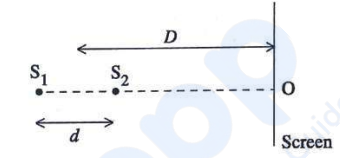
Two points of monochromatic and coherent sources of light of wavelength $\lambda$ each, are placed as shown in figure. The initial phase difference between the sources is zero, ($D \gg d$). Mark the correct statement(s).
Important Questions from Optics
- A point source is kept at the center of a spherically enclosed detector. If the volume of the detector increased by 8 times, the intensity will
- Five persons $\text{P}_1, \text{P}_2, \text{P}_3, \text{P}_4 \text{ and } \text{P}_5$ recorded object distance ($u$) and image distance ($v$) using same convex lens having power $+5\text{D}$ as $(25, 96), (30, 62), (35, 37), (45, 35)$ and $(50, 32)$ respectively. Identify correct statement
- In the Young's double slit experiment the intensity produced by each one of the individual slits is $I_o$. The distance between two slits is $2 \text{ mm}$. The distance of screen from slits is $10 \text{ m}$. The wavelength of light is $6000 \text{ \AA}$. The intensity of light on the screen in front of one of the slits is _______.
- In a microscope the objective is having focal length $f_o = 2 \text{ cm}$ and eye-piece is having focal length $f_e = 4 \text{ cm}$. The tube length is $32 \text{ cm}$. The magnification produced by this microscope for normal adjustment is ____________.
- A collimated beam of light of diameter $2 \text{ mm}$ is propagating along x-axis. The beam is required to be expanded in a collimated beam of diameter $14 \text{ mm}$ using a system of two convex lenses. If first lens has focal length $40 \text{ mm}$, then the focal length of second lens is ____________ $\text{mm}$.


