
To determine the magnetic flux passing through the square, we need to evaluate the contribution of the magnetic field component perpendicular to the square's surface.
The square is situated in the \(x-y\) plane, which means its normal vector is along the \(z\)-axis, i.e., \(\hat{k}\).
The given magnetic field is \(B = B_0 (2\hat{i} + 3\hat{j} + 4\hat{k})\). For calculating the magnetic flux through the square, we need only the component of the magnetic field along the normal to the surface. Thus, the relevant component of the magnetic field is the one along \(\hat{k}\) direction, which is \(4B_0\).
Magnetic flux \(\Phi\) through a surface is given by:
\(\Phi = \int \vec{B} \cdot d\vec{A}\)
For a flat surface with uniform magnetic field component perpendicular to it, this simplifies to:
\(\Phi = B_{\text{perpendicular}} \cdot A\)
Here, \(B_{\text{perpendicular}} = 4B_0\) and the area \(A\) of the square is \(L^2\).
Substituting these values, we get:
\(\Phi = 4B_0 \cdot L^2 = 4B_0L^2\)
The magnetic flux passing through the square is therefore \(4B_0L^2\), which matches the correct answer choice:
$4 B_0 L^2$
.
Similar Questions
- Consider a fuse wire of length $l$ and radius $r$. The time of heating ($t$) for passing the maximum current will depend on
- A circular coil, carrying current, has radius $R$. The distance from the centre of the coil on the axis where the magnetic induction will be $\frac{1}{27}$th of its value at the centre of the coil is
- A resistor of resistance '$R$' draws power '$P$' when connected to an AC source. If an inductance is now placed in series with $R$, such that the impedance of the circuit becomes '$Z$', the power drawn will be
- A simple pendulum of length $l$ has a bob of mass $m$, with a charge $q$. On it a vertical sheet of charge, with surface charge density '$\sigma$' passes through the point of suspension. At equilibrium, if the string makes an angle $\theta$ with the vertical, then
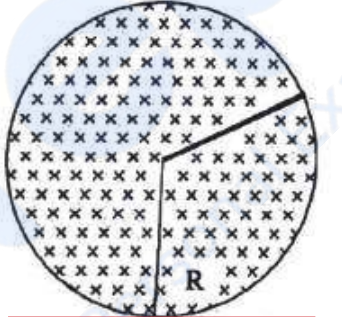
A uniform time-varying magnetic field exists in a circular region of radius $R$, directed perpendicular into the plane of the paper, increasing at a constant rate $\alpha$. A straight conducting rod of length $2R$ is placed exactly along the diameter of the circular region (passing through the centre). Find the induced emf across the rod.
There is a ring of radius $r$ having linear charge density $\lambda$ and rotating with a uniform angular velocity $\omega$. The magnitude of the magnetic field produced by this ring at its own centre would be
($\mu_0 = \text{permeability of air}$)- The magnetic moment of an iron bar is $M$. It is now bent in such a way that it forms an arc section of a circle subtending an angle of $60^{\circ}$ at the centre. The magnetic moment of the arc section is
- The displacement current flows through a capacitor when the voltage across its plates
Important Questions from Electricity and Magnetism
- The electric field of a plane electromagnetic wave, travelling in an unknown non-magnetic medium is given by,
$E_y = 20 \sin(3 \times 10^6 x - 4.5 \times 10^{14} t) \text{ V/m}$
(where x, t and other values have S.I. units). The dielectric constant of the medium is _________.
(speed of light in free space is $3 \times 10^8 \text{ m/s}$) - A conducting circular loop is rotated about its diameter at a constant angular speed of 100 rad/s in a magnetic field of 0.5 T perpendicular to the axis of rotation. When the loop is rotated by $30^\circ$ from the horizontal position, the induced EMF is 15.4 mV. The radius of the loop is _________ mm.
$\left(\text{Take } \pi = \frac{22}{7}\right)$ - A cylindrical conductor of length 2 m and area of cross-section $0.2 \text{ mm}^2$ carries an electric current of 1.6 A when its ends are connected to a 2 V battery. Mobility of electrons in the conductor is $\alpha \times 10^{-3} \text{ m}^2\text{/V.s}$. The value of $\alpha$ is :
(electron concentration $= 5 \times 10^{28} \text{/m}^3$ and electron charge = $1.6 \times 10^{-19} \text{ C}$) - A short bar magnet placed with its axis at $30^\circ$ with an external field of 800 Gauss, experiences a torque of 0.016 N.m. The work done in moving it from most stable to most unstable position is $\alpha \times 10^{-3} \text{ J}$. The value of $\alpha$ is ______.
- A regular hexagon is formed by six wires each of resistance $r \text{ }\Omega$ and the corners are joined to the centre by wires of same resistance. If the current enters at one corner and leaves at the opposite corner, the equivalent resistance of the hexagon between the two opposite corners will be


