Consider the following sequence of reactions to give the major product (X)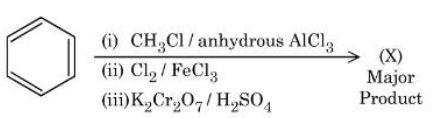
$\text{P}~\text{g}$ of the major product (X) formed is reacted with $\text{NaHCO}_3$ solution to liberate a gas which occupied $11.2~\text{dm}^3$ at STP.
$\text{P} = \_\_\_\_\_\_\_\_~\text{g}$.
(Given molar mass in $\text{g~mol}^{-1}$ $\text{H}: 1, \text{C}: 12, \text{O}: 16, \text{Cl}: 35.5$)
Step 1: Identify the reaction sequence
Starting compound: Benzene
(i) $ \mathrm{CH_3Cl/AlCl_3} $
Friedel–Crafts alkylation gives toluene
(ii) $ \mathrm{Cl_2/FeCl_3} $
Chlorination of toluene gives mainly p-chlorotoluene (major product)
(iii) $ \mathrm{K_2Cr_2O_7/H_2SO_4} $
Oxidation of side chain $(-CH_3)$ to $(-COOH)$
So final major product $(X)$ is:
$p$-chlorobenzoic acid
Formula:
$ \mathrm{C_7H_5ClO_2} $
Step 2: Reaction with NaHCO3_33
Carboxylic acid reacts as:
$ \mathrm{RCOOH + NaHCO_3 \rightarrow RCOONa + CO_2 + H_2O} $
Thus,
$1$ mole acid gives $1$ mole $CO_2$
Step 3: Calculate moles of CO2CO_2CO2
At STP:
$22.4 \text{ dm}^3 = 1 \text{ mole}$
Given:
$11.2 \text{ dm}^3$
So,
$ \text{moles of } CO_2 = \frac{11.2}{22.4} = 0.5 $
Hence,
$ \text{moles of acid} = 0.5 $
Step 4: Molar mass of product
For $ \mathrm{C_7H_5ClO_2} $:
$ = 7(12) + 5(1) + 35.5 + 2(16) $
$ = 84 + 5 + 35.5 + 32 $
$ = 156.5 \text{ g/mol}$
Step 5: Mass of product
$ P = 0.5 \times 156.5 = 78.25 \text{ g}$
Nearest integer:
$ \boxed{78} $
Final Answer:
$\boxed{78}$
Similar Questions
- In Dumas method for estimation of nitrogen, 0.50 g of an organic compound gave 70 mL of nitrogen collected at 300 K and 715 mm pressure. The percentage of nitrogen in the organic compound is ______ %.
(Aqueous tension at 300 K is 15 mm). - $0.25 \text{ g}$ of an organic compound "A" containing carbon, hydrogen and oxygen was analysed using the combustion method. There was an increase in mass of $\text{CaCl}_2$ tube and potash tube at the end of the experiment. The amount was found to be $0.15 \text{ g}$ and $0.1837 \text{ g}$, respectively. The percentage of oxygen in compound A is ______ %. (Nearest integer)
(Given: molar mass in $\text{g mol}^{-1}$ $\text{H} : 1, \text{C} : 12, \text{O} : 16$) - Grignard reagent $\text{RMgBr (P)}$ reacts with water and forms a gas $\text{(Q)}$. One gram of Q occupies $1.4 \text{ dm}^3$ at STP. (P) on reaction with dry ice in dry ether followed by $\text{H}_3\text{O}^+$ forms a compound $\text{(Z)}$. 0.1 mole of $\text{(Z)}$ will weigh _________ g. (Nearest integer)
- Consider all the structural isomers with molecular formula $\text{C}_5\text{H}_{11}\text{Br}$ are separately treated with $\text{KOH(aq)}$ to give respective substitution products, without any rearrangement. The number of products which can exhibit optical isomerism from these is ___________.
Consider the following reactions sequence
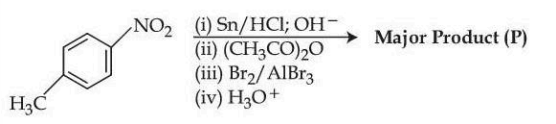
When the product (P) is subjected to Carius analysis using $\text{AgNO}_3$, $1.0\text{ g}$ of the product (P) will produce __________ g of the precipitate of AgBr. (Nearest Integer)
(Given : molar mass in $\text{g mol}^{-1}$ C : 12, H : 1, O : 16, N : 14, Br : 80, Ag : 108)- 2.0 g of a bromo hydrocarbon (X) was subjected to Carius analysis, gave 3.36 g of AgBr. The percentage of carbon in the compound (X) is 26.7%. Total number of carbon atoms in the empirical formula for compound (X) is _______.
(Given molar mass in $\text{g~mol}^{-1}$ $\text{H}: 1, \text{C}: 12, \text{Br} : 80, \text{Ag} : 108$) - The number of isomeric compounds (structural isomers only) possible with the molecular formula $C_5H_{10}O_2$, which do not react with metallic sodium is ________
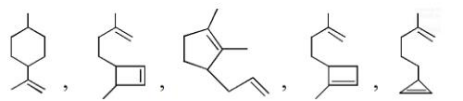
Among the following, how many hydrocarbon (s) with formula $C_{10}H_{16}$ which on reaction with acidic potassium permagenate yield(s) same product? ____________
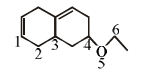
On treatment of the following compound with a strong acid, the most susceptible site for bond cleavage is :-
The total number of optically active compounds formed in the following reaction is :-
Important Questions from Organic Chemistry
- In Dumas method for estimation of nitrogen, 0.50 g of an organic compound gave 70 mL of nitrogen collected at 300 K and 715 mm pressure. The percentage of nitrogen in the organic compound is ______ %.
(Aqueous tension at 300 K is 15 mm). - $0.25 \text{ g}$ of an organic compound "A" containing carbon, hydrogen and oxygen was analysed using the combustion method. There was an increase in mass of $\text{CaCl}_2$ tube and potash tube at the end of the experiment. The amount was found to be $0.15 \text{ g}$ and $0.1837 \text{ g}$, respectively. The percentage of oxygen in compound A is ______ %. (Nearest integer)
(Given: molar mass in $\text{g mol}^{-1}$ $\text{H} : 1, \text{C} : 12, \text{O} : 16$) - Grignard reagent $\text{RMgBr (P)}$ reacts with water and forms a gas $\text{(Q)}$. One gram of Q occupies $1.4 \text{ dm}^3$ at STP. (P) on reaction with dry ice in dry ether followed by $\text{H}_3\text{O}^+$ forms a compound $\text{(Z)}$. 0.1 mole of $\text{(Z)}$ will weigh _________ g. (Nearest integer)
- Consider all the structural isomers with molecular formula $\text{C}_5\text{H}_{11}\text{Br}$ are separately treated with $\text{KOH(aq)}$ to give respective substitution products, without any rearrangement. The number of products which can exhibit optical isomerism from these is ___________.
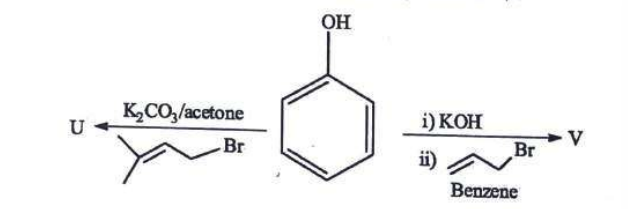
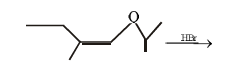
The major products U and V in the following reaction are