
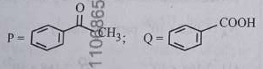
Compound Identification Using Chemical Tests
The problem asks to identify compounds P and Q based on their molecular formula ($C_8H_8O$) and chemical reaction properties.
Analysis of Compound P Properties
- Formula: $C_8H_8O$.
- 2,4-DNP Test: A positive result (red-orange precipitate) indicates the presence of a carbonyl group (C=O), common in aldehydes and ketones.
- Fehling's Test: A negative result means P is not a typical aldehyde (like aliphatic aldehydes). It could be a ketone or possibly a sterically hindered/electronically deactivated aromatic aldehyde.
- Oxidation: Drastic oxidation with chromic acid ($CrO_3$) produces an aromatic product Q. This suggests P might have an oxidizable group, like an alkyl side chain on an aromatic ring, or a benzylic alcohol/ketone structure.
- Product Q Property: Q produces effervescence with aqueous sodium bicarbonate ($NaHCO_3$), signifying the formation of carbon dioxide ($CO_2$). This indicates Q is an aromatic carboxylic acid.
Evaluating the Options
Let's analyze the structure corresponding to the correct answer (Option 1), which is Acetophenone.
- Structure (Acetophenone): $C_6H_5COCH_3$
- Molecular Formula: $C_8H_8O$. Matches.
- Reactivity:
- It's a ketone, so it gives a positive 2,4-DNP test.
- Ketones do not reduce Fehling's reagent. Matches.
- Oxidation of the methyl group adjacent to the carbonyl on the benzene ring yields benzoic acid. The reaction is: $C_6H_5COCH_3 \xrightarrow{CrO_3, H_2SO_4, \Delta} C_6H_5COOH$
- Benzoic acid ($C_6H_5COOH$) is an aromatic carboxylic acid.
- Benzoic acid reacts with $NaHCO_3$ to produce $CO_2$ gas (effervescence): $C_6H_5COOH + NaHCO_3 \rightarrow C_6H_5COONa + H_2O + CO_2 \uparrow$ Matches.
Acetophenone (P) fits all the described properties. Oxidation yields Benzoic acid (Q), which reacts with $NaHCO_3$. Other possible isomers with the formula $C_8H_8O$ might include phenolic ketones or aromatic aldehydes, but acetophenone is the structure that satisfies all given reaction conditions, especially the negative Fehling's test and the formation of an aromatic carboxylic acid upon oxidation.
Conclusion
Based on the analysis:
- Compound P is Acetophenone.
- Compound Q is Benzoic Acid.
The structure corresponding to Acetophenone is given in Option 1.
Similar Questions
Select the reagents that reduce nitriles to primary amines :
A. (i) $LiAlH_4$ ; (ii) $H_2O$
B. $Sn + HCl$
C. $H_2 / Ni$
D. $Na(Hg) / C_2H_5OH$
E. $Br_2 / \text{aq. } NaOH$
Choose the correct answer from the options given below :The major product Z formed in the following sequence of reactions is :
$$C_2H_6 \xrightarrow{Cl_2, \text{UV light}} X \text{ (monochlorinated product)} \xrightarrow{NH_3} Y \xrightarrow{(i) NaNO_2, HCl, (ii) H_2O} Z$$- The pair of molecules that are metamers among the following is :
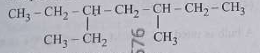
The correct IUPAC name of the following compound is :
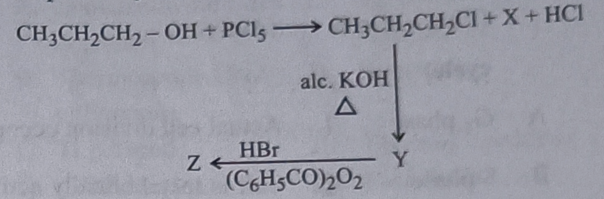
In the following reaction sequence, X and Z respectively are :
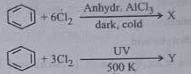
The number of chlorine atoms present in the organic products X and Y of the following reactions, respectively, are :
Two products X and Y are formed in the following reaction sequence.

The suitable method that can be used for the separation of products X and Y is :List I (Reactions) List II (Reagents) A. 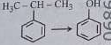
I. (i) oleum, (ii) $NaOH, \Delta$, (iii) $H^+$ B. $CH_3COOH \rightarrow CH_3CH_2OH$ II. (i) $O_3$, (ii) $H_2O/H^+$ C. $CH_3CH_2CH_2OH \rightarrow $ 
III. (i) $CH_3OH, H^+$, (ii) $H_2$, catalyst D. 
IV. (i) conc. $H_2SO_4, \Delta$, (ii) $H_2O$ Match List I with List II.
The following two reactions give the same foul smelling product Z.
$$C_2H_5Cl \xrightarrow{X} Z$$

X and Z, respectively, are :- Given below are two statements:
Statement-I : Oxidation of p-nitrotoluene with acidic $KMnO_4$ gives an acid that is stronger than benzoic acid.
Statement-II : Reduction of p-nitrotoluene with Sn/HCl followed by neutralization gives an amine that is more basic than aniline.
In light of the above statements, choose the most appropriate answer from the options given below.
Important Questions from Organic Chemistry
- In Dumas method for estimation of nitrogen, 0.50 g of an organic compound gave 70 mL of nitrogen collected at 300 K and 715 mm pressure. The percentage of nitrogen in the organic compound is ______ %.
(Aqueous tension at 300 K is 15 mm). Given below are two statements:
Statement I: The dipole moment of R-CN is greater than R-NC and R-NC can undergo hydrolysis under acidic medium to produce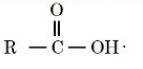
Statement II: R-CN hydrolyses under acidic medium to produce a compound which on treatment with $\text{SOCl}_2$, followed by the addition of $\text{NH}_3$ gives another compound(x). This compound (x) on treatment with $\text{NaOCl/NaOH}$ gives a product, that on treatment with $\text{CHCl}_3\text{/KOH/}\Delta$ produces R-NC
In the light of the above statements, choose the correct answer from the options given below- Given below are two statements:
Statement I: Cross aldol condensation between two different aldehydes will always produce four different products.
Statement II: When semicarbazide reacts with a mixture of benzaldehyde and acetophenone under optimum pH, it forms a condensation product with acetophenone only.
In the light of the above statements, choose the correct answer from the options given below - $0.25 \text{ g}$ of an organic compound "A" containing carbon, hydrogen and oxygen was analysed using the combustion method. There was an increase in mass of $\text{CaCl}_2$ tube and potash tube at the end of the experiment. The amount was found to be $0.15 \text{ g}$ and $0.1837 \text{ g}$, respectively. The percentage of oxygen in compound A is ______ %. (Nearest integer)
(Given: molar mass in $\text{g mol}^{-1}$ $\text{H} : 1, \text{C} : 12, \text{O} : 16$) - Grignard reagent $\text{RMgBr (P)}$ reacts with water and forms a gas $\text{(Q)}$. One gram of Q occupies $1.4 \text{ dm}^3$ at STP. (P) on reaction with dry ice in dry ether followed by $\text{H}_3\text{O}^+$ forms a compound $\text{(Z)}$. 0.1 mole of $\text{(Z)}$ will weigh _________ g. (Nearest integer)


