A 45-year-old lady presents with a hard lump in the left breast. On examination, the lump is found to be 4 cm x 6 cm in size, not fixed to the skin, but fixed to the underlying pectoralis major muscle. The T stage of this is
cT4a
The correct answer is cT4a. In breast TNM staging, T4 means a tumour of any size with direct extension beyond the breast, and size then becomes irrelevant. T4a is extension to the chest wall; T4b is skin ulceration, satellite skin nodules or skin oedema (peau d'orange); T4c is both; T4d is inflammatory carcinoma. Here the lump is fixed to pectoralis major, taken as deep fixity, giving cT4a, and it is explicitly not fixed to skin, excluding T4b. Deep fixity is elicited by loss of mobility when the patient contracts pectoralis major by pressing her hand on her hip. T4 disease is stage IIIB and is treated with neoadjuvant chemotherapy followed by surgery and radiotherapy.
cT2 is greater than 2 cm but not more than 5 cm and cT3 is greater than 5 cm, but both require a tumour confined to the breast with no chest wall or skin involvement, so neither applies despite the 4 x 6 cm size. cT4b is wrong as there is no ulceration, oedema or satellite nodule.
Key point: Deep fixity equals T4a, skin involvement equals T4b; once a breast tumour is T4, its diameter no longer alters the T stage.
Similar Questions
An infant is brought to the clinic by the parents with the history of a swelling in the neck since birth. On examination, the swelling is found to be soft, partially compressible and brilliantly trans-illuminant. The most likely diagnosis is
A 29-year-old lady presents with a history of discharge from the nipple of the left breast since 1 month duration. Which one of the following is not warranted in the initial assessment of this patient?
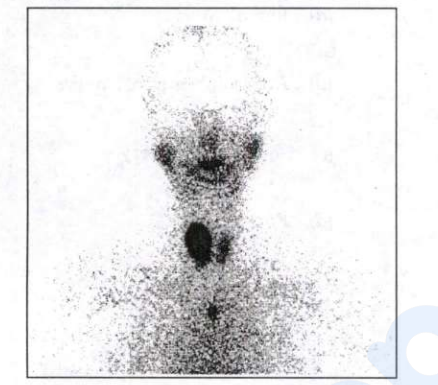
A 40-year-old female presents with symptoms of heat intolerance, excessive sweating and weight loss since 10-12 months. After clinical examination, the surgeon orders an investigation which is as shown in the image. The scan shown below is a/an
Important Questions from Neck & Breast Surgery
- Medical management of thyrotoxic crisis includes all of the following EXCEPT:
- First line hormone therapy for post-menopausal woman with metastatic carcinoma breast is:
- All of the following are major subtypes of breast cancer based on Gene array analysis EXCEPT:
- Which of the following statements regarding lymphoedema following breast cancer treatment are correct?
1. Incidence has decreased due to rarely combined therapy of axillary LN dissection and
radiotherapy
2. Precipitating cause like LN metastasis is a major determinant
3. The condition is often painful
4. Oedematous limb is susceptible to bacterial infection
Select the correct answer using the code given below: - No increased relative risk of invasive breast carcinoma based on histopathological examination of benign breast tissue is for all of the following EXCEPT: