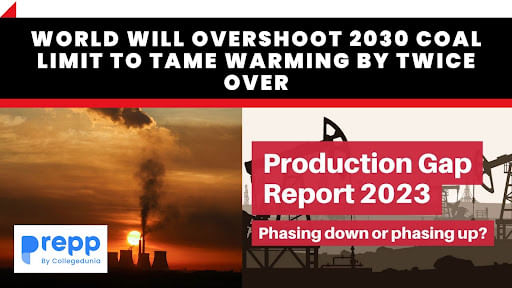
World Will Overshoot 2030 Coal Limit To Tame Warming By Twice Over
Relevance: GS3 - Conservation, environmental pollution and degradation, environmental impact assessment.
(Source: The Hindu, 11/09/2023)
Click here for Daily Current Affairs
Why in the news?
- Recently, the Production Gap Report revealed that governments are set to produce twice as much fossil fuels in 2030 than predicted to limit warming to 1.5°C.
- The increase in fossil fuel production was in spite of commitments to limit global warming to 1.5°C or 2°C.
Table of Contents
What is the Production Gap Report 2023?
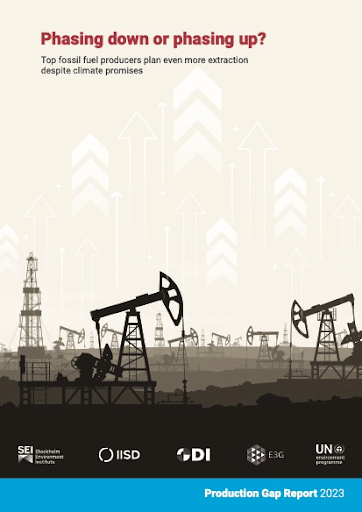
- The “Production Gap Report 2023: Phasing down or phasing up? “ is published by Stockholm Environment Institute (SEI), Climate Analytics, E3G, International Institute for Sustainable Development (IISD), and the UN Environment Programme (UNEP).
- It was first published in 2019
- Aim: Assess the planned and projected production of coal, oil, and gas by governments across the world against global levels consistent with the goals outlined under the Paris Agreement and limiting warming to 1.5°C or 2°C.
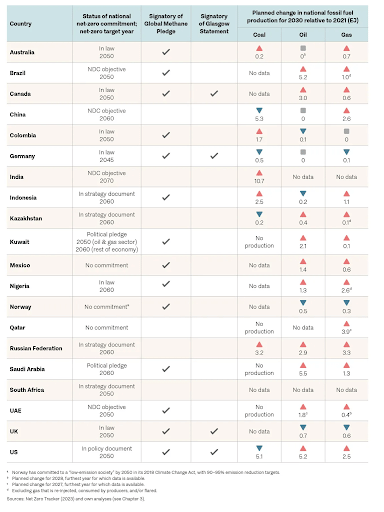
- Countries of focus: It analyzes 20 major fossil-fuel-producing countries - Australia, Brazil, Canada, China, Colombia, Germany, India, Indonesia, Kazakhstan, Kuwait, Mexico, Nigeria, Norway, Qatar, the Russian Federation, Saudi Arabia, South Africa, the United Arab Emirates, the United Kingdom of Great Britain and Northern Ireland, and the United States of America.
What is the Production Gap?
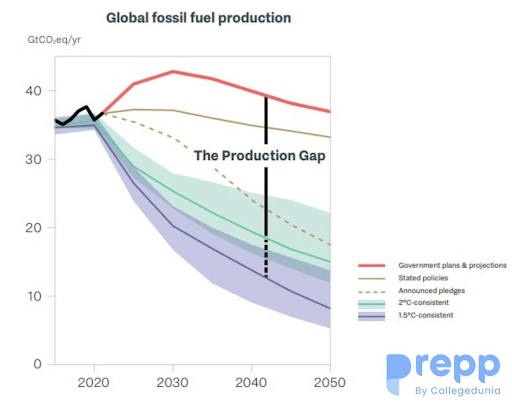
- The production gap is the difference between governments’ planned fossil fuel production and global production levels consistent with limiting global warming to 1.5°C or 2°C.
- The 2023 assessment features two major updates.
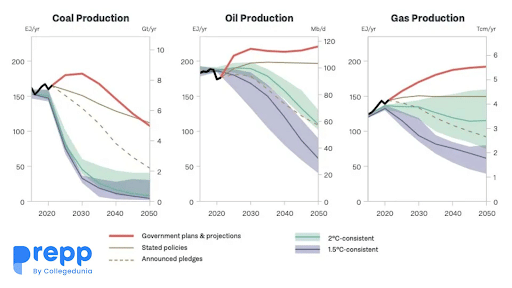
- The “government plans and projections” global pathway reflects how major fossil fuel-producing countries have adjusted their coal, oil, and gas production targets since late 2021 due to the energy crisis and increased climate ambitions.
- The new scenario database compiled for the Working Group III contribution to the IPCC’s Sixth Assessment Report (AR6) has helped update global pathways for fossil fuel production consistent with limiting warming to 1.5°C or 2°C.
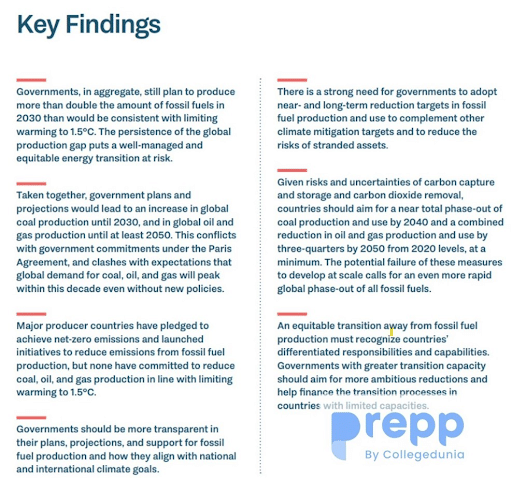
- In aggregate, governments are planning on producing around 110% more fossil fuels in 2030 than would be consistent with limiting warming to 1.5°C, and 69% more than would be consistent with limiting warming to 2°C.
- By 2050, planned fossil fuel production is projected to be 350% and 150% above the levels consistent with 1.5°C or 2°C, meaning the production gap will grow.
What are the findings of the Report?
Suggestions
- Governments must be more transparent and reveal their plans, projections, support for fossil fuel production and how they align with national and international climate goals to the public which will help build accountability.
- Governments must adopt short- and long-term reduction targets for fossil fuel production.
- This must complement steps to achieve other climate mitigation targets and reduce the risks of stranded assets.
- It suggests the following strategies for the phase-out of fossil fuels.
- Reduce fossil fuel consumption
- Expand renewable energy
- Reduce methane emissions from all sources
- Target investments and social protection for affected communities.
- Countries should aim to complete a total phase-out of coal production and use by 2040 and a combined 75% reduction from 2020 levels in oil and gas production and use by 2050.
- The potential failure of these measures to develop at scale calls for an even more rapid global phase-out of all fossil fuels.
- The transition process must be equitable and reflect the differentiated responsibilities and capabilities of different countries.
- Governments with greater transition capacity should aim for more ambitious reductions and help finance the transition processes in countries with limited capacities.
Why is a rapid transition important?
- A rapid global phase-out of fossil fuels has become necessary due to the potential failure of other schemes in terms of their viability and ability to counter near-term harms.
- According to research, committed emissions of CO2 expected to occur over the lifetime of existing fossil-fuel-producing infrastructure have already exceeded the remaining carbon budget for a 50% chance of limiting warming to 1.5°C by 2100.
- Fossil fuel extraction and burning are associated with many near-term and localized non-climatic social, economic, and environmental harms that have not been accounted for in climate mitigation scenarios.
- The continued production and use of coal, oil, and gas are not compatible with a safe and livable future.
- Governments must commit to, plan for, and implement global reductions in the production of fossil fuels to achieve net-zero CO2 emissions by 2050.
Conclusion
- Both demand and supply influence the global energy landscape, therefore targets and policies to phase out fossil fuels must be combined with other transition and mitigation measures.
- This will ensure that the costs of decarbonization are reduced and promote policy coherence and that renewables replace fossil fuels.
(*Click this link to read prelims specific weekly current affairs articles)
FAQs
Question: What is net zero?
Answer:
‘Net zero’ means that any emissions are balanced by the absorption of an equivalent amount from the atmosphere. At the United Nations Framework Convention on Climate Change Summit in 2021, India committed to achieving net zero by 2070.
Question: What is decarbonization?
Answer:
Decarbonization is the reduction or elimination of carbon dioxide emissions from a process through the use of low-carbon sources.
UPSC Mains Practice Question:
|
MCQs
Question: The ‘’Common Carbon Metric’’ supported by UNEP, has been developed for (UPSC CSE 2021)
(a) Assessing the carbon footprint of building operations around the world
(b) Enabling commercial farming entities around the world to enter carbon emission trading
(c) Enabling governments to assess the overall carbon footprint caused by their countries
(d) Assessing the overall carbon foot-print caused by the use of fossil fuels by the world in a unit time
Answer: (a) See the Explanation
- Carbon footprint of an entity is the total amount of greenhouse gases that are generated by that entity.
- The Common Carbon Metric is a protocol developed by United Nations Environment Program’s Sustainable Buildings & Climate Initiative (UNEP-SBCI) for measuring energy use & reporting GHG emissions from Building Operations.
- It aims to support GHG emissions reductions through accurate measurement of energy efficiency improvements in building operations.
Therefore, option (a) is the correct answer.
Question: With reference to furnace oil, consider the following statements:
- It is a product of oil refineries
- Some industries use it to generate power
- Its use causes sulphur emissions into the environment
Which of the statements given above are correct? (UPSC CSE 2021)
(a) 1 and 2 only
(b) 2 and 3 only
(c) 1 and 3 only
(d) 1, 2 and 3
Answer: (d) See the Explanation
- Furnace oil is a dark viscous residual fuel obtained by blending heavier component of crude oil. It is a is a product of oil refineries. Hence statement 1 is correct.
- Furnace oil uses include heating up homes and fuel trucks to lighting up furnaces, producing steam for industrial uses and for generating electric energy. It is produced from the burnable liquids derived from crude oil and is also called kerosene, home heating oil, diesel fuel or coal oil. Hence statement 2 is correct.
- Sulphur is a natural component in crude oil that is present in gasoline and diesel unless removed. Furnace oil has high component of sulphur leading to its emission when burned. Hence statement 3 is correct.
Therefore, option (d) is the correct answer.
Download the PREPP App and attempt FREE IAS Exam Mock Tests and get complete study material!

Full Test - 04: UPSC CSE Prelims CSAT (Paper-II)
Full Test - 03: UPSC CSE Prelims CSAT (Paper-II)
UPSC CSE Prelims 2026 GS Paper 1 Question Paper (24-May-2026)
UPSC CSE Prelims 2026 CSAT Paper 2 Question Paper (24-May-2026)

17 February 2025 | The Hindu Must Read Articles | Current Affairs

16 February 2026 | The Hindu Must Read Articles | Current Affairs

13 February 2026 | The Hindu Must Read Articles | Current Affairs









Comments