World Bank’s Flagship Gender Toolkit Launched (UPSC Current Affairs)
Relevance: GS2 - Important International institutions, agencies, and fora- their structure, mandate; GS3 - Infrastructure
(Source: The Hindu,12/09/22)
Click here for Daily Current Affairs
Why in the news?
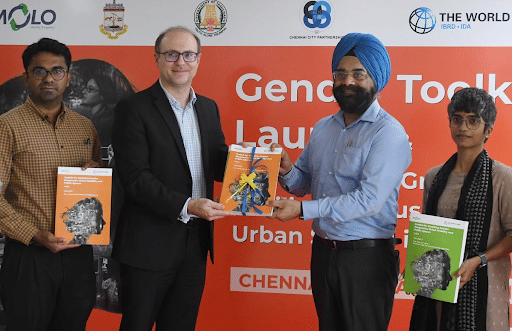
Recently, a Gender Toolkit based on “Enabling gender-responsive urban mobility and public spaces” was launched in a session conducted by the World Bank and the Chennai Urban Metropolitan Transport Authority.
What is Worldbank’s Gender Toolkit?
- The World Bank developed a two toolkit that outlines a four-pillar implementation structure for urban entities to construct a gender-responsive urban transportation and public spaces programme.
- Assessing the ground situation: The first pillar involves evaluating the current reality on the ground, which includes comprehending gender variations in mobility patterns, safety issues, and infrastructure and policy inadequacies.
- Strengthening planning and policies: The second pillar calls for improving planning and policies, which calls for incorporating gender as a lens into plans and encouraging gender inclusion among institutions and policymakers.
- Building awareness and capacity: The third pillar focuses on increasing knowledge and capability.
- Infrastructure: The fourth pillar prioritizes infrastructure improvement with a gendered lens.
- Additionally, the World Bank has provided guidance on each of the pillars.
What is the need?
- The safety and unique travel requirements of women are not generally taken into account while designing public transportation systems.
- Their access to jobs, education, and lifestyle options are severely constrained by this.
- India has amongst the lowest female labor force participation rates globally, at 26.2 percent in 2020-21.
- In Indian cities, women make up a significant portion of the public transportation users.
- According to estimates, public, intermediate public, and non-motorized transportation accounted for 84 percent of the trips made by women for work.
- There are fundamental differences between how men and women travel. Comparatively, 45.4 percent of women and 27.4 percent of males typically walk to work.
- More women take the bus than men do, and they are more inclined to plan their trips after considering affordability. Due to the higher cost of speedier modes of transportation, they frequently select slower ones.
Recommendations
- The research also suggests a number of transportation and public space improvements, particularly for women who frequently use non-motorized transportation, such as enough street lighting and enhanced walking and cycling paths.
- According to the survey, developing fair fare rules can increase the number of females and other genders.
- Setting up a good grievance redressal structure will assist in fast-track sexual harassment reports.
Significance
- The toolkit from the World Bank attempts to highlight the gender-related problems with urban planning and mobility.
- Men, women, and gender minorities all have diverse perspectives on cities.
- The World Bank toolkit offers resources to help these groups better understand and address gender-disaggregated mobility patterns, reinforce policies, and create an infrastructure that will suit their requirements.
- This toolkit will be helpful in discussions on urban planning and mobility as Indian urban local bodies and transport agencies start to comprehend the demands of different commuters.
World Bank
The development objective of the Chennai City Partnership : Sustainable Urban Services Program-for-Results Project for India
|
(*Click this link to read prelims specific weekly current affairs articles)
Some Important FAQs
Question: What is Chennai City Partnership project?
Answer:
It is to strengthen institutions and improve the quality and financial sustainability of selected urban services in the Chennai Metropolitan Area (CMA).
The government of Tamil Nadu’s new Chennai 2030 program (2021-2030) aims to accelerate Chennai’s transformation into a green, livable, competitive, and resilient city.
Question: What are the development institutions of the World Bank?
Answer:
The World Bank Group's five development institutions are:
- International Bank for Reconstruction and Development (IBRD)
- International Development Association (IDA)
- International Finance Corporation (IFC)
- Multilateral Guarantee Agency (MIGA)
- International Centre for the Settlement of Investment Disputes (ICSID)
Question: What is World Bank?
Answer:
The International Bank for Reconstruction and Development (IBRD) and the International Development Association (IDA), two of the World Bank Group's five international entities, are known as the World Bank.
It was formed with the International Monetary Fund at the 1944 Bretton Woods Conference.
Download the PREPP App and attempt FREE IAS Exam Mock Tests and get complete study material!

Full Test - 04: UPSC CSE Prelims CSAT (Paper-II)
Full Test - 03: UPSC CSE Prelims CSAT (Paper-II)
UPSC CSE Prelims 2026 GS Paper 1 Question Paper (24-May-2026)
UPSC CSE Prelims 2026 CSAT Paper 2 Question Paper (24-May-2026)

17 February 2025 | The Hindu Must Read Articles | Current Affairs

16 February 2026 | The Hindu Must Read Articles | Current Affairs

13 February 2026 | The Hindu Must Read Articles | Current Affairs









Comments