Women, Marriage and Labour Market Participation
Primary Source: The Hindu
Click here for Daily Current Affairs
Prepp Prelims Booster: Labor force participation rates (LFPRs), Periodic Labour Force Survey (PLFS), Claudia Goldin, Nobel Prize
Prepp Mains Booster: Indian Economy and issues relating to Planning, Mobilization of Resources, Growth, DevelopmentandEmployment, Government Policies and Interventions for Development
Why in the news?
- The economic impact of the non-participation of married women in India's workforce is a topic of growing concern given the significant representation of these women in the working-age population.
- Women's participation in the labour market leads to enhanced economic prospects and decision-making power in households.
- Nobel laureate Claudia Goldin's research highlights disparities in women’s labour market outcomes.
Table of Contents

What is the Labour Force Participation Rate (LFPR)?
- Labour Force Participation Rate (LFPR) is a crucial indicator in labour market studies and represents the proportion of a country's working-age population that is either employed or actively seeking employment.
- LFPR is defined as the ratio of the labour force to the working-age population. The labour force includes both the employed (those who have jobs) and the unemployed (those who are actively seeking jobs).
- Formula:
LFPR = (Labour Force / Working Age Population) ×100
- A high LFPR indicates that a large proportion of a country's potential workers are either employed or actively seeking employment.
- A low LFPR might suggest that significant portions of the working-age population are neither employed nor actively seeking work, possibly due to discouragement, lack of training, or being engaged in other activities like studies or household responsibilities.
Data on Women’s Labour Participation
- Worldwide LFPR for women in 2022 was 47.3%.
- There was a decline in women's LFPR in developing countries; India’s female LFPR dropped from 28% in 1990 to 24% in 2022.
- As per India’s NSSO Periodic Labour Force Survey (PLFS) for the age group of 25 to 49 years, following has been observed:
- Married women show a considerably lower employment proportion under the Usual Principal Status (UPS) status when compared to the Usual Principal and Subsidiary Status (UPSS) status.
- Marriage significantly influences women’s labour market outcomes.
- In the year 2022-23, there was a decrease of 5% in the female labour force participation rate (FLFPR) among married women aged 25 to 49 years.
- The FLFPR among this group was 50% in 2004-05 and declined to 45% in 2022-23.
- The decline in the FLFPR is primarily concentrated within the age group of 25-29.
What is NSSO?
What is Usual Principal Status (UPS) and Usual Principal and Subsidiary Status (UPSS)?The Usual Principal Status (UPS) and Usual Principal and Subsidiary Status (UPSS) are classifications used in labour force surveys, particularly in India, to determine and categorize the employment status of individuals. These terms originate from the surveys conducted by the National Sample Survey Office (NSSO) in India. Usual Principal Status (UPS)
Usual Principal and Subsidiary Status (UPSS)
|
Claudia Goldin’s Observations About Female Participation in the Labour Force
Professor Claudia Goldin of Harvard University has been awarded the 2023 Nobel Prize in Economic Sciences for her advancements in understanding women’s labour market outcomes. Her work provides the first comprehensive account of women’s earnings and labour market participation over the centuries.
- U-Shaped Curve: Rather than showing a consistent upward trend in female labour market participation, Goldin found that the trend follows a U-shaped curve. This indicates that economic growth did not always lead to reduced gender differences in the labour market.
- Factors Influencing Female Labour Supply and Demand: Goldin highlighted multiple factors that impacted the labour supply and demand for women. These encompassed opportunities for juggling paid work with family responsibilities, decisions related to education and child-rearing, technological innovations, societal norms, laws, and overall structural shifts in the economy.
- Misrepresentation in Historical Data: Goldin noticed that official census data often mischaracterized women's participation in the labour force. Women's roles were often reduced to that of "wife," overlooking their active contributions to family businesses, farms, and other non-domestic labour engagements. Correcting these misrepresentations, Goldin revealed that the actual employment rate for married women at the end of the 1890s was three times greater than official census figures.
- Impact of Industrialization: The onset of industrialization made it challenging for married women to balance work and family duties, causing a decline in their labour force participation. Although unmarried women found employment opportunities in manufacturing, the broader trend for all women was downward during the industrial era.
- Twentieth Century Upward Movement: The 20th century marked a positive shift in women's labour force participation, driven by technological advancements, the growth of the services sector, and increased education.
- Role of Expectations: Expectations played a crucial part in shaping women's labour market decisions. Initially, women were anticipated to leave the workforce upon marriage, but this expectation evolved later in the century, prompting married women to rejoin the workforce once their children grew older.
- Birth Control Pills: The introduction of birth control pills in the 20th century empowered women to better plan their careers, although this did not eliminate the earnings gap between men and women.
- Pay Discrimination: Goldin observed that pay discrimination surged with the growth of the services sector in the 20th century. This occurred despite a shrinking gender earnings gap and a transition from piecework contracts to monthly payments.
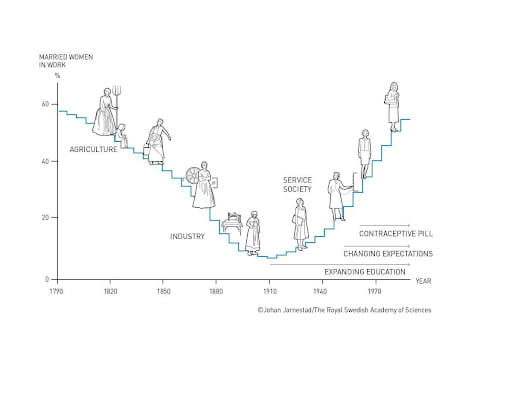
U-Shaped Curve
Factors Affecting Married Women’s LFPR
- Educational Attainment: Women's limited educational achievements can restrict their entry into certain job markets or professional roles.
- Mobility Constraints: Due to increasing family obligations post-marriage, many women find their mobility restricted, which can impact their ability to participate in jobs that require commuting or relocation.
- Societal Disapproval: In many societies, there is still a prevalent stigma associated with married women working outside the domestic sphere.
- Domestic Obligations: The institution of marriage often amplifies domestic responsibilities for women, like child-rearing, housekeeping, and caregiving roles. These increased responsibilities can limit their time and energy for external employment.
- Social and Cultural Impediments: Marriage can impose cultural and social constraints on women. In some societies, women are expected to prioritize their role as wives and mothers over their professional aspirations.
- Religious and Caste Affiliations: The expectations and norms dictated by certain religious or caste groups can influence women's decisions about participating in the labour force.
- Geographical Location: The place of residence, whether urban or rural, can affect opportunities and perceptions about women's work. For instance, in certain rural areas, women might primarily be involved in agricultural work, while urban areas might offer more diversified opportunities.
- Household Wealth: The economic status of a household can play a role. In some cases, women from wealthier households might face societal pressure to not work, while women from lower economic strata might be compelled to work due to financial necessities.
- Societal Norms: Prevailing societal norms about women’s employment outside the home can impact their decision to enter or remain in the workforce.
- Professional Costs: Women might encounter gender-asymmetrical professional costs stemming from societal constraints. This can manifest in the form of gender disparities in career choices, income inequality, decisions about marriage age, and fertility choices.
- Lack of Flexibility: Upon deciding to resume work after marriage, women might seek employment opportunities offering flexibility and proximity to their homes, limiting their choices.
- Availability of Support Systems: The absence of adequate support systems like day-care services or family support can act as a disincentive for female labour force participation.
Solutions to Improve Married Women’s LFPR
- Quality Day-Care Services/Crèches: Enhancing the quality and accessibility of day-care services and crèches for children can help in reducing the burden on working mothers.
- Government Initiatives: Effective implementation of schemes like the National Creche Scheme for The Children of Working Mothers is crucial. Both public and private sectors should be involved in ensuring that such programs cater to the needs of working mothers.
- Flexible Work Settings: Organizations should prioritize creating work environments that accommodate the needs and well-being of women. This includes flexible working hours, options for remote work, and extended maternity leaves.
- Secure Transportation: Providing safe transportation options for women, especially those working in shifts or in locations far from their homes, can play a role in increasing their participation in the workforce.
- Promotion of Part-Time Job Opportunities: Expanding opportunities for part-time jobs can offer women the balance between their domestic responsibilities and professional aspirations.
- Skill Development and Training: Offering skill development and training programs can empower women, particularly those who might have had a break in their career due to marriage or motherhood, to rejoin the workforce with renewed confidence.
- Awareness Campaigns: Conducting societal awareness campaigns can help in changing societal perceptions and norms about married women working. Promoting positive narratives around working women can reduce stigmas and societal pressures.
- Gender Sensitization: Implementing gender sensitization programs in workplaces can foster a more inclusive environment, ensuring women feel welcomed and respected.
- Legal Framework: Strengthening the legal framework around sexual harassment at workplaces, ensuring equal pay for equal work, and other gender-specific employment issues can create a safer and more equitable environment for women.
- Entrepreneurship Encouragement: Providing incentives, resources, and training for women to start their own businesses can offer them a flexible work-life balance and financial independence.
National Creche Scheme for The Children of Working Mothers
|
Conclusion
The non-participation of married women in the workforce has significant economic repercussions for India. It's crucial to implement strategies and initiatives to promote their participation for overall economic progress and women's empowerment.
(*Click this link to read prelims specific weekly current affairs articles)
FAQs
Question: What is the Labour Force Participation Rate (LFPR)?
Answer:
Labour Force Participation Rate (LFPR) is a crucial indicator in labour market studies and represents the proportion of a country's working-age population that is either employed or actively seeking employment. LFPR is defined as the ratio of the labour force to the working-age population. The labour force includes both the employed (those who have jobs) and the unemployed (those who are actively seeking jobs).
Question: What is the significance of women's labour force participation rate (LFPR)?
Answer:
Women’s labour market participation is often associated with enhanced economic prospects and greater household decision-making power. From a macroeconomic perspective, a high LFPR for women is crucial for the overall economic progress of the nation. It affects women's intra and inter-household bargaining power and influences broader gender disparities in the workforce.
Question: Who won the Nobel Prize for Economics in 2023?
Answer:
Professor Claudia Goldin of Harvard University has been awarded the 2023 Nobel Prize in Economic Sciences for her advancements in understanding women’s labour market outcomes. Her work provides the first comprehensive account of women’s earnings and labour market participation over the centuries.
UPSC Mains Practice Question:
|
MCQs
Question: Increase in absolute and per capita real GNP do not connote a higher level of economic development, if (UPSC 2018)
(a) industrial output fails to keep pace with agricultural output.
(b) agricultural output fails to keep pace with industrial output.
(c) poverty and unemployment increase.
(d) imports grow faster than exports.
Answer: (c) See the Explanation
Economic growth is characterized by an increase in real national income/national production. It entails an improvement in the quality of life and living standards, such as literacy, life expectancy, and health-care services.
Economic development occurs when a country experiences various economic changes, such as a reduction in poverty and unemployment, a reduction in income and wealth inequality, an increase in literacy rate, an improvement in health and hygiene, and so on, that improve the quality of life.
Therefore, option (c) is the correct answer.
Question: Disguised unemployment generally means (UPSC 2013)
(a) large number of people remain unemployed
(b) alternative employment is not available
(c) marginal productivity of labour is zero
(d) productivity of workers is low
Answer: (c) See the Explanation
Disguised unemployment is a phenomenon in which more individuals are employed than are required. It is largely found in India's agricultural and unorganized sectors. The labour’s marginal productivity is zero.
Therefore, option (c) is the correct answer.
Question: What was the worldwide LFPR for women in 2022 according to World Bank estimates?
(a) 65.4%
(b) 47.3%
(c) 52.2%
(d) 58.1%
Answer: (b) See the Explanation
The World Bank estimated that the worldwide LFPR for women in 2022 was 47.3%.
Therefore, option (b) is the correct answer.
Question: Which economist was awarded the Economics Nobel for advancing the understanding of women’s labour market outcomes?
(a) Amartya Sen
(b) Esther Duflo
(c) Claudia Goldin
(d) Paul Romer
Answer: (c) See the Explanation
Claudia Goldin was awarded the Economics Nobel for her comprehensive analysis of the economic history of women and for advancing the understanding of women’s labour market outcomes.
Therefore, option (c) is the correct answer.
Download the PREPP App and attempt FREE IAS Exam Mock Tests and get complete study material!

Full Test - 04: UPSC CSE Prelims CSAT (Paper-II)
Full Test - 03: UPSC CSE Prelims CSAT (Paper-II)
UPSC CSE Prelims 2026 GS Paper 1 Question Paper (24-May-2026)
UPSC CSE Prelims 2026 CSAT Paper 2 Question Paper (24-May-2026)

17 February 2025 | The Hindu Must Read Articles | Current Affairs

16 February 2026 | The Hindu Must Read Articles | Current Affairs

13 February 2026 | The Hindu Must Read Articles | Current Affairs









Comments