Women in Red: On an Optimum Menstrual Hygiene Policy
Primary Source: The Hindu
Click here for Daily Current Affairs
Why in the news?
Recently, the Supreme Court of India has directed the government to finalize an optimal menstrual hygiene policy, emphasizing the distribution of sanitary napkins and the need for adequate girls' toilets in schools.
Table of Contents
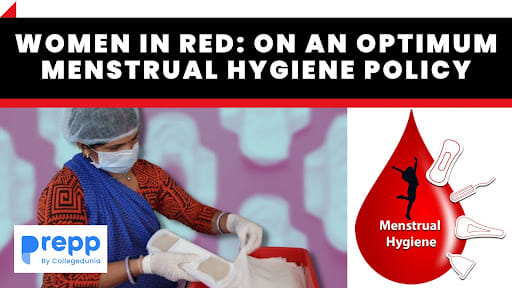
Current Status of Menstrual Hygiene Policy in India
- Menstruation affects a significant portion of the female population, yet India has only recently begun to formulate a policy on menstrual hygiene.
- Despite over seventy years of independence, a formal policy on this issue is still in the developmental stage.
- The Supreme Court of India, recognizing the importance of menstrual health and hygiene, called for a uniform national policy to ensure menstrual hygiene for girls in schools.
- The Ministry of Health and Family Welfare has prepared a draft for the National Menstrual Hygiene Policy in 2023.
- This draft is open for comments from various stakeholders, indicating a collaborative approach to policy formulation
Menstrual Hygiene - Statistics and Trends
- As per the National Family Health Survey (NFHS) Data:
- 73% of rural women use a hygienic method of menstrual protection.
- 90% of urban women use a hygienic method of menstrual protection.
- There's been a notable increase from NFHS4 to NFHS5 in the use of hygienic menstrual protection among women aged 15-24, increasing from 58% to 78%.
- Types of Hygienic Methods Used: The primary methods of menstrual protection mentioned are sanitary napkins, cloth, and locally prepared napkins.
- Link Between Education and Hygiene Preference: Women with 12 or more years of schooling are more than twice as likely to use a hygienic method compared to those with no schooling.
- Menstruation and Education: An established link between menstruation and dropping out of school is highlighted, attributed to stigma and lack of access to sanitation, including products, toilets, and water.
Challenges Related to Menstrual Hygiene in India
- Access and Affordability of Menstrual Hygiene Products: While urbanization has improved the availability of menstrual hygiene products for many young women, affordability remains a significant issue. This is particularly pronounced in semi-urban and rural areas.
- Educational Link: There's a direct correlation between education and the preference for hygienic menstrual practices. Women with higher levels of schooling are more likely to use hygienic methods compared to those with no education.
- School Dropout Rates: Menstruation is closely linked to school dropout rates among girls. This is attributed to the stigma surrounding menstruation and a lack of access to proper sanitation facilities, including access to menstrual hygiene products, toilets, and water.
- Policy and Implementation Gap: While the Indian government is working on a menstrual hygiene policy, it should be noted that policy creation is only a part of the solution. Effective implementation, ensuring access to affordable menstrual hygiene products, clean toilets, and water, is critical.
- Holistic Approach: The policy should address the entire lifecycle of menstruation, covering the range of health and social issues that arise from it.
Way Forward
- Ensuring Accessibility and Affordability: The policy must ensure that menstrual hygiene products, especially sanitary napkins, are affordable and accessible to all women, particularly in semi-urban and rural areas.
- Education and Awareness: Educational initiatives should be a core component of the policy, targeting both men and women to break the stigma around menstruation and educate them about hygienic practices.
- Infrastructure Development: There is a need for proper sanitation facilities, including clean toilets and access to water in schools and public places.
- Addressing Health and Social Implications: The policy should cover the entire menstrual health lifecycle, addressing health and social issues that arise from menstruation.
- Stakeholder Engagement: Collaboration with various stakeholders, including NGOs, healthcare professionals, and educational institutions, is vital for the successful implementation of the policy.
- Monitoring and Evaluation: Regular monitoring and evaluation of the policy's implementation will be crucial to ensure its effectiveness and to make necessary adjustments based on feedback and evolving needs.
- Role of CSO: CSO can play an important role in spreading awareness about the issue and acting as a bridge between government and concerned sections of society.
Conclusion
A draft policy is under review with feedback from various stakeholders. The policy should address all aspects of menstruation, including health and social consequences. The government's role in not just policy formulation but also in ensuring practical implementation and accessibility.
(*Click this link to read prelims specific weekly current affairs articles)
FAQs
Question: What is meant by menstrual hygiene policy?
Answer:
A menstrual hygiene policy is a framework designed by governments or organizations to address the challenges and needs related to menstrual hygiene management (MHM). Such policies typically aim to ensure that women and girls have access to safe, affordable, and hygienic menstrual products, along with the necessary education and facilities to manage menstruation in a dignified and healthy way.
Question: What is the link between education and hygienic menstrual practices?
Answer:
There's a direct correlation between education and the preference for hygienic menstrual practices. Women with higher levels of schooling are more likely to use hygienic methods compared to those with no education.
Question: What challenges do rural women in India face in accessing menstrual hygiene products?
Answer:
Rural women in India face several challenges in accessing menstrual hygiene products, including affordability and availability. As per the NFHS, a lower percentage of rural women use hygienic menstrual protection compared to urban women, highlighting the disparity in access due to socio-economic and infrastructural factors.
UPSC Mains Practice Question:
|
MCQs
Question: Consider the following statements in relation to Janani Suraksha Yojana: (UPSC 2023)
- It is a safe motherhood intervention of the State Health Departments.
- Its objective is to reduce maternal and neonatal mortality among poor pregnant women.
- It aims to promote institutional delivery among poor pregnant women.
- Its objective includes providing public health facilities to sick infants up to one year of age.
How many of the statements given above are correct?
(a) Only one
(b) Only two
(c) Only three
(d) All four
Answer: (c) See the Explanation
Janani Suraksha Yojana is a safe motherhood initiative funded by the Indian government's National Rural Health Mission (NHM). This program promotes institutional birthing among low-income pregnant women in order to reduce maternal and neonatal mortality. It is a state health department intervention for safe motherhood. It is executed on a nationwide scale by the central government's nationwide Rural Health Mission in partnership with state health departments. Hence, statement 1 is correct.
Its goal is to reduce maternal and newborn mortality in low-income pregnant mothers. Hence, statement 2 is correct.
Its goal is to encourage poor pregnant women to have their babies in a hospital. The JSY was created primarily to increase institutional births among low-income expectant women by giving cash help and lowering out-of-pocket expenses. Hence, statement 3 is correct.
While the National Rural Health Mission's broad goal includes child health, the JSY's specific focus is to enhance institutional delivery and minimize maternal and newborn mortality. It does not directly include delivering public health services to unwell infants under the age of one year. Hence, statement 4 is incorrect.
Therefore, option (c) is the correct answer.
Question: Consider the following statements in the context of interventions being undertaken under Anaemia Mukt Bharat Strategy: (UPSC 2023)
- It provides prophylactic calcium supplementation for pre-school children, adolescents and pregnant women.
- It runs a campaign for delayed cord clamping at the time of childbirth.
- It provides for periodic deworming to children and adolescents.
- It addresses non-nutritional causes of anaemia in endemic pockets with special focus on malaria, hemoglobinopathies and fluorosis.
How many of the statements given above are correct?
(a) Only one
(b) Only two
(c) Only three
(d) All four
Answer: (c) See the Explanation
Anaemia Mukt Bharat Strategy is a government of India initiative to combat anemia. It works under the auspices of the National Nutrition Strategy. The AMB plan is extensive and includes a variety of actions.
The AMB Strategy includes preventive iron and folic acid supplementation, both of which are required for hemoglobin formation, but it does not include calcium supplementation. Hence, statement 1 is incorrect.
It runs a campaign to prolong cord clamping during childbirth. This is part of the AMB Strategy. Delayed cord clamping is recommended since it is known to lower the risk of neonatal anemia. Hence, statement 2 is correct.
It calls for children and adolescents to be dewormed on a regular basis. Deworming is an important component of the AMB Strategy since intestinal worms can interfere with food absorption, contributing to anaemia. Hence, statement 3 is correct.
Non-nutritional causes of anemia are also targeted by the AMB Strategy in places where they are common. This encompasses infections such as malaria as well as ailments such as hemoglobinopathies and fluorosis, which can cause or worsen anemia. Hence, statement 4 is correct.
Therefore, option (c) is the correct answer.
Question: As per the latest National Family Health Survey, what is the percentage of rural women using hygienic methods of menstrual protection?
(a) 58%
(b) 73%
(c) 90%
(d) 78%
Answer: (b) See the Explanation
According to the NFHS, 73% of rural women use a hygienic method of menstrual protection, indicating progress yet highlighting the gap in accessibility and awareness in rural areas compared to urban areas, where the percentage is 90%.
Therefore, option (b) is the correct answer.
Download the PREPP App and attempt FREE IAS Exam Mock Tests and get complete study material!

Full Test - 04: UPSC CSE Prelims CSAT (Paper-II)
Full Test - 03: UPSC CSE Prelims CSAT (Paper-II)
UPSC CSE Prelims 2026 GS Paper 1 Question Paper (24-May-2026)
UPSC CSE Prelims 2026 CSAT Paper 2 Question Paper (24-May-2026)

17 February 2025 | The Hindu Must Read Articles | Current Affairs

16 February 2026 | The Hindu Must Read Articles | Current Affairs

13 February 2026 | The Hindu Must Read Articles | Current Affairs









Comments