Wolbachia: An Unlikely Hero
Relevance: GS3- Science and Technology- developments and their applications and effects in everyday life GS2 - Issues relating to development and management of Social Sector/Services relating to Health Prelims - Current events of international importance
(Source: The Hindu, 11/07/2023)
Click here for Daily Current Affairs
Why in the news?
- This article discusses the Wolbachia method which can be used to control viral diseases spread by mosquitoes.
- The World Mosquito Program aims to breed and release Wolbachia mosquitos into mosquito-borne disease-affected areas.
Table of Contents
- What is Wolbachia?
- Rising incidence of mosquito-borne diseases
- How does Wolbachia affect mosquitoes?
- How can Wolbachia help control the spread of diseases?
- World Mosquito Program’s Wolbachia method
- Advantages of the Wolbachia method
- What are some other methods to control mosquito-borne diseases?
- FAQs
- MCQs
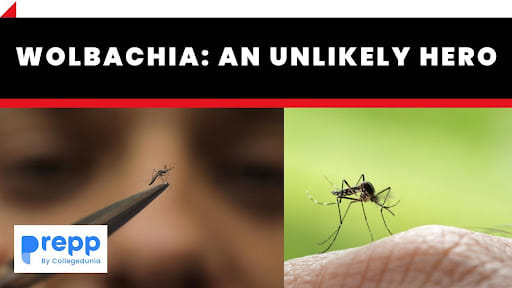
What is Wolbachia?
- Wolbachia is a genus of natural bacteria that are found in around 60% of insects around the world including mosquitoes, fruit flies, moths, dragonflies, and butterflies.
- Aedes aegypti mosquitoes that cause zika, dengue, chikungunya, and yellow fever don’t normally carry Wolbachia.
- It was named after the American physiologist Simeon Burt Wolbach who discovered the bacteria in coordination with Marshall Hertig in 1924.
- It lives inside insect cells and is passed from one generation to the next through an insect’s eggs.
- It is safe for humans and the environment with the release of Wolbachia mosquitoes posing a negligible risk to humans and the environment.
Rising incidence of mosquito-borne diseases
- There has been a rapid increase in the number of people affected by mosquito-borne diseases.
- Rapid population growth, increased rural-urban migration and international travel, and the rise in adverse events related to climate change have contributed to an increase in the spread of Aedes aegypti mosquitoes.
- As a result, the number of people affected by mosquito-borne diseases has also increased.
- According to the World Health Organization, dengue fever is the most critical mosquito-borne viral disease in the world and the fastest s with global incidence increasing 30 times over the last fifty years.
How does Wolbachia affect mosquitoes?
- In 1971, researchers discovered that when male Culex diseases infected with the Wolbachia bacteria fertilized the healthy eggs of a female, the eggs died.
- This was because the bacteria altered the sperm of the male mosquito in such a way that it could be reversed only by the bacteria.
- Therefore, the egg cells would be damaged if the female mosquito was healthy while the eggs would be viable if the female was infected and the male was either uninfected or infected by the same strain of the Wolbachia bacteria.
- As a result, infected females have a reproductive advantage over uninfected mosquitoes over time as the population of Wolbachia in the mosquito population increases.
How can Wolbachia help control the spread of diseases?
- Scientists have found that Wolbachia can help reduce the rate of multiplication of chikungunya and yellow fever viruses.
- It has also been found that some Wolbachia species can protect mosquitoes against the malaria parasite.
- In Wolbachia carrying Aedes aegypti mosquitoes, the bacteria competes with viruses like dengue, Zika, chikungunya, and yellow fever.
- As a result, it is more difficult for the virus to reproduce inside the mosquito, thereby reducing the likelihood of the disease being transmitted to humans.
- Scientists at the World Mosquito Programme are studying ways to spread a particular strain of the Wolbachia bacteria in a specific mosquito population in optimal environmental conditions. This will help control the transmission of malaria.
- Wolbachia mosquitoes are bred and then in partnership with local communities, released into mosquito-borne disease-affected areas.
World Mosquito Program’s Wolbachia method
- Researchers from the World Mosquito Program used Wolbachia-infected mosquitoes to control dengue in Yogyakarta, Indonesia.
- Method: Some mosquitoes were infected with Wolbachia and then released into the city.
- These mosquitoes then bred with local mosquitoes so that nearly all the mosquitoes in the area were carrying Wolbachia bacteria.
- This method is also known as the Population Replacement Strategy.
- Findings: After 27 months, the incidence of dengue was found to be 77% lower in areas where Wolbachia-infected mosquitoes had been released.
- This method was found to be effective against not just dengue but other viruses present in mosquitoes as well.
India’s Wolbachia method
|
Advantages of the Wolbachia method
- Self-sustaining: The Wolbachia method is natural and self-sustaining
- The bacteria are passed from generation to generation, and over time, the percentage of mosquitoes carrying Wolbachia grows.
- Not harmful to mosquitos: The Wolbachia method does not suppress mosquito populations or involve genetic modification.
- Effectiveness: It can be deployed at a large scale with evidence from Colombia, Brazil, and Indonesia revealing its feasibility and effectiveness in highly populated cities.
- A gold-standard randomized controlled trial in Yogyakarta, Indonesia displayed a 77% reduction in dengue and an 86% reduction in dengue hospitalizations in Wolbachia-treated areas.
- Cost-effective: The Wolbachia method is predicted to be cost-saving in urban communities.
- According to estimates, the method costs US$420 per disability-adjusted life year (DALY) averted while the overall cost-effectiveness ratio was negative from the societal perspective.
- This means that the economic benefits outweighed the costs.
What are some other methods to control mosquito-borne diseases?
- Insecticide spraying: Chemical toxins that can kill mosquitoes and other insects are sprayed both indoors and outdoors.
- Transmission of diseases to humans can be reduced if a sufficient number of mosquitoes can be killed.
- However, such methods have been found to have a limited impact on Aedes aegypti mosquitoes.
- Sterile Insect Technique (SIT): Irradiation is used to sterilize male mosquitoes released in large numbers to mate with wild females.
- This prevents wild female eggs from hatching and leads to a gradual decline in wild populations.
- Incompatible Insect Technique (IIT): It uses a different approach with Wolbachia in which mosquitoes are reared in laboratories containing Wolbachia.
- The mosquitoes are sexed and only the males are released so the eggs do not hatch when they mate with uninfected females.
- Combined Sterile Insect Technique & Incompatible Insect Technique: In the IIT method, accurate sexing is necessary for populations to decline.
- However, this is hard to achieve, so IIT can be combined with low doses of irradiation to sterilize any fertile females that are accidentally released in an IIT program.
- There is no evidence to prove the effectiveness of the SIT, IIT, and combined techniques.
- Genetic modification: Lethal genes are introduced into the target mosquito population with the aim of reducing the size of the mosquito population over time.
- There are concerns about its safety for humans.
(*Click this link to read prelims specific weekly current affairs articles)
FAQs
Question: What is the World Mosquito Program?
Answer:
The World Mosquito Program (WMP) is an Australia-based not-for-profit group of companies owned by Monash University. It works toward protecting the global community from mosquito-borne diseases like dengue, Zika, yellow fever, and chikungunya.
Question: What is yellow fever?
Answer:
The yellow fever virus is transmitted by infected mosquitoes, most commonly from the Aedes species. It is endemic to Africa and Central and South America. It is usually associated with jaundice, hence the name yellow fever. It cannot be transmitted by human contact and can be prevented by using the 17D vaccine which provides life-long immunity against the disease.
UPSC Mains Practice Question:
|
MCQs
Question: “Wolbachia method’ is sometimes talked about with reference to which one of the following? (UPSC CSE 2023)
(a) Controlling the viral diseases spread by mosquitoes
(b) Converting crop residues into packing material
(c) Producing biodegradable plastics
(d) Producing biochar from thermo-chemical conversion of biomass
Answer: (a) See the Explanation
- Wolbachia is a bacterium that can be used to control the spread of viral diseases by mosquitoes. Wolbachia-infected mosquitoes are unable to transmit viruses to humans, which can help to prevent the spread of diseases such as dengue, Zika, and chikungunya.
Therefore, option (a) is the correct answer.
Question: Consider the following statements: (UPSC CSE 2017)
- In tropical regions, Zika virus disease is transmitted by the same mosquito that transmits dengue.
- Sexual transmission of Zika virus disease is possible.
Which of the statements given above is/are correct?
(a) 1 only
(b) 2 only
(c) Both 1 and 2
(d) Neither 1 nor 2
Answer: (c) See the Explanation
- Zika virus is spread by the Aedes Egypti mosquito which also transmits other diseases like dengue and chikungunya. Hence statement 1 is correct.
- Zika is primarily transmitted through mosquito bites but can be transmitted through sexual contact as well. Hence statement 2 is correct.
Therefore, option (c) is the correct answer.
Download the PREPP App and attempt FREE IAS Exam Mock Tests and get complete study material!

Full Test - 04: UPSC CSE Prelims CSAT (Paper-II)
Full Test - 03: UPSC CSE Prelims CSAT (Paper-II)
UPSC CSE Prelims 2026 GS Paper 1 Question Paper (24-May-2026)
UPSC CSE Prelims 2026 CSAT Paper 2 Question Paper (24-May-2026)

17 February 2025 | The Hindu Must Read Articles | Current Affairs

16 February 2026 | The Hindu Must Read Articles | Current Affairs

13 February 2026 | The Hindu Must Read Articles | Current Affairs









Comments