Why Are The China-Bhutan Boundary Talks Significant?
(Source: The Hindu, 10/27/2023)
Click here for Daily Current Affairs
Why in the news?
- Recently, China and Bhutan conducted the 25th Round of Boundary Talks between the two countries and signed a Cooperation Agreement on the “Responsibilities and Functions of the Joint Technical Team (JTT) on the Delimitation and Demarcation of the Bhutan-China Boundary.
- This is expected to advance the Three-Step Roadmap for Boundary resolution between the two countries.
- However, India has concerns over the talks due to its security concerns related to Chinese aggressiveness along the Tri-junction region.
Table of Contents

What is the significance of the Bhutan-China talks?
- Long delay: The Boundary talks between Bhutan and China took place after a gap of seven years.
- This was the 25th Round of Boundary talks between the two countries since 1984.
- The last round was conducted in 2016 and the delay was due to the Doklam standoff between the Indian and Chinese armies in 2017 and the COVID pandemic in 2019-21.
- Contiguous border: There is a 470 km long contiguous border between Bhutan and the Tibetan Autonomous Region (within China) along the north and west of Bhutan.
- China had earlier threatened to open a new front for a border dispute to the east of Bhutan during the delay in talks by laying claim to the Sakteng Wildlife Sanctuary.
- Progress made: The governments of Bhutan and China have claimed that the two sides were close to completing the roadmap.
- The first boundary delimitation technical talks were held in August 2023 after talks at various levels.
- Lack of diplomatic presence: Bhutan does not have diplomatic relations with China due to its policy to avoid diplomatic relations with Permanent Members of the United Nations Security Council.
What is the 3-Step Roadmap?
- The 3-Step roadmap is part of a Memorandum of Understanding which was signed by Bhutan and China in 2021.
- It involves three steps:
- Agreeing to the border “on the table”
- Visiting the sites on the ground
- Formally demarcating the boundary.
- A Joint Technical Team was established in August 2023 by the Expert Group to implement the Roadmap.
- It aims to delineate Bhutanese and Chinese territory for the first time by drawing a clear line.
Why is India watching the talks closely?
- Chinese aggressiveness in the neighborhood: India has concerns over China’s attempts to develop closer ties with countries in its neighborhood in the aftermath of the Indo-China standoff at the Line of Actual Control.
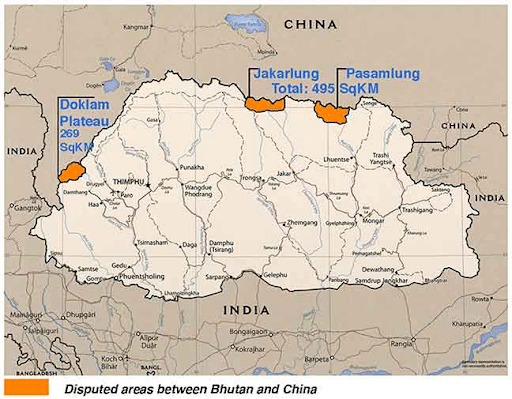
- Doklam: One of the proposals made by China involves the swap of Bhutan-controlled areas in Doklam with areas in Jakarlung and Pasamlung which are climbed by China.
- However, the Doklam trijunction is in close proximity to India’s Siliguri corridor which connects the North Eastern States to mainland India.
- China gaining access to areas close to such a strategically important area is a major concern for India.
- Since the 2017 standoff, China has increased infrastructural activities by building underground storage facilities, new roads, and villages in the disputed areas, which is a major setback for India from a military and diplomatic perspective.
- Closer Bhutan-China ties: China has demanded full diplomatic relations with Bhutan and an embassy in Thimphu.
- India has already faced challenges with Chinese projects and funding in other countries in the neighborhood like Bangladesh, Nepal, Sri Lanka, and the Maldives.
- Similarly, Chinese presence in Bhutan would be problematic for India particularly due to the significance of the India-Bhutan relationship in the hydrological sector.
- However, India’s concerns have been alleviated by Bhutan’s consistent emphasis on considering India’s interests and consulting India on issues concerning it.
Conclusion
India will have to adopt a balanced approach to the talks by not compromising on its security and other interests while understanding Bhutan’s need for a resolution of its boundary disputes.
(*Click this link to read prelims specific weekly current affairs articles)
FAQs
Question: What is delimitation?
Answer:
Delimitation refers to the act of fixing limits or boundaries of territorial constituencies. It is undertaken within a country to ensure equal representation to equal segments of a population.
Question: What is the Tibetan Autonomous Region?
Answer:
The Tibet Autonomous Region is the highest region on earth with an average elevation of 4380 meters. It has been controlled by China since the annexation of Tibet by China in 1951.
UPSC Mains Practice Question:
|
MCQs
Question: Which one of the following Himalayan Passes was reopened around in the middle of the year 2006 to facilitate trade between India and China? (UPSC CSE 2007)
(a) Chang La
(b) Jara La
(c) Nathu La
(d) Shipki La
Answer: (c) See the Explanation
- Nathu La is a mountain pass in the Himalayas that connects Sikkim with China's Tibet Autonomous Region.
- It was sealed by India after the 1962 Sino-Indian War and re-opened in 2006
Therefore, option (c) is the correct answer.
Question: Which one of the following was the venue for the preliminary talks between the Sri Lankan Government and representatives of Tamil United Liberation Front and other militant groups? (UPSC CSE 1998)
(a) New Delhi
(b) Colombo
(c) Thimpu
(d) Madras
Answer: (c) See the Explanation
The preliminary talks between the Sri Lankan government liberation front and other militant groups were held at Thimpu, the capital of Bhutan.
Therefore, option (c) is the correct answer.
Download the PREPP App and attempt FREE IAS Exam Mock Tests and get complete study material!

Full Test - 04: UPSC CSE Prelims CSAT (Paper-II)
Full Test - 03: UPSC CSE Prelims CSAT (Paper-II)
UPSC CSE Prelims 2026 GS Paper 1 Question Paper (24-May-2026)
UPSC CSE Prelims 2026 CSAT Paper 2 Question Paper (24-May-2026)

17 February 2025 | The Hindu Must Read Articles | Current Affairs

16 February 2026 | The Hindu Must Read Articles | Current Affairs

13 February 2026 | The Hindu Must Read Articles | Current Affairs









Comments