Wholesale Prices Remain In Deflation Zone In October
Relevance: GS3- Indian Economy and issues relating to planning, mobilization, of resources, growth, development and employment.
(Source: The Hindu, 11/15/2023)
Click here for Daily Current Affairs
Why in the news?
- Recently, the Wholesale Price Index (WPI) revealed that wholesale prices in the country in October remained in the deflationary zone for the seventh consecutive month.
- According to the WPI, inflation in October dropped to -0.52% from -0.26% in September.
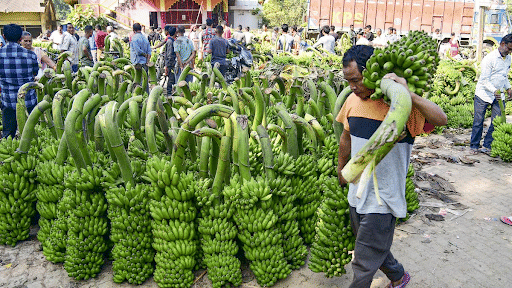
Trends in the Wholesale Price Index
- The annual rate of inflation for October 2023 based on the all-India WPI is -0.52% against -0.26% in September 2023.
- In October 2022, wholesale price inflation was 8.4% which resulted in a high base effect for the index in October 2023.
- On a month-on-month basis, the WPI was up 0.4% in October.
- Reasons for the negative rate of inflation: It is primarily due to the fall in prices of chemicals and chemical products, electricity, textiles, basic metals, food products, paper and paper products, etc.
- Wholesale food index: It has risen by 1.07% in October 2023 as compared to October 2022 and food prices had gone up 1% from September levels.
- However, the price trends of commodities in the food basket were divergent.
- The prices of some commodities like onions and pulses posed risks to retail inflation which had eased to 4.87% in October.
Month-over-Month Change in Major Groups of WPI
- Primary Articles (Weight 22.62%): The index increased by 1.15% to 184.5 in October 2023 from 182.4 in September.
- The prices of Minerals (7.81%) and Food Articles (1.33%) also increased in October 2023 while the prices of Crude Petroleum & Natural Gas (- 0.60%) and Non-food Articles (- 0.24%) declined in the same period.
- Fuel & Power (Weight 13.15%): The index increased by 0.65% to 154.1 in October 2023 from September.
- However, fuel and power prices were 2.5% lower than 2022 levels.
- The prices of Mineral Oils (1.28%) increased while the prices of Electricity (-0.73%) declined in October from September 2023.
- Crude petroleum and natural gas inflation dropped to -2.2% in October from 15.6% in September.
- Manufactured Products (Weight 64.23%): The index remained constant at 140.3 in October 2023 and September 2023.
- The year-on-year inflation rate moderated to -1.1.% in October from -1.3% in September.
- The manufacture of food products; chemicals and chemical products; motor vehicles trailers & semi-trailers; textiles; and other non-metallic mineral products saw a month-on-month increase in food prices.
- On the other hand, the manufacture of basic metals; fabricated metal products, except machinery & equipment; rubber & plastic products; and other transport equipment saw a decrease in prices in October 2023 as compared to September 2023.
Wholesale Food Price Index
- The Wholesale Food Price Index is the most widely used inflation indicator in the country.
- It measures the changes in the prices of a basket of wholesale goods sold and traded in bulk by wholesale businesses to other businesses.
- It does not concentrate on goods purchased by the consumers.
- Publisher: It is published by the Office of the Economic Adviser, Union Ministry of Commerce and Industry.
- Base year: The base year of All-India WPI has been revised from 2004-05 to 2011-12 in 2017.
| Commodities | Weightage (in%) |
| Primary Articles | 22.62 |
| Fuel and Power | 13.15 |
| Manufactured Products | 64.23 |
| Food Index | 24.38 |
- It helps the Government of India in formulating various trade, fiscal, and other economic policies.
- It can also be used as a deflator of various nominal macroeconomic variables, including Gross Domestic Product (GDP).
To know more, click the link.
Deflation
Inflation
|
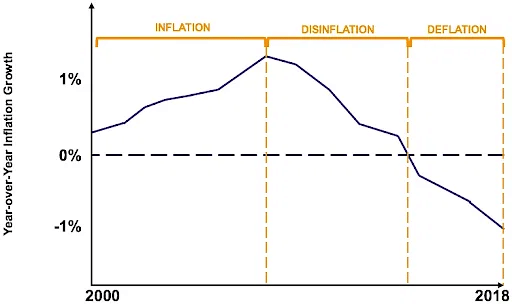
How does deflation affect the Indian economy?
- Reduced Revenue: The prices of products or services are usually reduced by manufacturers or providers in a deflationary economy.
- This leads to a drop in revenues.
- Reduced Wages and Layoffs: Due to the drop in revenue and lowered production, firms reduce wages and implement layoffs which may have a negative impact on the economy.
- This results in customers having fewer funds in hand to spend and customers postponing spending in the hope of prices dropping further in the future.
- Rise in the real value of debt: The real value of money and debt increases in a deflationary period.
- This makes it difficult for debtors to repay their debts so consumers and businesses spend a greater portion of their disposable income on debt repayment.
- Negative inflation would make it difficult for Indian corporations to repay debts as their debt burden would rise.
- Real wage unemployment: Real wages rise during deflationary periods which could lead to real-wage joblessness.
- No incentive to produce: Producers require inflation to increase their profits, therefore producers cut back on production when prices decrease.
- This results in a shortage of supplies in the long term.
- Greater Export Competitiveness: Deflation can help increase an economy’s export competitiveness if most other economies are suffering from inflation.
- This results in exports becoming profitable with the fall in the rate of products and services.
To learn more, click the link.
Way forward
- According to the Chief Economist at the ICRA (formerly Investment Information and Credit Rating Agency of India Limited), global commodity prices are expected to moderate in November 2023.
- A marginal inflation in WPI (0.1%) is predicted for November following an uptrend in domestic prices of most food items and an unfavorable base.
(*Click this link to read prelims specific weekly current affairs articles)
FAQs
Question: What is inflation?
Answer:
Inflation refers to the general rise in the price level of goods and services over a period of time within a particular economy where the purchasing power of the customer decreases. Rising inflation reduces purchasing power, leading to lower real earnings.
Question: What is the GDP?
Answer:
GDP or Gross Domestic Product is a measure of the value of the economic activity within the country. It refers to the sum of the final prices of the goods and services produced in an economy in a given period.
UPSC Mains Practice Question:
|
MCQs
Question: With reference to the Indian Economy, consider the following statements: (UPSC CSE 2022)
- An increase in the Nominal Effective Exchange Rate (NEER) indicates the appreciation of the rupee.
- An increase in Real Effective Exchange Rate (REER) indicates an improvement in trade competitiveness.
- An increase in the trend in domestic inflation relative to inflation in other countries is likely to cause an increasing divergence between NEER and REER.
Which of the above statements is/are correct?
(a) 1 and 2 only
(b) 2 and 3 only
(c) 1 and 3 only
(d) 1, 2 and 3
Answer: (c) See the Explanation
- Nominal Effective Exchange Rate (NEER) is the weighted average of bilateral nominal exchange rates of the home currency in terms of foreign currencies.
- An increase in (NEER) indicates the appreciation of the rupee. Hence statement 1 is correct.
- The Real Effective Exchange Rate (REER) is the weighted average of nominal exchange rates adjusted for relative price differential between the domestic and foreign countries.
- An increase in REER is an indication that exports are becoming more expensive and imports are becoming cheaper, i.e., it is losing its trade competitiveness. Hence statement 2 is incorrect.
- REER is the NEER adjusted by relative prices or costs, typically captured in inflation differentials between the home economy and trading partners.
- A nation’s NEER when adjusted for inflation in the home country, equals its REER. The higher the inflation, the higher the divergence. Hence statement 3 is correct.
Therefore, option (c) is the correct answer.
Question: Consider the following statements:
- The weightage of food in the Consumer Price Index (CPI) is higher than that in the Wholesale Price Index (WPI).
- The WPI does not capture changes in the prices of services, which CPI does.
- The Reserve Bank of India has now adopted WPI as its key measure of inflation and to decide on changing the key policy rates.
Which of the statements given- above is/are correct? (UPSC 2020)
(a) 1 and 2 only
(b) 2 only
(c) 3 only 4
(d) 1, 2 and 3
Answer: (a) See the Explanation
- Weightage of food in the CPI is around 50% while the weightage of food in the WPI is around 39.06%. Hence statement 1 is correct.
- Unlike the CPI, the WPI does not capture changes in the prices of services. Hence statement 2 is correct.
- The Consumer Price Index has been adopted by the RBI as the key measure of inflation in 2014.
- Under the new monetary policy Framework, RBI tries to control inflation at 2-6% of CPI (All India). Hence statement 3 is incorrect.
Therefore, option (a) is the correct answer.
Question: Which one of the following is likely to be one of the most inflationary in its effects? (UPSC CSE 2021)
(a) Repayment of public debt
(b) Borrowing from the public to finance a budget deficit
(c) Borrowing from the banks to finance a budget deficit
(d) Creation of new money to finance a budget deficit
Answer: (d) See the Explanation
- Inflation increases as a result of the financing of large deficits by printing economy.
- When the supply of money increases in an economy, customer demand increases, leading to a rise in aggregate demand.
Therefore, option (d) is the correct answer.
Question: Which one of the following statements is an appropriate description of deflation? (UPSC CSE 2010)
(a) It is a sudden fall in the value of a currency against other currencies
(b) It is a persistent recession in both the financial and real sectors of the economy
(c) It is a persistent fall in the general price level of goods and services
(d) It is a fall in the rate of inflation over a period of time
Answer: (c) See the Explanation
- Deflation is a decrease in the prices of goods and services. It occurs when the annual inflation rate falls below 0% which is a negative inflation rate.
Therefore, option (c) is the correct answer.
Download the PREPP App and attempt FREE IAS Exam Mock Tests and get complete study material!

Full Test - 04: UPSC CSE Prelims CSAT (Paper-II)
Full Test - 03: UPSC CSE Prelims CSAT (Paper-II)
UPSC CSE Prelims 2026 GS Paper 1 Question Paper (24-May-2026)
UPSC CSE Prelims 2026 CSAT Paper 2 Question Paper (24-May-2026)

17 February 2025 | The Hindu Must Read Articles | Current Affairs

16 February 2026 | The Hindu Must Read Articles | Current Affairs

13 February 2026 | The Hindu Must Read Articles | Current Affairs









Comments