What The OECD Report Says Of Climate Finance Ahead Of COP 28
Relevance: GS3 - Conservation, environmental pollution and degradation GS2 - Important International institutions, agencies and fora- their structure, mandate
(Source: The Hindu, 11/22/2023)
Click here for Daily Current Affairs
Why in the news?
- Recently, a report prepared by the Organization for Economic Cooperation and Development (OECD) revealed that Developed countries have not fulfilled their commitments to mobilize funds for the climate adaptation and mitigation requirements in developing countries even after the 2020 deadline.
- At COP 15 in Copenhagen in 2009, developed countries committed to mobilize $100 billion every year to help developing countries cut carbon emissions.
- According to the OECD, developing countries will require around $1 trillion per annum in climate investments by 2025 and around $2.4 trillion per annum between 2026 and 2030.

What are the highlights of the OECD Report?
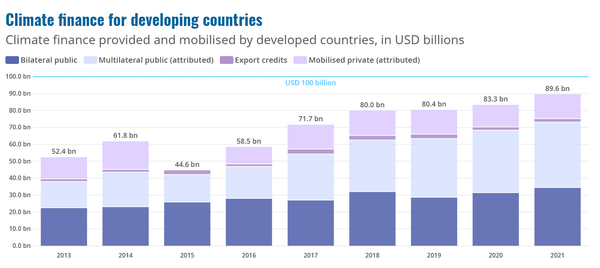
- Progress on $100 Billion Goal: Developed countries have only been able to mobilize $89.6 billion of funds in 2021 despite the commitment to achieve $100 billion per annum since 2020 (Copenhagen COP).
- This amounted to a 7.6% increase over 2020.
- Public climate finance: Public climate finance, including both bilateral and multilateral sources, rose from $38 billion to $73.1 billion between 2013 and 2021.
- It accounted for the majority of the $89.6 billion mobilized in 2021.
- Adaptation finance: Adaptation finance fell by 14% (around $4 billion) in 2021 from 2020 levels.
- As a result, the share of adaptation finance in total climate finance dropped from 34% to 27%
- However, cross-cutting finance increased to $11.2 billion in 2021 from USD 6 billion in 2020.
- Private finance: Private climate finance accounted for 16% of the total i.e. 14.4 billion in 2021.
Why is the OECD report notable?
- The report provides a clear insight into the likely approach to be adopted by the OECD countries regarding climate finance at COP28.
- Since the OECD consists of rich economies like the U.S., the U.K., Germany, France, Switzerland, and Canada, the report provides a perspective of the developed countries regarding the inadequacies in climate finance.
- Moreover, the developed countries had expressed regret for not meeting the $100 billion target by 2020 at the 26th COP in Glasgow and had committed to doubling adaptation finance.
- The acknowledged failure of the developed countries to mobilize climate finance has a severe impact on developing countries.
- It has compromised their ability to address
- Climate mitigation i.e. implementing renewable energy systems to reduce emissions
- Adaptation requirements such as investments in developing and incentivizing the use of climate-resilient agriculture products and techniques
- Furthermore, it has led to a trust deficit between the developing and developed countries regarding their commitment to fighting the challenge of climate change.
How is climate finance accounted for?
- According to the report, $49.6 billion of the $73.i billion mobilized by the public sector was in the form of loans.
- This indicated that rich countries were highly dependent on loans at commercial rates to fulfill their climate finance obligations.
- Consider the Global Landscape of Climate Finance 2021 report prepared by the American not-for-profit Climate Policy Initiative, 61% of climate finance was provided as loans, of which only 12% was at concessional interest rates.
- The OECD report claims that since around two-thirds of public climate financing was provided as loans, the conditions associated with these loans could lead to debt stress and economic distress in developing countries.
- This would further impact their ability to adapt to and mitigate climate change.
What is included as climate finance in OECD figures?
- OECD figures capture four distinct components of climate finance provided and mobilized by developed countries:
- Bilateral public climate finance: It is provided by institutions of developed countries such as bilateral aid agencies and development banks.
- Multilateral public climate finance: It is provided by multilateral development banks and multilateral climate funds which are attributed to developed countries.
- Climate-related officially supported export credits: They are provided by the official export credit agencies of developed countries.
- Private finance: It refers to local, national, or transnational financing drawn from private sources attributed to developed countries.
How much do developing countries need?
- Although a report by the OECD claims that the $100 billion target was achieved in 2022, no verifiable data has been published as evidence.
- According to the OECD, developing countries will need around $1 trillion a year in climate investments in 2025, and around $2.4 trillion a year between 2026 and 2030.
- This highlights the insufficiency of the $100 billion target, which has been criticized for its unscientific formulation and the lack of proper assessment of the needs of the developing countries.
- The developing countries have also raised concerns about this in light of the failure of the developed countries to meet the much smaller target of $100 billion.
Criticism of the report
- Loans: The OECD report considers loans at face value instead of the grant equivalent when calculating total climate finance figures.
- This means that the loans are counted as climate finance provided by developed countries despite the developing countries having to repay the principal and interest, which defeats the purpose of climate finance assistance.
- Additionality: According to the UNFCCC, developed countries must provide new and additional financial resources to meet the full costs incurred by the developing country to meet its obligations.
- They cannot cut their overseas development assistance (ODA) to finance climate needs.
- Moreover, developed countries are not permitted to double-count i.e. a project that contributed to overall development and emissions reduction cannot be categorized as both ODA and Climate finance as it violates the “new and additional” clause of the Convention.
- However, many developed countries including those from the EU have been practicing double-counting in order to artificially inflate their climate finance contributions.
- Lack of definitional clarity: Generally, the developed countries have campaigned against any attempts to develop an explicit definition of ‘climate finance’.
- This allows countries to reroute their climate finance funds while indicating large expenditures on climate finance and the use of practices like double-counting.
- Therefore, an assessment of the actual flows of climate finance needs to be conducted to understand their incidence.
What role can the private sector play?
- U.S. Climate envoy John Kerry and the President of the World Bank, Ajay Banga have suggested that private sector finance can be a solution to the shortfall in public finance.
- However, the OECD report revealed that private sector finance for climate has remained stagnant over the last decade.
- This has been mainly due to the fact that climate finance has not been able to generate returns on investment that are attractive enough to bring in large investors.
- In comparison mitigation activities like solar farms, and windmills are attractive options for private investors due to their higher return potential.
- As a result, the private sector has been on the whole reluctant to scale up its investments in climate finance.
Conclusion
- The OECD report highlights the persistent shortfall in climate finance by developed countries which has in turn impacted the ability of developing nations to address climate challenges.
- The reluctance of the private sector to invest in climate finance has meant that the governments in the developed world and multilateral development banks are the major source of funds for the struggling developing countries that face the worst effects of climate change.
OECD
|
(*Click this link to read prelims specific weekly current affairs articles)
FAQs
Question: What is climate finance?
Answer:
According to the UNFCCC, climate finance refers to local, national, or transnational financing from public, private, and alternative sources that seeks to support mitigation and adaptation actions to address climate change.
Question: How is climate change adaptation different from mitigation?
Answer:
- Adaptation means anticipating the adverse effects of climate change and taking appropriate action to prevent or minimize the damage they can cause, or taking advantage of opportunities that may arise.
- Examples: Building defenses to protect against sea-level rise.
- Mitigation means making the impacts of climate change less severe by preventing or reducing the emission of greenhouse gases.
- It can be achieved either by reducing the sources of these gases or by enhancing the storage of these gases.
|
UPSC Mains Practice Questions Q.1) Describe the major outcomes of the 26th session of the Conference of the Parties (COP) to the United Nations Framework Convention on Climate Change (UNFCCC). What are the commitments made by India in this conference? (UPSC GS3 2021) |
MCQs
Question: Consider the following statements:
- “The Climate Group” is an international non-profit organization that drives climate action by building large networks and runs them.
- The International Energy Agency in partnership with the Climate Group launched a global initiative “EP100”.
- EP100 brings together leading companies committed to driving innovation in energy efficiency and increasing competitiveness while delivering on emmission reduction goals.
- Some Indian companies are members of EP100.
- The International Energy Agency is the Secretariat to the “Under2 Coalition”.
Which of the statements given above are correct? (UPSC CSE 2022)
(a) 1, 2, 4 and 5
(b) 1, 3 and 4 only
(c) 2, 3 and 5 only
(d) 1, 2, 3, 4 and 5
Answer: (b) See the Explanation
- The Climate Group is a non- profit organisation that works with business and government leaders around the world to address climate change. The group has programmes focussing on renewable energy and reducing greenhouse gas emissions. Hence Statement 1 is correct.
- EP100 is a global initiative led by the international non- profit Climate Group, bringing together over 120 energy smart businesses committed to measuring and reporting on energy efficiency improvements. The Climate Group’s global EP100 initiative, delivered in partnership with the Alliance to Save Energy, brings together leading companies improving their energy productivity; using less energy to achieve higher economic output. Hence Statement 2 is not correct and Statement 3 is correct.
- Mahindra & Mahindra Ltd., the world’s largest manufacturer of tractors, has signed up to EP100. The Indian-based company has committed to doubling their energy productivity by 2030, a core requirement for any business signing on to the campaign. Recently, Dalmia Cement and JSW Cement – two leading Indian cement companies - committed to the Climate Group’s flagship business initiatives RE100, EV100 and EP100. Dalmia Cement committed to EV100, while they are already members of RE100 and EP100. JSW Cement, committed to all the three campaigns in one go. Hence Statement 4 is correct.
- It is the largest global network of state and regional governments committed to reducing emissions in line with the Paris Agreement. Hence Statement 5 is not correct.
Therefore, option (b) is the correct answer.
Download the PREPP App and attempt FREE IAS Exam Mock Tests and get complete study material!

Full Test - 04: UPSC CSE Prelims CSAT (Paper-II)
Full Test - 03: UPSC CSE Prelims CSAT (Paper-II)
UPSC CSE Prelims 2026 GS Paper 1 Question Paper (24-May-2026)
UPSC CSE Prelims 2026 CSAT Paper 2 Question Paper (24-May-2026)

17 February 2025 | The Hindu Must Read Articles | Current Affairs

16 February 2026 | The Hindu Must Read Articles | Current Affairs

13 February 2026 | The Hindu Must Read Articles | Current Affairs









Comments