What Has Caused The Recent Thaw in U.S.-Venezuela Ties?
(Source: The Hindu, 10/30/2023)
Click here for Daily Current Affairs
Why in the news?
- Recently, the U.S. government agreed to relax the sanctions imposed on Venezuela’s oil, gas, and mining industries on the condition that Venezuelan President Nicolas Maduro hold free and fair elections in 2024.
- The sanctions will provide economic relief to the Venezuelan economy which collapsed from the fourth-largest economy in South America in 2013 to one of the poorest countries in the region.
Table of Contents
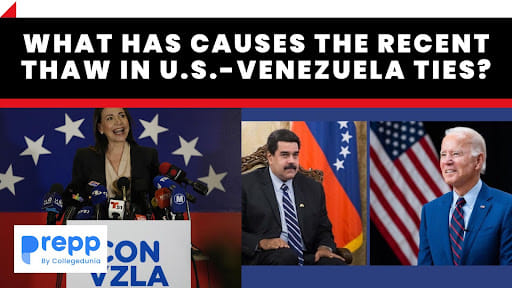
What are the reasons for the present thaw in relations between the U.S.A. and Venezuela?
- Oil and the Ukraine crisis: As a result of the aftereffects of the invasion of Ukraine by Russia, the U.S.A. has recognized the need to improve its ties with Venezuela.
- The invasion and subsequent bans on Russian oil have led to an energy crisis especially since the U.S.A. had turned to Russian oil to replace Venezuelan oil following sanctions in 2019.
- Venezuela holds the largest reserves of oil in the world, making it a crucial player in tackling the worst effects of the energy crisis.
- Geopolitical shifts in South America: The U.S.A. is apprehensive about Russia’s support for its Latin American allies.
- There are fears that the widening of the conflict between Russia and Ukraine, and by proxy the West could have regional security implications.
- Venezuela has close ties with Russia, which along with China, Iran, and Cuba (all of which are not friendly with the USA) helped support the South American country when the U.S.A. and the EU imposed sanctions on the country’s energy and mining sectors.
- Venezuela offers Russia an opportunity for Russia to maintain a foothold in the Western Hemisphere, reassert itself as a global power, and challenge the Western-dominated world order.
- That means that it is in the U.S.A.’s interests to improve ties with Venezuela as it will help isolate Russia and separate it from its Latin American allies.
- End of Venezuela’s isolation and economic relief: Improved ties between the U.S.A. and Washington could end Venezuela’s international isolation which was an aftereffect of U.S. sanctions.
- The country suffered economically as well becoming one of the poorest countries in the region.
- The expected relief from the sanctions will help the country’s state-owned oil firm resume production and enable Venezuelan firms to access the U.S. financial markets.
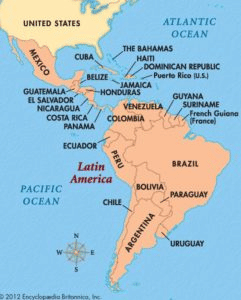
U.S.-Venezuela
- The U.S.A and Venezuela shared historically close relations on account of being a major supplier of oil to the U.S.A.
- However, friction emerged in the relationship during the Chavez presidency as the U.S.A. alleged that Venezuela was undermining human rights and freedom of expression.
- Ties have worsened under Chavez’s successor Maduro, who has launched crackdowns on the opposition, media, and civil society.
- The US has repeatedly employed sanctions including financial and otherwise on the Maduro government and revoked the visas of Venezuelan officials.
- Maduro’s second term has been described as illegitimate by Venezuelans and members of the international community.
- The US, along with at least 57 other countries, recognized Guaidó as the interim president who has however been unable to wrest power from Maduro.
Venezuelan crisis
- In the mid-2010s, Venezuela went into an economic crisis following the end of the global boom in commodities.
- During the boom, Venezuela under Hugo Chavez spent massively on social spending.
- Venezuela was still one of the poorest countries in Latin America despite the growth of the country’s oil-dependent economy during the boom.
- Following the economic collapse, the crime rate in the country doubled, drug trafficking and corruption worsened, and inflation multiplied.
- This was worsened by the sanctions imposed by the West, which have been blamed by the Venezuelan government for the country’s economic problems.
- The socio-economic crisis at home has resulted in a mass exodus of over seven million people.
- As a result, the International Criminal Court (ICC) has begun to investigate Venezuela for crimes against humanity including extra-judicial killings.
- Venezuela is a petro-state whose economy, politics, and society are heavily dependent on oil with the government revenue almost completely reliant on exports.
- This has meant that Venezuela is suffering from “Dutch disease” which is a situation when the local currency appreciates due to the influx of foreign capital which then becomes the main source of income
- As a consequence, imports rise, and traditional activities like agriculture and manufacturing are replaced by a trading economy.
- This leads to a rise in unemployment and debt.
Way Forward
- The Venezuelan opposition has remained highly fragmented despite its popular support.
- The hardline stance adopted by Maria Corina Machado, the leader of the Opposition including the demand for President Maduro to be tried for war crimes, support for economic sanctions on the government, and advocacy for foreign military intervention against the Maduro regime could affect their popularity.
- Moreover, it is doubtful whether she can contest the elections since she was disqualified in June 2023 from holding public office for fifteen years on allegations of corruption and support for American sanctions.
- The Biden administration’s willingness to negotiate with the government of Venezuela is a recognition of the non-viability of the Opposition winning elections.
- The likely sanctions relief will depend on the democratic progress that can be made by the Venezuelan government, particularly the conduct of free and fair elections.
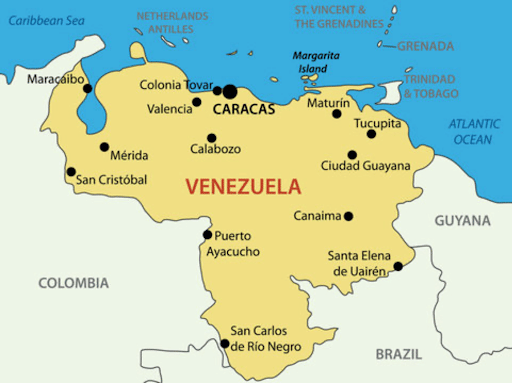
Venezuela
|
(*Click this link to read prelims specific weekly current affairs articles)
FAQs
Question: What are sanctions?
Answer:
Sanctions are coercive measures that can be applied to diplomatic, economic, and cultural relations between states. They are generally non-military and mostly economic in nature and can be unilateral or collective in nature. They can be targeted or wide-ranging in scope.
Question: What is the International Criminal Court?
Answer:
The International Criminal Court (ICC) is the only permanent international criminal tribunal and was created by the Rome Statute of the International Criminal Court (1998). It came into force in 2002 and is mandated to investigate and try individuals charged with crimes such as genocide, war crimes, crimes against humanity, etc. It is headquartered in the Hague, Netherlands. India, the U.S.A., China, and Russia are not members.
MCQs
Question: Match List-I with List-II and select the correct answer using the codes given below the lists: (UPSC 2000)
List-I (Minerals) List-II (Major producer)
- Minerals Oil 1. Zambia
- Copper 2. Guyana
- Manganese 3. Venezuela
- Bauxite 4. Gabon
Codes:
(a) A-3; B-1; C-4; D-2
(b) A-3; B-1; C-2; D-4
(c) A-1; B-3; C-2; D-4
(d) A-1; B-3; C-4; D-2
Answer: (a) See the Explanation
- The Major producer of mineral oil in South America is Venezuela.
- Zambia is the world's seventh largest producer of copper
- Gabon is one of the five top global producers of manganese.
- Guyana is the major producer of bauxite.
Therefore, option (a) is the correct answer.
Question: Match List-I with List-II and select the correct answer using the codes given below the lists: (UPSC 2001)
List-I (Country) List-II (President)
- Columbia 1. Vicente Fox
- Philippines 2. Hugo Chavez
- Mexico 3. Gloria Macapagal Arroya
- Venezuela 4. Andres Pastrana
Codes:
(a) A-4; B-3; C-2; D-1
(b) A-3; B-4; C-2; D-1
(c) A-4; B-3; C-1; D-2
(d) A-3; B-4; C-1; D-2
Answer: (c) See the Explanation
- Andres Pastrana is a former President of Colombia (1998-2002).
- Gloria Macapagal Arroyo became President of the Philippines in 2001.
- Vicente Fox Quesada is a former President of Mexico who served between 2001 and 2006.
- Hugo Chavez was the President of Venezuela between 1999 and 2013.
Therefore, option (c) is the correct answer.
Question: Other than Venezuela, which one among the following from South America is a member of OPEC? (UPSC 2009)
(a) Argentina
(b) Brazil
(c) Ecuador
(d) Bolivia
Answer: (c) See the Explanation
- The Organization of the Petroleum Exporting Countries (OPEC) presently consists of 14 countries including Algeria, Angola, Congo, Ecuador, Islamic Republic of Iran, Equatorial Guinea, Gabon, Nigeria, Saudi Arabia, Iraq, Kuwait, Libya the United Arab Emirates, and Venezuela.
Therefore, option (c) is the correct answer.
Download the PREPP App and attempt FREE IAS Exam Mock Tests and get complete study material!

Full Test - 04: UPSC CSE Prelims CSAT (Paper-II)
Full Test - 03: UPSC CSE Prelims CSAT (Paper-II)
UPSC CSE Prelims 2026 GS Paper 1 Question Paper (24-May-2026)
UPSC CSE Prelims 2026 CSAT Paper 2 Question Paper (24-May-2026)

17 February 2025 | The Hindu Must Read Articles | Current Affairs

16 February 2026 | The Hindu Must Read Articles | Current Affairs

13 February 2026 | The Hindu Must Read Articles | Current Affairs









Comments