What Does The Abortion Verdict Mean For Reproductive Justice?
Primary Source: The Hindu
Click here for Daily Current Affairs
Prepp Prelims Booster: Medical Termination of Pregnancy(Amendment)Act2021
Prepp Mains Booster: Issues Relating to Development and Management of Services relating to Health
Why in the news?
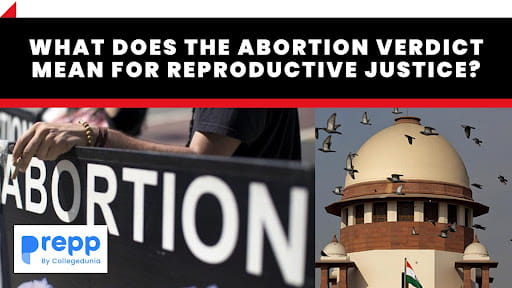
- Recently, the Supreme Court denied a woman's plea for abortion, even though she was physically, emotionally, mentally, financially, and medically unfit to raise a child.
- The case has reopened the debate on women’s rights versus “rights of the unborn child.”
Table of Contents
Background of the Case
- The woman, who was 26 weeks pregnant, married, with two children, and suffering from postpartum psychosis, sought permission for an abortion.
- She justified her request on the grounds of being "physically, emotionally, mentally, financially, and medically unable to carry, deliver, or raise a child."
- The Supreme Court, in its verdict, denied her request.
What was the Verdict of the Court?
- The three-judge Bench, headed by the Chief Justice of India D. Y. Chandrachud, stated that while the Court recognizes a woman’s autonomy, this cannot overshadow the “rights of the unborn child.”
- According to India's Medical Termination of Pregnancy Act, abortions are permissible up to 24 weeks.
- After this period, termination is allowed only if a board of doctors confirms that continuing the pregnancy poses a risk to the woman’s life or if there are foetal abnormalities.
- The woman had discovered her pregnancy at 25 weeks, due to lactational amenorrhea (a condition where breastfeeding temporarily stops menstruation, which can mask the signs of pregnancy).
- After examining her situation, the AIIMS medical board concluded that the foetus was healthy and viable.
- As a remedy, the Court mentioned that the government would cover medical expenses and suggested the possibility of giving the child up for adoption after birth.
This stance seems to clash with a previous landmark ruling from last year (X v NCT) which acknowledged a woman's right to choose, emphasizing her right over her body.
Landmark Ruling in the Case of X vs NCT of Delhi
Judgment
|
Limitations of the SC Judgment
- Discrepancy with Past Precedents: The current verdict is at odds with the Supreme Court's earlier decision in X v NCT, which acknowledged a woman's right to choose.
- Questioning the Woman's Mental Health Claims: The Court questioned the authenticity of the prescriptions presented by the woman as evidence of her postpartum psychosis. The Court's skepticism might discourage other women from approaching the judiciary in the future due to fear of their claims being dismissed.
- Undefined Rights of the Foetus: The rights or interests of the foetus under Indian law remain ambiguous. Pitting these against a woman's right to autonomy without clearly defined parameters can lead to subjective interpretations in the future.
- Over Reliance on Medical Termination of Pregnancy Act: The Court leaned heavily on the Medical Termination of Pregnancy Act, 1971, to justify its decision. However, the Supreme Court, with its power to do 'complete justice', has shown flexibility in past cases even when the text of the law didn't explicitly allow for it.
- Undermining Women's Autonomy: The verdict seems to place more importance on the viability and health of the foetus than on a woman's autonomy, well-being, and socio-economic implications of carrying the child to term.
- Influence of Global Discourse: The Court's verdict reflects global pro-life vs. pro-choice debates, which might not be entirely relevant in the Indian context.
- Underestimating Social and Medical Implications: The Court seemed to overlook the broader implications of denying abortion, which can include pushing women toward unsafe abortions and the associated health risks.
- Impact on Women's Right to Equality: Denial of abortion reinforces gender stereotypes and has broader implications on women's right to equality.
- Foetal Viability Argument: The argument that the foetus is “a viable baby with a reasonable chance of survival” introduces a concept that historically hasn't been a part of Indian abortion law discussions. This could potentially influence future decisions.
What is the Concept of Foetal Viability?
|
Pro-life vs Pro-choice
The concepts of "Pro-life" and "Pro-choice" refer to two opposing views on the issue of abortion.
| Aspect | Pro-life | Pro-choice |
|---|---|---|
| Basic Belief | Belief that human life begins at conception (or shortly thereafter). | Advocacy for a woman's autonomy and the right to make decisions about her own body, including pregnancy. |
| Abortion Stance | Generally, opposes abortion due to the belief that the fetus has a right to life. | Argues that access to safe and legal abortion is a fundamental right. |
| Arguments | - Moral and ethical reasons. - Biological markers of life. - Adoption as an alternative. | - Bodily autonomy. - Safety concerns related to illegal abortions. - Recognition of various personal and medical reasons. - Socio-economic factors. |
| Exceptions | Some allow for exceptions in cases of rape, incest, or threats to the mother's life. | Not specifically about exceptions but emphasizes the woman's right to choose in any circumstance. |
Important Provisions Related to Women’s Reproductive Choices
- Article 21 - Right to Life and Personal Liberty: This is one of the most crucial provisions that has been interpreted to include the right to make reproductive choices.
- Article 14 - Right to Equality: Women's right to health, including reproductive health, can be connected with the right to equality, ensuring that women have equal access to health services without discrimination.
- Directive Principles of State Policy: Though not justiciable, the Directive Principles provide guidelines for the state's governance. For example:
- Article 42 requires the state to make provisions for securing just and humane conditions of work and for maternity relief.
- Article 47 casts a duty on the state to raise the level of nutrition and the standard of living of its people, which can be linked to reproductive health.
- Other Legal Provisions: Several other legal frameworks indirectly touch upon reproductive rights:
- The Pre-Conception and Pre-Natal Diagnostic Techniques (Prohibition of Sex Selection) Act, 1994 is aimed at preventing female foeticide and addresses the misuse of diagnostic techniques for sex determination.
- The Protection of Women from Domestic Violence Act, 2005 recognizes that denying access to reproductive health services and family planning can be a form of domestic violence.
Medical Termination of Pregnancy (Amendment) Act 2021 – Key Provisions
The Medical Termination of Pregnancy (Amendment) Act, 2021, amends the Medical Termination of Pregnancy Act, 1971, which governs the conditions under which a pregnancy can be legally terminated in India. The Amendment Act came as a response to the need for greater reproductive rights for women and to address the challenges posed by the previous act.
Here are the key provisions of the Medical Termination of Pregnancy (Amendment) Act, 2021:
1) Increased Gestational Limit
- The Amendment permits the termination of pregnancy up to 20 weeks, compared to the previous limit of 12 weeks, upon the advice of a medical practitioner.
- For pregnancies between 20 to 24 weeks, termination can be allowed after considering the advice of two medical practitioners. Earlier, this was permitted only up to 20 weeks.
2) Special Category
- The 2021 Amendment Act introduces a "special category of women" which includes survivors of rape, victims of incest, differently-abled women, and minors.
- For such women, the termination of pregnancy is permitted up to 24 weeks.
3) Opinion of Medical Practitioners
- For the termination of pregnancies up to 20 weeks, the opinion of one medical practitioner is required.
- For termination between 20 to 24 weeks, the opinion of two medical practitioners is necessary.
4) Definition of Medical Boards
- The Amendment mandates state governments to set up Medical Boards which will decide on pregnancies to be terminated after 24 weeks due to fetal abnormalities.
- The Board will comprise a gynecologist, radiologist/sonologist, pediatrician, and any other member with relevant qualifications and experience.
5) Confidentiality
- The Amendment Act emphasizes the importance of maintaining the confidentiality of women seeking abortions.
- The identity of the woman should not be revealed except to a person authorized by law.
6) Name and Place Prescriptions
- The Act now allows the termination of pregnancy to not just be limited to hospitals established or maintained by the government.
- It also includes any other place prescribed by the government, giving more accessibility to facilities.
7) Removal of Limit for Certain Categories
- If the foetus has substantial abnormalities (as diagnosed by the Medical Board), then there is no upper gestational limit for the termination.
The Medical Termination of Pregnancy (Amendment) Act, 2021, represents a significant step forward in advancing women's reproductive rights in India. It addresses some of the shortcomings of the 1971 Act by offering greater flexibility, acknowledging the complexities of pregnancy, and expanding the accessibility of safe abortion services.
Way Forward
- Clarity in Law: There's a need for a clear articulation of the legal status of the foetus and its rights or interests.
- Engaging Broader Perspectives: Beyond legal definitions, we need an interdisciplinary engagement on this issue, incorporating medical, sociological, and ethical perspectives.
- Affirming Women’s Autonomy: While the rights or interests of the foetus might be recognized, women's autonomy over their bodies and the decisions affecting them must not be compromised.
- Re-examine the Criminal Framework: The framework under which abortion currently operates is criminal. Re-examining this approach will pave the way for better reproductive justice.
- Robust Medical Guidelines: Clear and robust medical guidelines that consider both the woman's and foetus's health are essential. This will help medical practitioners make informed decisions without being influenced by stigma, bias, or outdated notions.
- Public Awareness and Education: The government and civil society organizations should initiate public awareness campaigns on reproductive rights and safe abortion practices.
- Protecting the Right to Equality: Ensuring women's reproductive rights is crucial in guaranteeing their right to equality.
- Legislative Action: There's an urgent need for the legislature to revisit the Medical Termination of Pregnancy Act, considering the recent judgments, and amend it if necessary to ensure it adequately protects women's rights while balancing any potential rights of the foetus.
- Preparing for Future Cases: The judiciary should be prepared for an influx of similar cases. To ensure consistency, it's essential to set clear precedents that future benches can follow.
- International Comparisons and Learnings: India should actively study abortion laws and the evolving rights discourse in other countries. This can provide valuable insights and best practices that India might adopt.
Conclusion
The recent Supreme Court verdict brings into focus the debate between reproductive rights and the rights or interests of unborn children. The case might set a precedent that challenges India's traditionally liberal stance on abortion. There's a need for clearer legal articulations and definitions to safeguard women's rights while considering ethical and moral dimensions.
(*Click this link to read prelims specific weekly current affairs articles)
FAQs
Question: What is Medical Termination of Pregnancy (Amendment) Act 2021?
Answer:
The Medical Termination of Pregnancy (Amendment) Act, 2021, amends the Medical Termination of Pregnancy Act, 1971, which governs the conditions under which a pregnancy can be legally terminated in India. The Amendment Act came as a response to the need for greater reproductive rights for women and to address the challenges posed by the previous act.
Question: What is the concept of foetal viability?
Answer:
Foetal viability refers to the point in foetal development at which the foetus is capable of surviving outside the womb. It implies that if the foetus were to be born (either naturally or through a medical procedure), it has a reasonable chance of survival with or without medical assistance, depending on the stage of development.
Question: What is the amendment related to gestational period under MTP (Amendment) Act 2021?
Answer:
The Amendment permits the termination of pregnancy up to 20 weeks, compared to the previous limit of 12 weeks, upon the advice of a medical practitioner. For pregnancies between 20 to 24 weeks, termination can be allowed after considering the advice of two medical practitioners. Earlier, this was permitted only up to 20 weeks.
MCQs
Question: Consider the following statements regarding Medical Termination of Pregnancy(Amendment)Act2021:
1) It expanded the maximum gestation period for medical abortion from 20 weeks to 24 weeks.
2) Foetal abnormalities can be a reason for a pregnancy to be terminated after 24 weeks.
3) The Act also allows unmarried women to have abortions.
How many of the above statements are correct?
(a) Only one
(b) Only two
(c) Only three
(d) None
Answer: (c) See the Explanation
The Medical Termination of Pregnancy(Amendment)Act2021 expanded the maximum gestation period during which a woman can seek a medical abortion to 24 weeks, up from 20 weeks under the 1971 Act. Hence, statement 1 is correct.
If the pregnancy must be terminated after 24 weeks, abortion can only be done on the basis of fetal anomalies if a four-member Medical Board, as established in each State under the Act, grants approval. Hence, statement 2 is correct.
Because it does not include the requirement of spousal permission, unmarried women can also obtain abortion. Hence, statement 3 is correct.
Therefore, option (c) is the correct answer.
Download the PREPP App and attempt FREE IAS Exam Mock Tests and get complete study material!

Full Test - 04: UPSC CSE Prelims CSAT (Paper-II)
Full Test - 03: UPSC CSE Prelims CSAT (Paper-II)
UPSC CSE Prelims 2026 GS Paper 1 Question Paper (24-May-2026)
UPSC CSE Prelims 2026 CSAT Paper 2 Question Paper (24-May-2026)

17 February 2025 | The Hindu Must Read Articles | Current Affairs

16 February 2026 | The Hindu Must Read Articles | Current Affairs

13 February 2026 | The Hindu Must Read Articles | Current Affairs









Comments