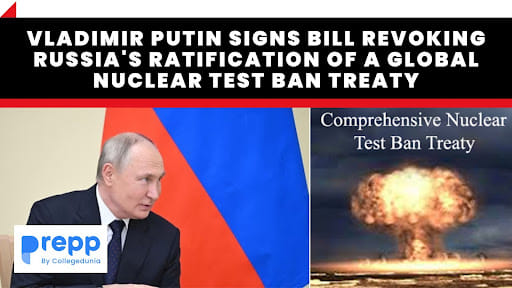
Vladimir Putin Signs Bill Revoking Russia's Ratification Of A Global Nuclear Test Ban Treaty
Relevance: GS2 - Bilateral, regional and global groupings and agreements involving India and/or affecting India’s interests.
(Source: The Hindu, 11/01/2023)
Click here for Daily Current Affairs
Why in the news?
- Recently, Russian President Vladimir Putin signed a bill that revoked Russia’s ratification of the Comprehensive Nuclear Test Ban Treaty, which banned all nuclear explosions across the world.
- The move was part of Russia’s efforts to achieve parity with the U.S.A. which has also not ratified the Treaty.
Table of Contents
Russia’s actions concerning the Comprehensive Nuclear Test Ban Treaty
- Russia rescinded the ratification of the Comprehensive Nuclear Test Ban Treaty (CTBT).
- In October 2023, both Houses of the Russian Parliament voted to revoke Russia’s ratification of the bill.
- However, the Russian Deputy Foreign Minister Sergei Ryabkov claimed that Russia would continue to respect the ban.
- It would only resume nuclear tests if the U.S.A. did so first.
International response
- U.S.A.: US Secretary of State Antony Blinken claimed that it was a step in the wrong direction which was likely to adversely impact confidence in the international arms control regime.
- He also urged Russia to hold to its commitments about respecting the ban.
- France: France condemned Russia’s decision which it said would compromise the universal working of the treaty.
- France, which is one of the first signatories of the Treaty reiterated the importance of the CTBT and its implementation.
- Comprehensive Nuclear-Test-Ban-Treaty Organization: The Comprehensive Nuclear-Test-Ban-Treaty Organization which is responsible for promoting the recognition of the treaty also condemned the decision.
Why has Russia revoked ratification of the CTBT?
- Competition with the U.S.A.: Moscow has claimed that the step is designed to mirror the U.S.A.’s position of signing but not ratifying the bill.
- It claimed that the U.S.A. was doing so to prevent the emergence of a new world order.
- The U.S.A. and Russia are already opposed on numerous topics such as the war in Ukraine, and U.S.A.’s allegations against China.
- Strategic move: Experts have claimed that the move is aimed at sending a message to the opponents of its military capabilities in order to dissuade them from launching deadly strikes aimed at Russia.
- Possible testing: Some analysts have said that this could drive Russia to resume nuclear testing, although only North Korea has conducted nuclear tests this century.
- They have cited a pattern in recent times in which Russia has withdrawn/ suspended its participation in arms control regimes like the New START Regime.
What is the CTBT?
- The Comprehensive Nuclear Test Ban Treaty (CTBT) is a multilateral treaty banning all nuclear explosions anywhere in the world by anyone.
- It covers both civilian and military purposes, in all environments.
- Definition: A comprehensive test ban has been defined as a “zero yield” test ban that would prohibit supercritical hydro-nuclear tests but not sub-critical hydrodynamic nuclear tests.
- It was negotiated at the Conference on Disarmament in Geneva and adopted by the United Nations General Assembly in 1996.
- It opened for signature in 1996.
- Signatories: 182 countries have signed the Treaty.
- India, North Korea, and Pakistan have not yet signed the Treaty.
- Obligations:
- Each State Party undertakes not to carry out any nuclear weapon test explosion or any other nuclear explosion, and to prohibit and prevent any such nuclear explosion at any place under its jurisdiction or control.
- Each State Party undertakes, furthermore, to refrain from causing, encouraging, or in any way participating in the carrying out of any nuclear weapon test explosion or any other nuclear explosion.
- Is the Treaty in force?
- In order for the Treaty to come into force, it has to be ratified by the 44 States listed in Annex 2 of the Treaty.
- Annex 2 countries are those that formally participated in the 1996 Conference on Disarmament and possessed nuclear power or research reactors at the time.
- Of these 44 states, China, North Korea, Egypt, India, Iran, Israel, Pakistan, the United States, and Russia have not ratified the treaty.
- Why was it established?
- Between 1945 and 1996, more than 2,000 nuclear tests were carried out — 1,032 of them by the United States and 715 of them by the Soviet Union, according to the UN
- Impact of the treaty: Since the CTBT’s adoption, there have been only 10 nuclear tests conducted by India, Pakistan, and North Korea while major nuclear powers like the United States, China, France, and Russia refrained from further testing.
Comprehensive Nuclear-Test-Ban Treaty Organization (CTBTO)
|
Conclusion
- Russia's decision to revoke its ratification of the CTBT is part of its strategic move to mirror the U.S.A.'s stance but this has raised concerns about the stability of international arms control efforts.
- Russia's actions challenge the global consensus on disarmament and non-proliferation and could impact the global security landscape.
(*Click this link to read prelims specific weekly current affairs articles)
FAQs
Question: Why is the CTBT known as a zero-yield treaty?
Answer:
The CTBT is known as a zero-yield agreement as it prohibits all nuclear explosions that produce a self-sustaining, supercritical chain reaction of any kind whether for weapons or peaceful purposes.
Question: What is the New START Treaty?
Answer:
The New START (Strategic Arms Reduction Treaty) was the last remaining arms reduction treaty between the USA and Russia. It caps the number of nuclear warheads that can be deployed by Russia and United States of America to 1,550.
It entered into force on 5th February, 2011 and was set to expire in 2026.
UPSC Mains Practice Question:
|
MCQs
Question: The “New START” treaty was in the news. What is this treaty ? (UPSC 2011)
(a) It is a bilateral strategic nuclear arms reduction treaty between the USA and the Russian Federation.
(b) It is a multilateral energy security cooperation treaty among the members of the East Asia Summit.
(c) It is a treaty between the Russian Federation and the European Union for the energy security cooperation.
(d) It is a multilateral cooperation treaty among the BRICS countries for the promotion of trade.
Answer: (a) See the Explanation
- The New Strategic Arms Reduction Treaty ('New START') was signed 2010 in Prague by Russia and the United States.
- This treaty continues the bipartisan process of verifiably reducing U.S. and Russian strategic nuclear arsenals begun by former Presidents Ronald Reagan and George H.W. Bush through START-I in 1994.
Therefore, option (a) is the correct answer.
Question: Consider the following countries (UPSC 2015)
- China
- France
- India
- Israel
- Pakistan
Which among the above are Nuclear Weapons States as recognized by the Treaty on the Non-Proliferation of Nuclear Weapons, commonly known as Nuclear Non-Proliferation Treaty (NPT)?
(a) 1 and 2 only
(b) 1, 3, 4 and 5 only
(c) 2, 4 and 5 only
(d) 1, 2, 3, 4 and 5
Answer: (a) See the Explanation
- The NPT designated nuclear weapon states are China, France, Russia, United Kingdom and the United States.
- It is a landmark international treaty whose objective is to prevent the spread of nuclear weapons and weapons technology and to promote cooperation in the peaceful uses of nuclear energy and to further the goal of achieving nuclear disarmament and complete disarmament.
Therefore, option (a) is the correct answer.
Download the PREPP App and attempt FREE IAS Exam Mock Tests and get complete study material!
Live Test : UPSC IAS : GS - Modern History - Subject Knowledge Test

Live Test : UPSC CSE Prelims CSAT (Paper-II) (Oct 14 - 17)
Full Test - 04: UPSC CSE Prelims CSAT (Paper-II)
Full Test - 03: UPSC CSE Prelims CSAT (Paper-II)
UPSC CSE Prelims 2026 GS Paper 1 Question Paper (24-May-2026)
UPSC CSE Prelims 2026 CSAT Paper 2 Question Paper (24-May-2026)

17 February 2025 | The Hindu Must Read Articles | Current Affairs

16 February 2026 | The Hindu Must Read Articles | Current Affairs

13 February 2026 | The Hindu Must Read Articles | Current Affairs









Comments