Virtual Reality (VR) – Science & Technology Notes
Virtual reality is a three-dimensional, computer-generated environment that can be examined and interacted with by humans. This person is immersed in or becomes a part of the virtual world, where they can manipulate objects or perform a series of actions. In this article, we will discuss regarding Virtual Reality, including its benefits and limitations which will be helpful for UPSC exam preparation.
Table of Contents
- Virtual Reality (VR)
- How Does Virtual Reality Work?
- Categories of Virtual Reality
- Application of Virtual Reality
- Advantages of Virtual Reality
- Limitations of Virtual Reality
- Difference between Virtual Reality (VR) and Augmented Reality (AR)
- Virtual Reality-Related Initiatives in India
- Conclusion
- FAQs
- MCQs
What is Virtual Reality (VR)?
- Virtual reality (VR) is a computer-generated 3D environment (including computer graphics and 360-degree video) that surrounds and responds to a user's actions in a natural way, typically via immersive head-mounted displays.
- Hand and body tracking is provided by gesture recognition or handheld controllers, and haptic (or touch-sensitive) feedback may be included.
- It is a simulated 3D environment that allows users to explore and interact with a virtual environment in a way that simulates reality as perceived by the users' senses.
- Because the gaming industry has been at the forefront of the VR effort, virtual reality is frequently associated with it.
- Beyond entertainment, virtual reality (VR) technology is a powerful tool in education, science, commerce, manufacturing, and other fields.
- HTC Vive, Oculus Rift, and PlayStation VR (PSVR) are all major players in virtual reality.
- Virtual reality is expected to play an important technical role in the creation of immersive metaverse experiences as technology advances.
- Because there is no concrete standard for what constitutes a virtual reality experience, opinions vary depending on the field in question and the mode used to achieve virtual reality. However, virtual reality adheres to a few accepted guidelines:
- Unless the desired effect deviates from this, the environment must be composed of images that appear life-sized from the perspective of the user/viewer.
- The system in charge of running the virtual environment must be able to track the user's motions, particularly eye and head movements, in order to react and change the images on the display or initiate any related actions.
- Jonathan Steuer, a well-known Ph.D. in communication theory and research, proposed that virtual reality have two important components in order to fully immerse the user.
- Depth of Information: The quality and quantity of data fed to the user by the virtual environment itself. This can be accomplished through display resolution, graphics quality, sound quality, haptic feedback, and environment complexity.
- Breadth of Information: The number of senses stimulated by the virtual environment is referred to as its breadth of information. The most basic of these should be audio and visual, while the most advanced systems should include stimulation of all five senses to improve immersion.
| Other Relevant Links | |
|---|---|
| NASA: Asteroid impact and deflection assessment mission | Commercial use of Lithium-Ionbattery technology |
| Hyperspectral imaging satellite | Water propulsion system in CUBESAT |
| Neutrino Observatory | Indian Space Vision-2025 |
| Major Policy Initiatives National Optical Fibre network | Spectrum Management |
| Cyber Law | Internet, Types of Network and e- Governance |
| Spectrum Policy in India | Mobile Spectrum |
| Cloud Computing | Big Data |
| Encryption | Biometrics |
What is Augmented Reality (AR)?
What is Mixed Reality (MR)?
|
How Does Virtual Reality Work?
- VR combines hardware and software to create immersive experiences that "fool" the eye and brain.
- Sound, touch, smell, and heat intensity are examples of sensory stimulation and simulation supported by hardware, while software creates the rendered virtual environment.
- The creation of immersive experiences mimics how the eye and brain form visuals.
- Because human eyes are about three inches apart, they form two slightly different views.
- The brain combines these perspectives to produce a sense of depth or stereoscopic display.
- VR applications mimic that phenomenon by displaying identical images from two different perspectives.
- Instead of a single image covering the entire screen, it displays two identical images offset to each eye.
- VR technology tricks the viewer's brain into perceiving depth and accepting the illusion of a multi-dimensional image.
Categories of Virtual Reality
1) Non-Immersive Virtual Reality
- Because it is so common, this category is frequently overlooked as VR.
- Non-immersive VR technology employs a computer-generated virtual environment in which the user is both aware and controlled by their physical surroundings.
- Non-immersive VR is exemplified by video games.
2) Semi-Immersive Virtual Reality
- This type of VR offers an experience that is based partially in a virtual environment.
- With graphical computing and large projector systems, such as flight simulators for pilot trainees, this type of VR makes sense for educational and training purposes.
3) Fully Immersive Virtual Reality
- There are currently no fully immersive VR technologies, but advances are so rapid that they could be right around the corner.
- This type of VR produces the most realistic simulation experience, from sight to sound and, in some cases, olfactory sensations.
- Car racing games are an example of immersive virtual reality, as they provide the user with the sensation of speed and driving abilities.
- VR has been developed for gaming and other forms of entertainment, but its use in other industries is growing.
Application of Virtual Reality
Training Programmes
- Virtual reality makes it possible to train employees in a safe, effective, and cost-effective manner.
- People in high-risk or highly specialised occupations, such as firefighters, EMTs, police officers, soldiers, surgeons, or other medical personnel, can benefit especially from it.
Educational Advancement
- VR provides innovative teaching and learning techniques to educational institutions.
- While maintaining their interest in the subject, it can provide students with close access to settings that are otherwise inaccessible.
- For example, a history teacher could use virtual reality to transport students to ancient India or China.
Enhancement of Healthcare Facilities
- Virtual Reality has the potential to assist people working in the healthcare sector, such as patients, practitioners, and researchers.
- Virtual reality, for example, has the potential to treat conditions such as anorexia, anxiety, and post-traumatic stress disorder (PTSD).
- Medical professionals, on the other hand, may be able to use VR to communicate diagnoses or available treatments to patients.
- VR may benefit people who have certain physical limitations.
Entertainment
- Although virtual reality has already had an impact on gaming, it has the potential to completely transform the film and television industries by providing viewers with an immersive experience that immerses them in the action.
- Virtual reality (VR) has the potential to create an entire tourism industry by allowing people to visit places they would never be able to visit in person.
Retail Sector
- While VR has had significant success in the retail sector, there is still much room for growth.
- Customers will be able to use the appropriate apps to try on clothes, design their homes, experiment with hairstyles, test eyeglasses, and generally make better choices of goods and services.
Real Estate Industry
- There are numerous benefits to using virtual reality in the real estate industry.
- Building experts, for example, can virtually tour HVAC systems, homeowners can see how their remodels will look, and architects can display precise drawings in 3D.
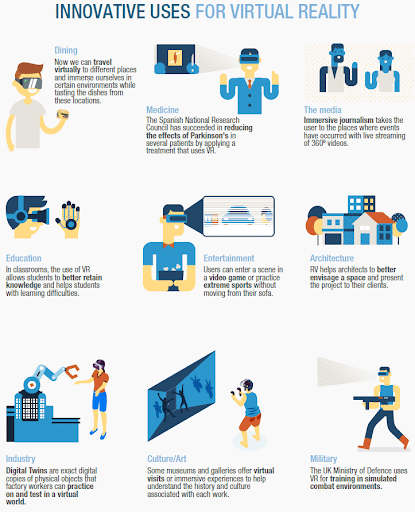
Uses of Virtual Reality
Advantages of Virtual Reality
Increased Customer Engagement
Customers get a realistic 3D product experience with virtual reality, allowing them to see all of the features and decide which ones are best for them. This immersive experience increases customer engagement and brand loyalty.
Enhanced Customer Retention
Brands that provide VR-enabled technology distinguish themselves from those that use push marketing tactics. VR leaves a lasting impression, increasing customer retention and enhancing brand reputation.
Product Designs That Are Simplified
Designers can use virtual reality software to mix and match different design elements in a virtual space to determine which vector goes where. This helps to streamline product designs and reduces prototyping time.
Optimized Return on Investment (ROI)
Although implementing VR takes time, it has the potential to significantly improve every value chain. This results in a consistent flow of customers and deals, resulting in an increased ROI.
Reduced Costs
Virtual reality can eliminate the need for costly training methods such as onboarding new employees, evaluating their performance, and holding appraisal meetings in a virtual world. This low-cost approach allows businesses to save time and money.
Remote Connectivity
VR headsets can map various environments in space, allowing people to connect and collaborate in a virtual world. This feature is especially beneficial for remote teams who collaborate but are physically located in different parts of the world.
Limitations of Virtual Reality
Expensive Implementation
- Implementing virtual reality is an expensive process.
- Because virtual reality necessitates expensive equipment and technology, only a select few could afford it.
- As a result, the initial installation of this type of equipment is costly.
No Real Interaction
- Because VR experiences are based on pre-recorded environments, interaction with an instructor is not possible, even if technical skill is obtained.
- As a result, until another knowledgeable individual shares their knowledge of the subject, the learner's uncertainties persist.
Complex Technology
Virtual reality technology must be studied in order to acquire abilities, and because it is difficult for everyone to grasp how to use it, training is required.
Virtual Reality Addiction
- Teenagers and a few adults have been observed developing a virtual reality addiction and experiencing physiological side effects on a regular basis.
- Addiction causes a variety of problems, and youths will also neglect their regular work in favour of constantly playing video games.
The Effect on the Human Body
Many people who use virtual reality experience physical issues such as eye strain, vertigo, and nausea. This is due to the virtual reality illusion.
Cut off from Reality
- People who become addicted to virtual reality do not want to interact with the real world.
- They no longer want to interact with the physical world because the virtual world has replaced it.
Psychological Harm
It is recommended that people avoid using virtual reality for extended periods of time because addiction causes psychological harm.
Difference between Virtual Reality (VR) and Augmented Reality (AR)
| Factors | Virtual Reality (VR) | Augmented Reality (AR) |
|---|---|---|
| Virtuality | VR is completely virtual | AR uses a real-world entity to enhance digital content |
| Control | VR users are controlled by the system | AR users can control their presence in real world |
| Compatibility | VR requires compatible devices like a headset device | AR needs no specific device |
| Environment | VR only enhances a fictional reality | AR enhances both virtual and real-world entities |
| Freedom | VR is composed of cables and can be inaccessible over a specified distance. | AR is free from cables and free to move without any hindrances like distance. |
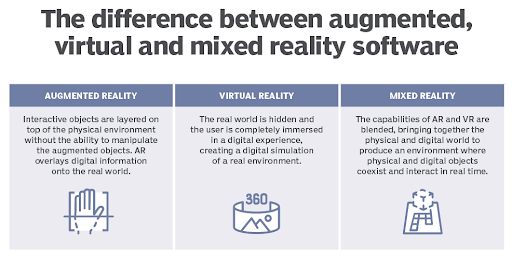
VR vs AR vs MR
Virtual Reality-Related Initiatives in India
Consortium for VR/AR/MR Engineering Mission in India (CAVE)
- The Indian Institute of Technology Madras has established the country's first Virtual Reality Consortium, known as the 'Consortium for VR/AR/MR Engineering Mission in India' (CAVE).
- The main goal of this consortium is to provide its members with the capabilities they need to collaborate on the development of new cutting-edge technologies and applications in VR, Augmented Reality, Mixed Reality (XR), and Haptics.
- Their research collaboration would involve industrial sponsors as well as participants from industry, academia, and the government.
MeitY Startup Hub (MSH)
- MeitY Startup Hub (MSH) is a collaboration between the Ministry of Electronics and Information Technology (MeitY) and Meta.
- They announced the launch of an accelerator programme in India to help and accelerate XR technology startups.
- This initiative, XR Startup Programme, focuses on skilling and building technological capabilities for the metaverse, and will help shape the ecosystem in the country for these emerging technologies, such as Augmented Reality (AR) and Virtual Reality (VR).
Future of Virtual Reality
- Virtual reality is one of the technologies with the greatest growth potential.
- According to the most recent projections, investment in VR and AR will increase 21-fold over the next four years.
- Furthermore, both technologies will be critical to businesses' digital transformation plans, and their spending in this area will outpace that of the consumer sector.
- As a result, it is expected that by 2020, more than half of the largest European companies will have a VR and RA strategy.
- In today's market, users want applications that go beyond leisure, tourism, or marketing and are more affordable.
- Virtual interfaces must also be improved to avoid flaws like clipping, which causes certain solid objects to appear as if they can be passed through.
- It will also mitigate the effects that VR has on people, such as motion sickness, which is characterised by dizziness caused by a mismatch between our body's movement and what is seen in the virtual world.
- The major technology companies are already working on developing headsets that do not require cables and can display images in high definition.
- They are working on 8K Virtual Reality headsets with much more powerful processors.
- There is even talk of incorporating Artificial Intelligence in the coming years.
Conclusion
Virtual reality is a solution for situations where performing a task in the real world would be dangerous, expensive, or impractical. Whether we're training fighter pilots or doctors for medical purposes, virtual reality allows us to take theoretical risks in order to gain real-world experience. As the cost of VR technology falls and adoption rates rise, it is expected to have more serious applications, such as those for education and productivity. VR and related augmented reality could significantly alter how we interact with our digital technology.
| Other Relevant Links | |
|---|---|
| Science & Technology Policy in India | Scientific Policy Resolution 1958 |
| Science & Technology Policy of 1983 | Science & Technology Policy of 2003 |
| Science, Technology and Innovation Policy 2013 | New Initiatives Aligned with the National Agenda |
| India and World collaboration in science projects | Technology Vision Document 2035 |
FAQs
Question. What is Virtual Reality (VR)?
Virtual Reality (VR) is a technology that creates a simulated environment through computer-generated imagery. It immerses users in a virtual world, often using special VR headsets and controllers, allowing them to interact with the environment as if it were real. VR can be used for gaming, education, training, and various professional applications.
Question. How does Virtual Reality (VR) work?
VR works by using a combination of hardware and software to create an immersive experience. VR headsets display 3D images to the eyes, and motion sensors track the user’s movements, allowing them to interact with the virtual environment. Controllers or gloves are often used to manipulate objects or navigate within the VR world.
Question. What are the different types of Virtual Reality?
There are several types of VR, including:
- Non-Immersive VR: The user interacts with a virtual environment on a screen but is not physically immersed.
- Immersive VR: The user is fully immersed in a virtual world through VR headsets, where all sensory experiences are simulated.
- Augmented Reality (AR): A form of mixed reality where virtual elements are overlaid on the real world.
- Mixed Reality (MR): Combines elements of both VR and AR, allowing interaction with both the real world and virtual objects.
Question. What are the applications of Virtual Reality?
VR has a wide range of applications, including:
- Entertainment & Gaming: Creating immersive gaming experiences.
- Medical Field: Training surgeons, treating phobias, and providing rehabilitation.
- Education: Creating virtual classrooms and interactive learning experiences.
- Architecture & Design: Allowing architects and clients to walk through virtual buildings and spaces.
- Military & Defense: Simulating combat scenarios for training purposes.
Question. What are the challenges faced in Virtual Reality technology?
Some challenges of VR include high costs of hardware and software, motion sickness for some users, and the need for powerful computers to run VR applications. Additionally, the technology is still evolving, and the development of fully immersive and realistic VR experiences requires overcoming technical limitations related to graphics, interactivity, and user comfort.
MCQs
- What is the primary purpose of Virtual Reality (VR)?
A) To create a virtual environment that simulates real-world interactions
B) To provide video editing tools
C) To track a user’s physical activity
D) To enhance image resolution for televisions
Answer: (A) See the Explanation
VR is designed to create immersive, simulated environments that allow users to interact with virtual worlds in a way that feels real.
- Which of the following is NOT a type of Virtual Reality?
A) Immersive VR
B) Augmented Reality (AR)
C) Mixed Reality (MR)
D) Photorealistic Reality (PR)
Answer: (D) See the Explanation
While immersive VR, AR, and MR are common types of virtual and mixed reality technologies, "Photorealistic Reality" is not a recognized category.
- Which sector uses Virtual Reality for creating realistic simulation-based training?
A) Education
B) Medical
C) Entertainment
D) Defense and Military
Answer: (D) See the Explanation
The defense and military sectors use VR to create realistic combat scenarios and training simulations, providing soldiers with virtual environments to practice without real-world risks.
- What is one of the primary hardware components required for Virtual Reality?
A) Motion sensors
B) VR headsets
C) High-definition monitors
D) Light sensors
Answer: (B) See the Explanation
VR headsets are one of the essential components for immersing the user in a virtual world by displaying 3D visuals and tracking head movement.
- What is a major challenge of Virtual Reality technology?
A) Lack of interest in virtual worlds
B) Cost of hardware and software
C) Low demand in the entertainment industry
D) Lack of virtual content
Answer: (B) See the Explanation
One of the main challenges of VR technology is the high cost of specialized hardware (like VR headsets) and software required to create immersive virtual experiences.
GS Mains Questions and Model Answers
Q1: Discuss the potential benefits and challenges of using Virtual Reality (VR) in education and training.
Answer: Virtual Reality (VR) has the potential to revolutionize education and training by providing immersive learning experiences that engage students and trainees in interactive environments. The benefits of using VR in education include enhanced learning experiences, where students can virtually explore historical sites, conduct virtual experiments, and interact with complex subjects in a hands-on way. VR can make education more engaging and accessible, especially in fields like medical training, engineering, and science, where practical experience is vital. For instance, medical students can practice surgeries in a virtual environment, gaining valuable experience without the risk of harm. However, VR also faces several challenges in education. The high cost of VR hardware and software can limit its widespread adoption, particularly in underfunded educational institutions. Additionally, there are technical limitations such as motion sickness, which can affect some users' comfort while using VR. Another challenge is the need for appropriate content and the development of high-quality educational VR applications, which can be resource-intensive. Despite these challenges, the potential of VR in education is immense, offering opportunities for more interactive, immersive, and personalized learning experiences.
Q2: Analyze the impact of Virtual Reality (VR) on the entertainment industry, especially gaming.
Answer: Virtual Reality (VR) has had a profound impact on the entertainment industry, particularly in the gaming sector. VR technology allows for highly immersive gaming experiences where players can interact with 3D virtual worlds in real-time, offering a level of engagement that traditional gaming cannot match. In VR gaming, players can physically move, interact with objects, and experience a sense of presence that makes the virtual world feel real. This level of immersion has led to new game genres and innovative gaming experiences that were previously unimaginable. The development of VR gaming hardware, such as VR headsets and motion controllers, has enhanced the gaming experience, making it more interactive and dynamic. Furthermore, VR has expanded beyond gaming into areas such as virtual concerts, theme park attractions, and interactive media, where users can be part of a live, immersive experience. However, there are challenges as well. The cost of VR equipment remains a barrier to entry for many players, and the need for powerful computers or gaming consoles to run VR games can limit accessibility. Additionally, motion sickness and the physical space required for VR gaming can be issues for some users. Despite these challenges, VR's influence on the entertainment industry continues to grow, offering new ways for people to interact with digital content.
Q3: Evaluate the potential and challenges of Virtual Reality (VR) in the medical field.
Answer: Virtual Reality (VR) has significant potential in the medical field, offering innovative solutions for training, diagnosis, and patient treatment. In medical training, VR allows students and professionals to practice surgeries and medical procedures in a risk-free, controlled virtual environment. This immersive training provides hands-on experience without the dangers associated with real-life practice on patients. For example, surgeons can rehearse complex procedures or emergency scenarios, improving their skills and decision-making abilities. VR is also being used in therapy, particularly in treating patients with phobias, anxiety, and PTSD, by immersing them in virtual environments that help them confront their fears in a safe manner. Another promising application of VR in medicine is in rehabilitation. VR technologies are used to create interactive exercises that help patients recover from injuries or surgeries by simulating real-world activities and environments, promoting faster healing and recovery. Despite these advantages, VR faces challenges in the medical field, including the high cost of specialized equipment and the need for continuous updates in software. The lack of standardized protocols for VR-based treatments and training can also hinder its widespread adoption. Furthermore, concerns about data security and privacy in handling sensitive patient information are significant barriers. However, as VR technology evolves, it is expected to play an increasingly important role in healthcare, enhancing both medical training and patient treatment.
Previous Year Questions Virtual Reality
1. UPSC CSE 2023
Question: What are the applications of Virtual Reality (VR) in sectors like education, healthcare, and entertainment?
Answer: Virtual Reality (VR) has wide-ranging applications across various sectors:
- Education: VR enhances learning by providing immersive experiences, such as virtual field trips and interactive lessons, making education more engaging and accessible.
- Healthcare: VR is used in medical training, surgery simulations, and therapy for conditions like PTSD, phobias, and rehabilitation.
- Entertainment: In gaming, VR offers an immersive experience where players interact with 3D environments, and in entertainment, VR is used for virtual concerts and interactive media.
2. UPSC CSE 2022
Question: Discuss the potential benefits and challenges of Virtual Reality (VR) technology in healthcare.
Answer: VR technology offers several benefits in healthcare, including enhanced training for medical professionals, immersive therapy for patients with mental health conditions, and rehabilitation tools for patients recovering from injuries. VR allows for realistic simulations, enabling doctors to practice surgeries and procedures without real-life risks. It also provides therapeutic experiences for patients suffering from phobias, anxiety, and PTSD by immersing them in controlled virtual environments.
However, challenges include the high costs of VR equipment, the need for specialized software, and the lack of widespread adoption in healthcare institutions. Additionally, the technical limitations of VR technology, such as motion sickness and user discomfort, need to be addressed for better patient acceptance. Despite these challenges, VR holds immense promise in transforming healthcare practices.
Download the PREPP App and attempt FREE IAS Exam Mock Tests and get complete study material!

Full Test - 04: UPSC CSE Prelims CSAT (Paper-II)
Full Test - 03: UPSC CSE Prelims CSAT (Paper-II)
UPSC CSE Prelims 2026 GS Paper 1 Question Paper (24-May-2026)
UPSC CSE Prelims 2026 CSAT Paper 2 Question Paper (24-May-2026)

17 February 2025 | The Hindu Must Read Articles | Current Affairs

16 February 2026 | The Hindu Must Read Articles | Current Affairs

13 February 2026 | The Hindu Must Read Articles | Current Affairs









Comments