Uttarakhand panel seeks input on Uniform Civil Code (UPSC Current Affairs)
Relevance: GS2 - Indian Constitution- Significant Provisions, Secularism
(Source: The Hindu)
Click here for Daily Current Affairs
Why in the news?
Recently, the expert committee formed by the government of Uttarakhand to look into the implementation of a Uniform Civil Code (UCC) has launched a website to gather feedback from the general public. The committee, which is led by retired judge Ranjana Prakash Desai, has asked residents for their ideas and comments on the issue.
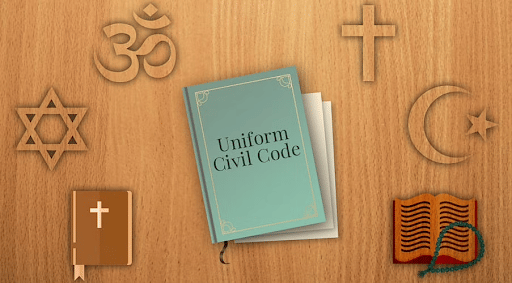
What is the Uniform Civil Code?
- Uniform civil code (UCC) is the set of personal laws which is based on common constitutional ideals for the matters of property, marriage, divorce, inheritance and succession for all religions.
What are the constitutional provisions for UCC?
Article 44
- Article 44 of the Constitution makes provision for a UCC and states that "The State should endeavour to obtain for the citizens a uniform civil code throughout the territory of India."
- Given that it is located in the chapter on the Directive Principles of State Policy, this is assumed to be of an advisory character.
Article 37
- According to Article 37, the idea of a uniform civil code is incorporated in the Indian Constitution as a vision that the country should work toward but not as a basic right nor a constitutional guarantee.
- A UCC cannot be obtained by going before the court. However, that doesn't preclude judges from offering their opinions.
What is the Uttarakhand Expert Committee on Uniform Civil Court?
- The Uttarakhand government formed an expert committee in May 2022 under the head of a former Supreme Court (SC) judge, Justice Ranjana Desai, to implement the Uniform Civil Code (UCC) and to review all pertinent legislation that governs personal laws for residents of Uttarakhand.
- In 2021, the Allahabad High Court also directed the Central government to initiate the process for implementation of the UCC.
What has been done so far towards UCC in India?
- Parliament so far has been unable to enact the Uniform Civil Code under Article 44. But Parliament has enacted various laws regarding the personal laws related to marriage, divorce, succussion, and property for nearly all religions.
- For Interfaith Marriage: The Special Marriage Act, the Indian Succession Act, and the Civil Marriage Act were all passed by Parliament in 1954. These enactments were made available to all Indians as a secular substitute. As a result, all Indians are guaranteed an optional UCC as a result of these acts.
- For Religious Marriage: To regulate religious marriages between Hindus, Buddhists, Jains, and Sikhs, Parliament also passed the Hindu Marriage Act in 1955.
- For Succession: To regulate the properties of persons covered by the Hindu Marriage Act of 1955, a Hindu Succession Act was put into effect.
What are the issues in the central personal laws?
- These recently passed central personal laws contain several provisions that deal with marriage, property, and divorce.
- In some circumstances, the Special Marriage Act is discriminatory. The extent to which it forbids marriages between close relatives is mentioned (similar to the Hindu Marriage Act). The Act does not forbid marriages between distant cousins.
- Thus, despite religious prohibition, a Hindu can wed a second cousin, whereas, despite religious approval, a Muslim cannot wed a first cousin.
- Contrary to the Special Marriage Act, the Hindu Marriage Act lifts the prohibition on prohibited degrees based on custom.
- The Special Marriage (Amendment) Act allowed the Hindu Succession Act to govern both partners' (if Hindu) properties during the Emergency period rather than the Indian Succession Act.This was a step backward.
Why is there a need for the state to enact UCC?
- The Indian constitution places family and succession-related personal legislation within the concurrent list.
- The States are able to pass similar rules since the central laws governing succession and marriage are subject to numerous problems.
- However, Indian nationals are subject to outdated foreign laws in some parts of the nation. As a result, a state may decide to implement such a code.
What will be the issues in the state-level Uniform Civil Code Laws?
- Article 44 of the Constitution looks to conflict with a state-level UCC.
- A single civil code must apply to all Indian residents on its whole territory, according to Article 44.
- According to the Constitution, the Center and the states jointly control family and succession legislation. As a result, Parliament can enact laws that apply to the whole nation.
- State-by-state variations in family and succession laws, as well as the laws of the Center, would only increase confusion rather than provide a solution to the current problems.
What are the issues in the implementation of the Uniform Civil Code?
- Diverse Personal Laws: Because of the variety of personal rules and the fervor with which they are upheld, uniformity of any type is challenging to achieve. It might be challenging for different communities to find common ground.
- False Perception: There are still a lot of people who don't understand what the unified civil code really means. A rational conversation about its implementation is difficult since there are still false beliefs about it, especially among minorities.
- Concerns of Fundamental Rights Violation: Concern exists that the fundamental freedoms of conscience, the free exercise and proclamation of religions (Article 25), and the freedom to conduct religious affairs will be violated by the universal civil code (Article 26).
- Opposition from Religious groups: When bringing up the UCC, this is one of the most fundamental and obvious challenges to overcome. Even in the twenty-first century, fundamentalism, which is firmly entrenched in many Indian religions, does not seem to be waning.
- Lack of Political Will: The government may lack the fortitude to face the effects of repealing the personal laws of the major religions and persuade the populace of the justice and reform they wish to bring about in order to benefit society and the country.
- Fear of Encroachment on Religious Liberty: Many people, especially minorities, consider the Uniform Civil Code to be an infringement on their right to practise their religion. They fear that a uniform code will disregard the customs of minorities and impose rules heavily influenced by the main faith groupings.
Way forward
- Awareness: To change current personal law reforms, significant public awareness initiatives are needed. These initiatives should be spearheaded by the local communities.
- A gradual transition is required to avoid an abrupt change from a diverse to a unified civil code. The administration will therefore need to implement changes piecemeal.
- Recommendations to the Law Commission: The panel emphasizes attempts to reconcile national diversity with claims of universal human rights.
- To expose bias and preconceptions across all religions, it argued for the codification of all personal laws.
- They will eventually be tested on the anvil of the fundamental rights of the constitution.
- It might contribute to the formulation of universal principles.
- Instead of imposing UCC, these may make it easier to prioritize equity.
The better course of action would be to make minor adjustments that would eliminate some of the underlying ridiculousness in some personal rules and make them appropriate for the modern world. It's important to examine differences among religions as well. This might lay the foundation for a UCC's later deployment.
Some Important FAQs
Question: What is Article 44 of the Constitution of India?
Answer:
Article 44 says, 'The State shall endeavor to secure for the citizens a Uniform Civil Code throughout the territory of India. ' The article is a part of the Directive Principles of State Policy.
Question: Is India's Uniform Civil Code in effect?
Answer:
In India, Goa is the only state to have a UCC regardless of gender, religion, and caste.in Goa, there is a common family law so we can say that Goa is the only state in India that has a Uniform civil code.
Question: When was Goa Civil Code adopted?
Answer:
In 1867, Portugal enacted the Portuguese Civil Code and in 1869 extended it to its overseas provinces, including Goa. And though Goa was liberated from Portuguese control in 1961, it has continued with the same civil code. Portugal, on the other hand, replaced its civil code with a modern one in 1966.
MCQs
Question: Which Article of the Indian Constitution directs the State to provide a Uniform Civil Code throughout Indian Territory?
(a) Article 19
(b) Article 40
(c) Article 44
(d) Article 51
Answer: (c) See the Explanation
Article 44 of Part IV (Directive Principles of State Policy) of the Constitution states that the State shall endeavor to provide a Uniform Civil Code for its citizens throughout India's territory.
Therefore, option (c) is the correct answer.
Download the PREPP App and attempt FREE IAS Exam Mock Tests and get complete study material!

Full Test - 04: UPSC CSE Prelims CSAT (Paper-II)
Full Test - 03: UPSC CSE Prelims CSAT (Paper-II)
UPSC CSE Prelims 2026 GS Paper 1 Question Paper (24-May-2026)
UPSC CSE Prelims 2026 CSAT Paper 2 Question Paper (24-May-2026)

17 February 2025 | The Hindu Must Read Articles | Current Affairs

16 February 2026 | The Hindu Must Read Articles | Current Affairs

13 February 2026 | The Hindu Must Read Articles | Current Affairs









Comments