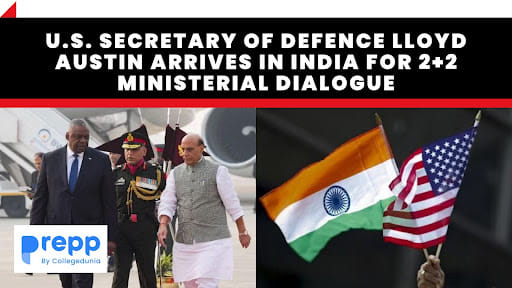
U.S. Secretary Of Defence Lloyd Austin Arrives In India For 2+2 Ministerial Dialogue
Relevance: GS3 - Defense Technology
(Source: The Hindu, 11/10/2023)
Click here for Daily Current Affairs
Why in the news?
- Recently, U.S. Secretary of Defence Lloyd J. Austin arrived in India to participate in the 2+2 Ministerial dialogue between India and the U.S.A.
- The two countries aim to make progress on the MQ-9B and F-414 jet engine deals.
Table of Contents
What are the 2+2 talks?
- The 2+2 dialogue is a format in which the Foreign and Defense ministers of India and its allies meet to discuss strategic and security issues.
- It enables dialogue partners to understand and appreciate each other’s strategic concerns, sensitivities, and political factors.
- This will help build a stronger and more integrated strategic relationship amid the rapidly changing global environment.
- India holds 2+2 dialogues with four key strategic partners - the USA, Australia, Japan, and Russia.
India-U.S. 2+2 Dialogue
- The US is India’s oldest and most important 2+2 talks partner with the Dialogue being organized annually since 2018.
- It is a reflection of India and the U.S.A.’s shared commitment to a positive and forward-oriented strategic partnership.
- It aims to build greater synergy in the diplomatic and security initiatives of the two countries.
- Ministries involved: The Defence and External Affairs Ministries of both countries are represented by the respective Ministers(India) and Secretaries (U.S.A).
Outcomes
- Logistics Exchange Memorandum of Agreement (LEMOA): It was signed in 2016 and aims to provide mutual logistics support around the world
- Communications Compatibility and Security Agreement (COMCASA): It was signed after the first 2+2 dialogue in 2018, and aims to facilitate communication between the weapons platforms of the two armed forces.
- Basic Exchange and Cooperation Agreement (BECA): It was signed in 2020 and aims to provide Indian military systems with a high-quality GPS to navigate and missiles with real-time intelligence to precisely target enemies.
- The three Agreements form the troika of “foundational pacts” for deep military cooperation.
2023 Summit
- The 2023 2+2 Ministerial Dialogue is the first major diplomatic visit between India and the U.S.A. since the conflict in Israel.
- Participants:
- U.S.A.: Secretary of Defense Lloyd Austin and Secretary of State Antony Blinken
- India: Union Defense Minister Rajnath Singh and Minister of External Affairs S. Jaishankar
Agenda
Although both countries, the world’s largest democracies, have not outlined a definite agenda for the talks, they have mentioned topics of interest. It consists of a high-level review of progress across sectors such as defense, security, technology, and people-to-people ties.
- Innovation: Both countries have expressed interest in cooperating in new and emerging areas such as semiconductors, advanced biotechnology, clean energy, and space.
- People-people ties: The two countries have been exploring opportunities for educational exchanges and facilitating travel as India has a 4.4 million strong diaspora in the U.S.A.
- Strategic partnership: In June, President Biden and PM Modi agreed on the need for a comprehensive strategic partnership to deliver the shared vision.
- The U.S.A. has prioritized a free and open, prosperous, secure, and resilient Indo-Pacific, and strengthened its partnership with QUAD members.
- The two countries agreed on the need to bolster the partnership in international peace, and security and work to promote a rules-based order, principles of sovereignty, territorial integrity, and independence.
- Multilateralism and international issues: India and the U.S.A. have sought to augment cooperation in multilateral platforms and develop a framework to address regional issues.
- India and the U.S.A. have expressed interest in developing a solution to the crises in West Asia and in Ukraine.
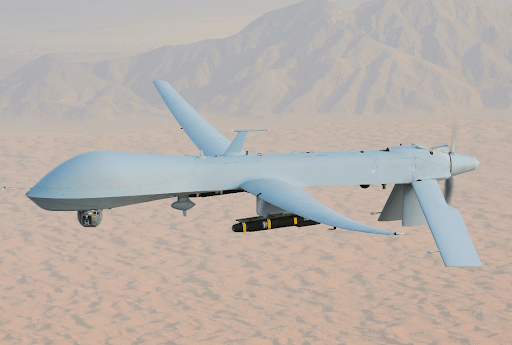
- Defense: India has expressed interest in purchasing the 31 MQ-9B high altitude long endurance drones for its defense fleet.
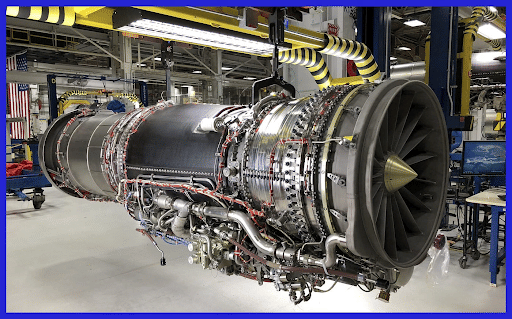
- India and the U.S.A. have also highlighted the need to conclude the deal to manufacture the General Electric F-414 jet engines in India.
MQ-9B
To know more, click the link. F-414 jet engine
To know more, click the link. |
Conclusion
- The 2+2 Ministerial Dialogue signifies the deepening strategic partnership between India and the U.S.A. Broader cooperation between India and the U.S.A. in defense, innovation, and people-to-people ties is necessary to address shared security concerns and promote regional stability in the Indo-Pacific.
(*Click this link to read prelims specific weekly current affairs articles)
FAQs
Question: What is a UAV?
Answer:
An unmanned aerial vehicle (UAV) is an aircraft that carries no human pilot or passengers. It can be fully or partially autonomous and can be used for warfare and surveillance.
Question: What is the rules-based order?
Answer:
A rules-based order is a shared commitment by nations to conduct their activities in accordance with an existing set of rules. It is based on a system of global governance that has developed since the Second World War. It is broader than the concept of international law as it also includes soft law, i.e. nonbinding commitments.
UPSC Mains Practice Question:
|
MCQs
Question: What is "Terminal High Altitude Area Defense (THAAD)", sometimes seen in the news? (UPSC 2018)
(a) An Israeli radar system
(b) India's indigenous anti-missile Programme
(c) An American anti-missile system
(d) A defense collaboration between Japan and South Korea
Answer: (c) See the Explanation
- The THAAD system is designed to intercept and destroy short and medium-range ballistic missiles during their final phase of flight.
- It is a ground-based missile system manufactured by manufactured by the US company Lockheed Martin.
Therefore, option (c) is the correct answer.
Question: Consider the following statements: (UPSC CSE 2023)
Statement-I: Recently, the United States of America (USA) and the European Union (EU) have launched the Trade and Technology Council.
Statement-II: The USA and the EU claim that through this they are trying to bring technological progress and physical productivity under their control.
Which one of the following is correct in respect of the above statements?
(a) Both statement-I and Statement-II are correct and Statement-II is the correct explanation for Statement-I
(b) Both Statement-I and Statement-II are correct and Statement-II is not the correct explanation for Statement-I
(c) Statement-I is correct but Statement-II is incorrect.
(d) Statement-I- is incorrect but Statement-II is correct.
Answer: (c) See the Explanation
- The Trade and Technology Council was launched by the United States of America and the European Union during the EU-US Summit on 15 June 2021 in Brussels. Hence statement 1 is correct.
- The USA and EU are not aiming to bring technological progress and physical productivity under their control through the Trade and Technology Council.
- It aims to promote the pooling of digital resources such as AI models and computing power, and make them available to partner countries to address challenges in areas such as climate change and extreme weather, healthcare, or smart agriculture. Hence statement 2 is incorrect.
Therefore, option (c) is the correct answer.
Download the PREPP App and attempt FREE IAS Exam Mock Tests and get complete study material!

Full Test - 04: UPSC CSE Prelims CSAT (Paper-II)
Full Test - 03: UPSC CSE Prelims CSAT (Paper-II)
UPSC CSE Prelims 2026 GS Paper 1 Question Paper (24-May-2026)
UPSC CSE Prelims 2026 CSAT Paper 2 Question Paper (24-May-2026)

17 February 2025 | The Hindu Must Read Articles | Current Affairs

16 February 2026 | The Hindu Must Read Articles | Current Affairs

13 February 2026 | The Hindu Must Read Articles | Current Affairs









Comments