Urgent need to control use of e-cigarettes, says WHO
Primary Source: The Hindu
Click here for Daily Current Affairs
Why in the news?
- World Health Organization (WHO) has expressed concerns about the increasing use of e-cigarettes and has called for urgent control measures.
- The WHO highlighted the ineffectiveness of e-cigarettes in quitting tobacco at the population level and points out adverse health effects.
Table of Contents
What are e-cigarettes?
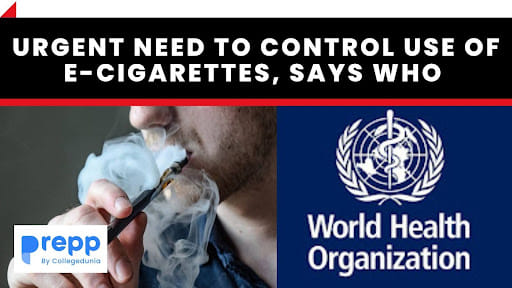
- E-cigarettes, short for electronic cigarettes, are battery-operated devices that simulate the act of traditional tobacco smoking.
- They are designed to deliver nicotine, flavorings, and other chemicals to the user in the form of an aerosol that is inhaled.
- E-cigarettes are sometimes referred to as vape pens, vaporizers, or simply "vapes."
Concerns regarding e-cigarettes
- Ineffectiveness for Quitting Tobacco: The WHO states that e-cigarettes as consumer products have not been proven effective for quitting tobacco use at the population level.
- Adverse Health Effects: There is alarming evidence of adverse health effects associated with e-cigarettes, which is a significant concern for the WHO.
- Risk to Children and Young People: The WHO is particularly concerned about the impact on children and young people. E-cigarettes are seen as a tool for recruiting and trapping young individuals into nicotine use, which may lead to a lifelong addiction.
- Aggressive Marketing: The WHO highlights that e-cigarettes are aggressively marketed to young people, increasing their appeal and potential for abuse among this demographic.
- Lack of Regulation: There is a notable lack of regulation in many countries regarding the sale of e-cigarettes, their advertisement, and the minimum age for purchase.
- Social Media Influence: Exposure to e-cigarette content on social media is linked to increased intentions to use these products and more positive attitudes towards them, particularly among young people.
- Gateway to Smoking: Studies indicate that young people who use e-cigarettes are significantly more likely to use traditional cigarettes later in life.
- Rising Usage Among Youth: Data shows a concerning increase in e-cigarette usage among young individuals, with notably higher rates than adults in many regions.
- Addictiveness and Health Harms: E-cigarettes containing nicotine are highly addictive and harmful to health. Long-term health effects are not fully understood, but they are known to generate toxic substances, some of which are carcinogenic or increase the risk of heart and lung disorders.
Usage Statistics
- Children in the 13-15 age group are using e-cigarettes at higher rates than adults across all WHO regions.
- In Canada, e-cigarette use among 16 to 19-year-olds doubled between 2017 and 2022.
- In the U.K., the number of young users tripled in the past three years.
Global Regulations with Regards to e-cigarettes
- Thirty-four countries have completely banned the sale of e-cigarettes.
- Eighty-eight countries do not have a minimum age requirement for purchasing e-cigarettes.
- Seventy-four countries lack regulations for e-cigarettes.
- In India, the possession of e-cigarettes is prohibited under the Prohibition of Electronic Cigarette Act, 2019.
Prohibition of Electronic Cigarette Act, 2019
|
Health Impacts of e-cigarettes
- Addiction and Health Risks: E-cigarettes containing nicotine are highly addictive and harmful to health. They generate toxic substances, some of which are carcinogenic and others that increase the risk of heart and lung disorders.
- Impact on Brain Development: There is a concern that e-cigarettes can affect brain development in young people, leading to learning disorders.
- Risks During Pregnancy: Foetal exposure to e-cigarettes can negatively impact the development of the foetus in pregnant women.
- Risks to Bystanders: Emissions from e-cigarettes also pose risks to bystanders.
Way Forward
- Strengthening Regulations: Countries should consider implementing stricter regulations on the sale and marketing of e-cigarettes, especially targeting the accessibility to minors.
- Public Awareness Campaigns: There's a need for more effective public awareness campaigns to educate people, particularly the youth, about the potential health risks associated with e-cigarettes.
- Global Collaboration: Encourage international collaboration such as sharing best practices, research findings, and strategies to combat the global rise in e-cigarette use.
- Monitoring Social Media and Online Content: Given the influence of social media on youth behavior, it's important to monitor and potentially regulate the promotion of e-cigarettes on these platforms.
- Addressing Nicotine Addiction: Implement comprehensive programs to address nicotine addiction more broadly, including education on the risks of nicotine dependency and support for individuals trying to quit.
Conclusion
The WHO calls for urgent measures to prevent e-cigarette uptake and combat nicotine addiction. A comprehensive approach to tobacco control is necessary, taking into account the national circumstances.
(*Click this link to read prelims specific weekly current affairs articles)
FAQs
Question: What are e-cigarettes?
Answer:
E-cigarettes, short for electronic cigarettes, are battery-operated devices that simulate the act of traditional tobacco smoking. They are designed to deliver nicotine, flavorings, and other chemicals to the user in the form of an aerosol that is inhaled. E-cigarettes are sometimes referred to as vape pens, vaporizers, or simply "vapes."
Question: What is the stance of the World Health Organization (WHO) on e-cigarettes?
Answer:
The WHO has raised concerns about the adverse population health effects of e-cigarettes and has underscored the urgent need for their control. The organization highlights the lack of effectiveness of e-cigarettes in quitting tobacco at the population level and points out the recruitment of children and young people into nicotine use through e-cigarettes.
Question: What are the regulatory measures on e-cigarettes in different countries?
Answer:
34 countries have banned the sale of e-cigarettes, 88 have no minimum age for purchasing them, and 74 have no regulations for these products. In India, possessing e-cigarettes and similar devices is prohibited under the Prohibition of Electronic Cigarette Act, 2019.
UPSC Mains Practice Question:
|
MCQs
Question: Consider the following statements: (UPSC 2023)
Statement-I: India's public sector health care system largely focuses on curative care with limited preventive, promotive and rehabilitative care.
Statement-II: Under India's decentralized approach to health care delivery, the States are primarily responsible for organizing health services.
Which one of the following is correct in respect of the above statements?
(a) Both Statement-I and Statement-II are correct and Statement-II is the correct explanation for Statement-I
(b) Both Statement-I and Statement-II are correct and Statement-II is not the correct explanation for Statement-I
(c) Statement-I is correct but Statement-II is incorrect
(d) Statement-I is incorrect but Statement-II is correct
Answer: (b) See the Explanation
The public healthcare system in India is made up of a network of different tiers of government-run healthcare facilities. Primary health centers (PHCs), community health centers (CHCs), district hospitals, and state and centrally sponsored specialized research and education facilities are all included in this.
The central government's Ministry of Health and Family Welfare is in charge of national health initiatives and has regulatory authority.
The state governments are in charge of planning and executing national health policies, overseeing local healthcare organizations, managing the healthcare workforce, and gathering and distributing healthcare services.
There are differences in insurance coverage, healthcare service availability, and service delivery mechanisms throughout states as a result of this responsibility sharing.
The central government creates laws and regulations, while state governments organize and supply healthcare services to their respective populations. Hence, statement 2 is correct.
This decentralized approach enables for adaptability to local demands and environments.
The public healthcare system in India is mostly focused on curative care, with less attention on preventive, promotional, and rehabilitative care.
India's healthcare system has evolved to focus on curative treatments, with a high concentration of hospitals and specialized medical facilities. This systemic bias toward curative care is evident in resource allocation and the education of healthcare workers who are largely focused on diagnosis and treatment. Hence, statement 1 is correct.
Therefore, option (b) is the correct answer.
Question: With reference to Ayushman Bharat Digital Mission, consider the following statements: (UPSC 2022)
- Private and public hospitals must adopt it.
- As it aims to achieve universal health coverage, every citizen of India should be part of it ultimately.
- It has seamless portability across the country.
Which of the statements given above is/are correct?
(a) 1 and 2 only
(b) 3 only
(c) 1 and 3 only
(d) 1, 2 and 3
Answer: (b) See the Explanation
Ayushman Bharat Digital Mission
- All Indian people will be given digital health IDs as part of this initiative, which will enable hospitals, insurance companies, and individuals to electronically access medical records as needed.
- In six States and Union Territories, the project is now in its pilot phase of implementation.
- The implementing agency will be the National Health Authority (NHA), which is part of the Ministry of Health and Family Welfare.
- Citizens may choose not to participate in the Ayushman Bharat Digital Mission at their discretion.
- Participation in a healthcare facility or institution is likewise voluntary and must be approved by the respective management (whether government or private). Hence, statements 1 and 2 are incorrect.
- However, once the management decides to register the respective healthcare facility/institution in the Ayushman Bharat Digital Mission, all healthcare professionals serving the facility/institution must register in the Healthcare Professionals Registry in order for the institution to be fully integrated with the National Digital Health Ecosystem (NDHE).
- It enables seamless cross-country portability. Hence, statement 3 is correct.
Therefore, option (b) is the correct answer.
Question: As per the WHO report, which of the following is a regulatory measure taken by India regarding e-cigarettes?
(a) Implementation of heavy taxes on e-cigarettes.
(b) Mandatory health warnings on e-cigarette packaging.
(c) Prohibition of Electronic Cigarette Act, 2019, banning possession of e-cigarettes.
(d) Limitation on the flavors of e-cigarettes available.
Answer: (c) See the Explanation
In India, the possession of e-cigarettes and similar devices is a violation under the Prohibition of Electronic Cigarette Act, 2019, which is a measure taken to control the use and spread of e-cigarettes in the country.
Therefore, option (c) is the correct answer.
Download the PREPP App and attempt FREE IAS Exam Mock Tests and get complete study material!

Full Test - 04: UPSC CSE Prelims CSAT (Paper-II)
Full Test - 03: UPSC CSE Prelims CSAT (Paper-II)
UPSC CSE Prelims 2026 GS Paper 1 Question Paper (24-May-2026)
UPSC CSE Prelims 2026 CSAT Paper 2 Question Paper (24-May-2026)

17 February 2025 | The Hindu Must Read Articles | Current Affairs

16 February 2026 | The Hindu Must Read Articles | Current Affairs

13 February 2026 | The Hindu Must Read Articles | Current Affairs









Comments