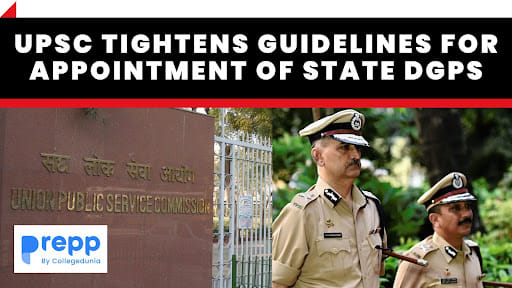
UPSC Tightens Guidelines for Appointment of State DGPs
Primary Source: The Hindu
Relevance: GS2, Indian Polity, Law, Governance, Role of Judiciary, Governance – Role of civil services in a democracy, Transparency, Accountability, Role of the UPSC and other bodies, Federalism, Police Reform, Role of Judiciary
Click here for Daily Current Affairs
Prepp Prelims Booster: Role of the UPSC and other bodies
Prepp Mains Booster: Governance – Role of civil services in a democracy
Why in the news?
- The Union Public Service Commission (UPSC) has updated its criteria for appointing State Directors General of Police (DGPs).
- Only officers with a minimum of six months left before retirement are eligible for the DGP role.
- IPS officers on central deputation won't be assessed for State DGP posts if the Centre communicates non-availability.
Table of Contents
Revised UPSC Guidelines – A Contextual Background
- Supreme Court Verdict on Police Reforms (2006): The article references a significant Supreme Court case from 2006 regarding police reforms in India.
- The court's directives included the procedure for the appointment of DGPs, intended to insulate the higher echelons of the police force from political interference.
- UPSC's Role in DGP Appointments: Following the Supreme Court verdict, in 2009, the UPSC formulated guidelines for the appointment of DGPs, which included criteria based on service length, a good service record, and a range of experiences.
- The UPSC's role is to create a shortlist of eligible officers from which the state government makes the final selection.
- State Appointment Practices: Some states have reportedly appointed acting DGPs or officers with full additional charges, bypassing the established UPSC process.
- This has been a contentious issue, with claims that it undermines the UPSC's authority and the principles laid out by the Supreme Court's police reforms.
- Central-States Tension: The issue reflects ongoing tension between the center and the states over the appointment and management of All India Services officers.
- The Indian Administrative Service (IAS), Indian Police Service (IPS), and Indian Forest Service (IFoS) are all central services, but their members are deployed in state cadres, often leading to a tug-of-war over control and deputation.
Prakash Singh & Ors vs. Union of India
Key aspects of the Supreme Court's judgment in the Prakash Singh case are:
|
What are the Key Changes?
- Service Requirement for Eligibility: Only officers who have at least six months of service remaining before retirement will now be considered for the position of DGP.
- Experience Criteria Relaxation: The experience requirement for eligibility has been reduced from a minimum of 30 years of service to 25 years.
- Cap on Shortlisted Candidates: The number of officers shortlisted for the DGP post cannot exceed three. However, this can be fewer in "exceptional circumstances."
- Voluntary Inclusion: Officers will only be included in the selection panel if they have expressed their willingness to be considered for the position.
- Exclusion of Officers on Central Deputation: IPS officers who are on central deputation will not be considered for a State DGP’s position if the Union Ministry of Home Affairs (MHA) communicates that these officers cannot be relieved for the state position.
Reasons for Addressing the Loopholes
- Appointments Close to Retirement: States were appointing officers as DGPs who were on the verge of retirement. This allowed for the potential extension of their service beyond the typical tenure, possibly for reasons other than merit or capability.
- Bypassing UPSC Process with Acting DGPs: Some states were appointing acting DGPs, or DGPs with "full additional charge," as a means to circumvent the UPSC's empanelment and selection process.
- Central Deputation Conflict: There was a lack of clarity about the availability of IPS officers on central deputation for state appointments.
- States’ Preferences Overruling UPSC Recommendations: Some states had shown a preference for certain officers, disregarding the UPSC's selection panel. This undermined the authority of the UPSC and the integrity of the selection process.
- Varying Standards of Eligibility: The previous requirement of 30 years of service could exclude potentially competent officers who had not yet reached that service length but were otherwise qualified.
- Lack of Explicit Consent from Officers: Prior guidelines did not make it clear whether the inclusion of officers in the panel considered their willingness to serve as DGP, potentially leading to the selection of candidates who were not interested in the position.
Examples of States Bypassing UPSC Process
|
Significance of the Revised Guidelines
- Promotion of Merit and Competence: By requiring a minimum of six months of service before retirement, the amendments ensure that the appointed DGP has sufficient time to implement policies and bring about effective changes.
- Standardization and Fairness: The amendments aim to standardize the appointment process across states and introduce a fair system that is less susceptible to manipulation or state-specific preferences that could undermine the uniformity and fairness of the selection process.
- Enhanced Accountability and Transparency: The new guidelines are intended to make the appointment process more transparent and accountable by closing loopholes that allowed for the circumvention of the established procedure, which could have led to appointments based on favouritism rather than qualification.
- Alignment with Supreme Court Directives: These amendments also align with the directives of the Supreme Court regarding police reforms and the selection process for DGPs, reinforcing the rule of law and the court’s authority in ensuring that police leadership is competent and stable.
- Fostering Willingness and Commitment: By including only those officers who are willing to be on the panel, the UPSC ensures that the candidates are committed to the role of DGP, which is crucial for maintaining high standards of policing and leadership within the police force.
- Clarifying Central Deputation Rules: By clarifying the position on officers on central deputation, the guidelines help to manage the human resources of All India Services more effectively, ensuring that officers are available where they are most needed, whether in the state or at the central level.
- Broader Pool of Candidates: Reducing the service requirement from 30 years to 25 years expands the pool of eligible candidates, potentially bringing in fresh perspectives and dynamic leadership to the role of DGP.
Criteria for IPS Officers’ Experience for State DGP Roles
- The UPSC's revised guidelines lay out specific experience requirements for IPS officers to be eligible for heading a State Police department.
- An IPS officer must have at least ten years of experience in key policing areas:
- Law and order
- Crime branch
- Economic offences wing
- Intelligence wing
- Additionally, experience through deputation to central agencies is also considered:
- Intelligence Bureau (IB)
- Research and Analysis Wing (RAW)
- Central Bureau of Investigation (CBI)
- In 2021, the Union government intended to amend the IAS (Cadre) Rules to allow central deputation of IAS, IPS, and IFoS officers without state consent.
- The proposed amendment faced opposition from states and was not implemented.
- The need for the proposed change was attributed to a shortage of All India Services officers available for central deputation, with states not sponsoring enough officers and a reluctance from officers to move to central government roles.
Conclusion
The UPSC has taken steps to ensure a more stringent and transparent selection process for State DGPs. The amendments attempt to balance the autonomy of state governments with the Union government's oversight, particularly in managing all India services like the IPS.
(*Click this link to read prelims specific weekly current affairs articles)
FAQs
Question: What is the full form of DGP?
Answer:
DGP stands for Director General of Police.
Question: How to become a DGP in Police?
Answer:
To become a DGP, one must pass the UPSC Civil Services test, join the IPS, and serve for at least 25 years in various posts until reaching the rank of DGP.
Question: What is the significance of Prakash Singh vs. Union of India case?
Answer:
The Prakash Singh case refers to a landmark judgment by the Supreme Court of India in 2006 concerning police reforms. Prakash Singh, the former Director General of Police (DGP) of Uttar Pradesh, along with others, filed a public interest litigation (PIL) asking for the court to direct governments to implement the recommendations of the National Police Commission (NPC) for police reforms.
UPSC Mains Practice Question:
|
MCQs
Question: With reference to India, consider the following pairs: (UPSC 2023)
| Sr. No. | Action | The Act under which it is covered |
|---|---|---|
| 1. | Unauthorized wearing of police or military uniforms | The Official Secrets Act, 1923 |
| 2. | Knowingly misleading or otherwise interfering with a police officer or military officer when engaged in their duties | The Indian Evidence Act, 1872 |
| 3. | Celebratory gunfire which can endanger the personal safety of others | The Arms (Amendment) Act, 2019 |
How many of the above pairs are correctly matched?
(a) Only one
(b) Only two
(c) All three
(d) None
Answer: (b) See the Explanation
The Official Secrets Act, 1923:
- Section 6 covers unauthorized use of uniforms, falsification of reports, forgery, personation, and falsification of papers.
- (1) If any person, for the purpose of getting entrance or assisting another person in gaining entry to a banned area, or for any other reason detrimental to the safety of the State—
- (a) without valid authority, uses or wears any naval, military, air force, police, or other official dress, or any uniform so closely resembling the same as to deceive, or falsely claims himself to be a person who is or has been entitled to use or wear any such uniform. Hence, statement 1 is correct.
- Section 7 covers interfering with police officers or members of the Union Armed Forces —
- (1) No one in the area of a forbidden site shall obstruct, knowingly mislead, or otherwise interfere or impede any police officer or member of 3 [the Armed Forces of the Union] on guard, Sentry, patrol, or other similar duty in regard to the prohibited place. Hence, statement 2 is incorrect.
The Arms (Amendment Act), 2019:
- New offenses in the Bill include:
- (i) forcibly obtaining a firearm from police or armed forces, which is punishable by imprisonment ranging from 10 years to life imprisonment, as well as a fine;
- (ii) using firearms in a celebratory gunfire that endangers human life or the personal safety of others, which is punishable by imprisonment of up to two years, or a fine of up to one lakh rupees, or both.
- Celebratory gunfire is the use of firearms to fire ammunition during public gatherings, religious sites, marriages, or other ceremonies. Hence, statement 3 is correct.
Therefore, option (b) is the correct answer.
Question: Consider the following statements: (UPSC 2023)
- According to the Constitution of India, the Central Government has a duty to protect States from internal disturbances.
- The Constitution of India exempts the States from providing legal counsel to a person being held for preventive detention
- According to the Prevention of Terrorism Act, 2002, confession of the accused before the police cannot be used as evidence.
How many of the above statements are correct?
(a) Only one
(b) Only two
(c) All three
(d) None
Answer: (a) See the Explanation
Article 355 of the Indian Constitution requires the Central Government to defend each state from external invasion as well as internal problems. The central government is responsible for ensuring that each state's government operates in conformity with the provisions of the constitution. Hence, statement 1 is correct.
Article 22(1) reads that "No person who is arrested shall be detained in custody without being informed, as soon as may be, of the grounds for such arrest nor shall he be denied the right to consult, and to be defended by, a legal practitioner of his choice."
Article 22 (5) states that when a person is detained pursuant to an order made under any law providing for preventive detention, the authority making the order must communicate the grounds for the order as soon as possible and provide him with the earliest opportunity to make a representation against the order. Hence, statement 2 is incorrect.
The Prevention of Terrorism Act (POTA) was an anti-terrorism law passed in India in 2002. It included provisions for preventative detention, which allowed law enforcement to detain people without filing formal charges for a set amount of time.
Section 32 of the Prevention of Terrorism Act (POTA) 20202 states that, notwithstanding anything in the Code or the Indian Evidence Act, 1872, but subject to the provisions of this section, a confession made by a person before a police officer not lower in rank than a Superintendent of Police and recorded by such police officer either in writing or on any mechanical or electronic device such as cassettes, tapes, or soundtracks from which sound or images can be reproduced shall be admissible in the prosecution of such person for an offense under this Act or the rules adopted under it. Hence, statement 3 is incorrect.
Therefore, option (a) is the correct answer.
Download the PREPP App and attempt FREE IAS Exam Mock Tests and get complete study material!

Full Test - 04: UPSC CSE Prelims CSAT (Paper-II)
Full Test - 03: UPSC CSE Prelims CSAT (Paper-II)
UPSC CSE Prelims 2026 GS Paper 1 Question Paper (24-May-2026)
UPSC CSE Prelims 2026 CSAT Paper 2 Question Paper (24-May-2026)

17 February 2025 | The Hindu Must Read Articles | Current Affairs

16 February 2026 | The Hindu Must Read Articles | Current Affairs

13 February 2026 | The Hindu Must Read Articles | Current Affairs









Comments