Unimpeded Freedom Of Navigation Vital: Rajnath
(Source: The Hindu, 11/17/2023)
Click here for Daily Current Affairs
Why in the news?
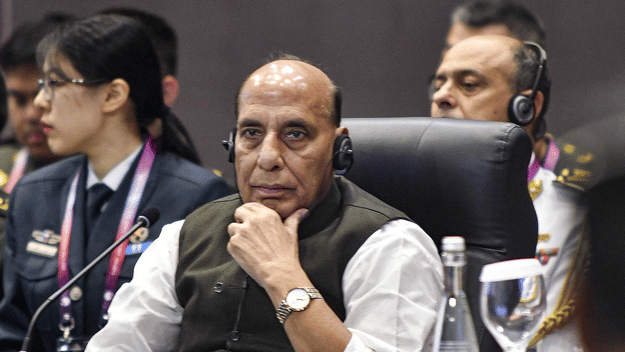
- Recently, the Defense Minister of India, Rajnath Singh, reiterated India’s commitment to the United Nations Convention on the Laws of the Sea (UNCLOS) and the freedom of navigation, overflight, and unimpeded lawful commerce in international waters.
- He also affirmed the importance of the role played by the ASEAN in promoting dialogue and consensus in the region at the ASEAN Defence Ministers Meeting-Plus (ADMM-Plus).
What has the Defense Minister stated at the ADMM-Plus?
- Freedom of navigation: India is committed towards supporting freedom of navigation, overflight, and unrestrained legal commerce in international waters.
- Freedom of navigation refers to the right of vessels of one or all states to navigate water bodies passing through two or more states under international law.
- It has been codified as Article 87(1)a of the UNCLOS.
- UN Convention on Laws of the Sea: India, which is a state party to the UNCLOS, has committed to upholding the Laws of the Sea.
- The UNCLOS stipulates a framework for the jurisdiction of the states in maritime spaces and provides the backbone for offshore governance by coastal states and those navigating the oceans.
- ASEAN: He confirmed that ASEAN held a central role in Southeast Asia and praised the body for its contributions in promoting dialogue and consensus in the region.
- ASEAN members have been active participants in India-ASEAN activities such as the initiatives related to marine plastic pollution and women in UN peacekeeping operations.
- Security collaboration: India recommended the implementation of consultative, consensus-based, and development-oriented regional security initiatives.
- India and ADMM-Plus could undertake practical and result-oriented cooperation to enhance maritime security in the Southeast Asian region.
- India will cooperate with ASEAN and Plus countries to ensure peace, prosperity, and security in the region and mitigate the worst effects of conflict such as loss of life and livelihoods, global and regional instability, and food and energy insecurity.
- The maiden ASEAN-India maritime exercise (AIME) was held in May this year.
- Counter-terrorism: India and the ASEAN and PLUS countries have recognized that terrorism is a major threat to regional and global peace and security.
- India’s proposal to co-chair the expert working group on counter-terrorism has been endorsed by ADMM-Plus.
- Humanitarian relief: India has reiterated its status as the “first responder” in the Indian Ocean Region (IOR).
- India and Indonesia are co-chairs of the ASEAN expert working group on humanitarian assistance and disaster relief activities in the 2020-2023 cycle.
What is the ADMM-Plus?
- The ASEAN Defence Ministers Meeting-Plus (ADMM-Plus) is a platform to strengthen security and defense cooperation among the ASEAN members and their dialogue partners i.e the Plus countries.
- The first ADMM-Plus session was convened in 2010 in Hanoi, Vietnam following the resolution adopted at the 2nd ASEAN Defence Ministers’ Meeting (ADMM) in Singapore (2007).
- Objectives:
- Promote mutual trust and confidence between the defense establishments of member nations through enhanced dialogue and transparency.
- Building capacity to address shared security challenges
- Enhance regional peace and stability through cooperation in defense and security
- Contribute to the realization of an ASEAN Security Community that aims to achieve peace, stability, democracy, and prosperity in the region
- Facilitate the implementation of the Vientiane Action Programme for a peaceful, secure, and prosperous ASEAN with greater outward-looking external relation strategies with its friends and dialogue partners.
- Membership:
- Ten ASEAN Member States - Indonesia, Malaysia, Philippines, Singapore, Thailand, Brunei, Vietnam, Laos, Myanmar and Cambodia
- Eight Plus countries - Australia, China, India, Japan, New Zealand, the Republic of Korea, the Russian Federation, and the United States.
- Chair in 2023: The Chairmanship of the ADMM-Plus follows that of the ADMM and ASEAN.
- The present chair is Indonesia.
- Areas of cooperation:
- Maritime security
- Counter-terrorism
- Humanitarian assistance and disaster relief
- Peacekeeping operations and military medicine.
What is the United Nations Convention on the Laws of the Sea?
- The United Nations Convention on the Law of the Sea (UNCLOS) is a peace accord that sets out rules for organizations, the climate, and the administration of marine regular assets.
- It was signed and adopted as an international treaty in 1982 and replaced the four Geneva Conventions (1958).
- The Treaty entered into force in 1994
- It is also known as the Law of the Sea Convention or the Law of the Sea Treaty which determines the freedoms and expectations of countries towards the utilization of the world's seas.
- It sets out an exhaustive system of peace and lawfulness on the planet's seas and oceans and lays out rules administering all purposes of the seas and their assets.
- Features of the Convention:
- UNCLOS provides nations full money rights for a 200-mile zone along the shoreline.
- The sea and oceanic bed extending to this area are regarded as the Exclusive Economic Zone (EEZ) of a country.
- The EEZ can be used by the country for its economic purposes.
International institutions established as a result of the Convention:
- International Tribunal for the Law of the Sea:
- It was established by the UNCLOS as an independent judicial body to adjudicate disputes arising out of the convention.
- International Seabed Authority:
- It was established in 1994 to regulate the exploration and exploitation of marine non-living resources in international waters.
- Commission on the Limits of the Continental Shelf:
- It has been established to facilitate the implementation of the UNCLOS with respect to the establishment of the outer limits of the continental shelf beyond 200 nautical miles.
To learn more, click the link.
What is ASEAN?
|
(*Click this link to read prelims specific weekly current affairs articles)
FAQs
Question: What is freedom of navigation?
Answer:
Freedom of navigation is a principle that has been defined as the freedom of movement for vessels to enter ports and make use of plants and docks, to load and unload goods, and to transport goods and passengers.
Question: What is an Exclusive Economic Zone?
Answer:
An exclusive economic zone (EEZ) is an area of the sea in which a sovereign state has special rights regarding the exploration and use of marine resources, including energy production from water and wind. It stretches from the baseline out to 200 nautical miles from the coast of the state in question.
|
UPSC Mains Practice Questions Q.1) ‘Sea is an important Component of the Cosmos’ Discuss in light of the above statement the role of the IMO (International Maritime Organisation) in protecting the environment and enhancing maritime safety and security. (UPSC GS2 2023) Q.2) With respect to the South China Sea, maritime territorial disputes and rising tension affirm the need for safeguarding maritime security to ensure freedom of navigation and overflight throughout the region. In this context, discuss the bilateral issues between India and China. (UPSC GS2 2014) |
MCQs
Question: With reference to the United Nations Convention on the Law of Sea, consider the following statements: (UPSC CSE 2022)
- A coastal state has the right to establish the breadth of its territorial sea up to a limit not exceeding 12 nautical miles, measured from baseline determined in accordance with the convention.
- Ships of all states, whether coastal or land-locked, enjoy the right of innocent passage through the territorial sea.
- The Exclusive Economic Zone shall not extend beyond 200 nautical miles from the baseline from which the breadth of the territorial sea in measure.
Which of the statements given above are correct?
(a) 1 and 2 only
(b) 2 and 3 only
(c) 1 and 3 only
(d) 1, 2 and 3
Answer: (d) See the Explanation
- According to Article 3 under Section 2 of United Nations conventions (UNCLOS) regarding the territorial limits of the sea- every state has the right to establish the breadth of its territorial sea up to a limit not exceeding 12 nautical miles, measured from baselines determined in accordance with this Convention. Hence statement 1 is correct.
- According to Article 17 under Section 3 of the United Nations Convention on the Laws of the Sea (UNCLOS) ships of all States, whether coastal or land-locked, enjoy the right of innocent passage through the territorial sea. Hence statement 2 is correct.
- The 1982 United Nations Convention on the Law of the Sea (UNCLOS) defines an Exclusive Economic Zone(EEZ). It is an area that shall not extend beyond 200 nautical miles from the baselines. The EEZ is measured from the breadth of the territorial sea. Hence statement 3 is correct.
Therefore, option (d) is the correct answer.
Question: Consider the following countries : (UPSC CSE 2018)
- Australia
- Canada
- China
- India
- Japan
- USA
Which of the above are among the 'free-trade partners' of ASEAN?
(a) 1, 2, 4 and 5
(b) 3, 4, 5 and 6
(c) 1, 3, 4 and 5
(d) 2, 3, 4 and 6
Answer: (c) See the Explanation
- The Free Trade Partners of the Association of Southeast Asian Nations (ASEAN) are:
- People’s Republic of China
- Republic of Korea
- Japan
- India
- Australia
- New Zealand
- Canada and the USA are not free trade partners of the ASEAN.
Therefore, option (c) is the correct answer.
Download the PREPP App and attempt FREE IAS Exam Mock Tests and get complete study material!

Full Test - 04: UPSC CSE Prelims CSAT (Paper-II)
Full Test - 03: UPSC CSE Prelims CSAT (Paper-II)
UPSC CSE Prelims 2026 GS Paper 1 Question Paper (24-May-2026)
UPSC CSE Prelims 2026 CSAT Paper 2 Question Paper (24-May-2026)

17 February 2025 | The Hindu Must Read Articles | Current Affairs

16 February 2026 | The Hindu Must Read Articles | Current Affairs

13 February 2026 | The Hindu Must Read Articles | Current Affairs









Comments