Understanding Temperature Anomalies
Relevance: GS1 - Important Geophysical phenomena such as earthquakes, Tsunami, Volcanic activity, cyclones etc., geographical features and their location changes in critical geographical features (including water-bodies and ice-caps) and in flora and fauna and the effects of such changes; GS3 - Environment
(Source: The Hindu, 04/26/2023)
Click here for Daily Current Affairs
Why in the news?
In this article, Raghu Murtugudde, a visiting professor at IIT Bombay and an emeritus professor at the University of Maryland has discussed how March 2023 was the second warmest month on record and what this truly means in terms of influence on the globe, local weather, and the human psychology.
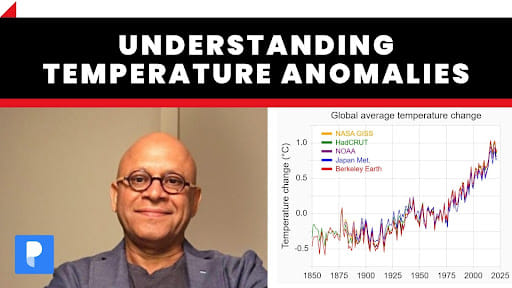
What is a temperature anomaly?
- Temperature anomaly refers to the difference between the average temperature of a specific time period (usually 30 years) and the temperature at a specific location and time. This difference is often used as an indicator of global warming and climate change.
- Climate scientists use temperature anomalies to study changes in Earth's temperature over time. They calculate the temperature anomaly by comparing the temperature of a given month or year to the long-term average temperature for that month or year. If the temperature is higher than the average, it is a positive temperature anomaly, while if it is lower, it is a negative temperature anomaly.
- Positive temperature anomalies can indicate warming trends in a particular region or globally, while negative temperature anomalies can indicate cooling trends. Temperature anomalies are usually expressed in degrees Celsius or Fahrenheit.
Variability in Climate
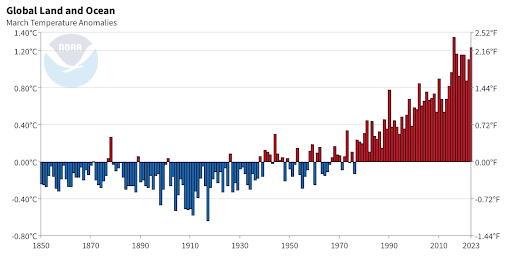
- March 2023 was the second hottest month on record.
- The warmest March occurred just a few years ago, in 2016, when the largest El Nino of the twenty-first century sparked a 'mini' global warming.
- However, the average temperature anomaly from January to March in 2023 ranks as the fourth highest on record.
- In India, we anticipate the start of the sweltering summer season in March. However, a specific year's March may be colder owing to other climate conditions, such as a La Nina, especially when averaged over a wide territory such as India or even an Indian state.
- An 'El Nino year' occurs when warmer water sweeps over the equatorial Pacific Ocean in a belt from west to east.
- During a 'La Nina year,' colder water travels east to west in the same region.
- Both phenomena have different and profound influences on the global climate.
El Nino
La Nina
|
Temperature Anomalies for March 2023
- The map of temperature anomalies shows the distribution of temperature departures from the baseline long-term average March temperature for March 2023.
- The tremendous warming to the west and north of India begins to tell the narrative of meteorological anomalies that resulted in a milder March over Mumbai, excessive pre-monsoon rains over the northwest, and scorching heat waves in Kerala and Odisha.
- The Arabian Sea has also warmed more than predicted this March. If this persists, it may favor a larger monsoon but may also boost cyclogenesis (the birth of cyclonic circulation) over the Arabian Sea.
- The worldwide distribution of temperature anomalies is caused by land-ocean-atmosphere systems that dynamically influence weather and climate.
- Global warming does not entail that each month or year will be warmer than the preceding month or year.
- The distribution of temperature anomalies for March 2023 is driven by a mix of global warming and natural variability such as El Nino and La Nina.
Significant impact on planet
- Environmental and Ecological changes: Rising temperatures can lead to a range of environmental and ecological changes, including melting of polar ice caps, rising sea levels, ocean acidification, changes in precipitation patterns, and increased frequency and intensity of extreme weather events.
- These changes can have far-reaching consequences for ecosystems, biodiversity, and the human societies that depend on them.
- Loss of habitat for species: The melting of polar ice caps and rising sea levels, can lead to loss of habitat for species that rely on these areas for survival.
- Coastal Erosion: It can also cause coastal erosion and flooding, which can have significant impacts on infrastructure, economies, and communities.
- Changes in precipitation patterns can lead to droughts in some regions, while causing flooding in others, leading to agricultural losses, water shortages, and increased risks of disease outbreaks.
- The increased frequency and intensity of extreme weather events can also have major consequences, including property damage, loss of life, and disruptions to transportation, energy systems, and other critical infrastructure.
Conclusion
The impacts are not limited to any one region of the world, but are likely to be felt globally. Thus, it is crucial that we take steps to mitigate the effects of climate change and address the underlying causes of these changes. While year-to-year temperatures may be higher or lower than the previous year, due to natural climatic variability, each decade is currently warmer than the preceding one on a global scale. Climate scientists need to provide the proper context, when comparing and ranking particular months. This will help the general public better grasp global warming and its cascading consequences on the weather they encounter every day.
(*Click tsshis link to read prelims specific weekly current affairs articles)
FAQs
Question: What is El Nino?
Answer:
El Nino is a weather phenomenon that describes the anomalous warming of surface waters in the eastern tropical Pacific Ocean.
Question: What is La Nina?
Answer:
It is the reverse phenomenon of El-Nino. The temperatures over the eastern Pacific Ocean decrease, along with a decrease in rainfall.
Question: What is a temperature anomaly?
Answer:
Temperature anomaly refers to the difference between the average temperature of a specific time period (usually 30 years) and the temperature at a specific location and time. This difference is often used as an indicator of global warming and climate change.
MCQ
Question: La Nina is suspected to have caused recent floods in Australia. How is La Nina different from El Nino? (UPSC 2011)
- La Nina is characterized by unusually cold ocean temperature in the equatorial Indian Ocean whereas El Nino is characterized by unusually warm ocean temperatures in the Equatorial Pacific Ocean.
- El Nino has an adverse effect on the southwest monsoon of India, but Na Nina has no effect on the monsoon climate.
Which of the statements given above is/are correct?
(a) 1 only
(b) 2 only
(c) Both 1 and 2
(d) Neither 1 nor 2
Answer: (d) See the Explanation
- Both La Nina and El Nino are linked with the Pacific Ocean.
- El Nino is caused by the rise of warm water in the Equatorial region of the Pacific Ocean.
- La Nina is characterized by unusually cold ocean temperatures in the Equatorial Pacific, compared to the El Nino which is characterized by unusually warm ocean temperatures in the Equatorial Pacific
- La Nina has an impact on the Indian monsoon. It is linked with excessive rains during the monsoon season.
Therefore, option (d) is the correct answer.
Download the PREPP App and attempt FREE IAS Exam Mock Tests and get complete study material!

Full Test - 04: UPSC CSE Prelims CSAT (Paper-II)
Full Test - 03: UPSC CSE Prelims CSAT (Paper-II)
UPSC CSE Prelims 2026 GS Paper 1 Question Paper (24-May-2026)
UPSC CSE Prelims 2026 CSAT Paper 2 Question Paper (24-May-2026)

17 February 2025 | The Hindu Must Read Articles | Current Affairs

16 February 2026 | The Hindu Must Read Articles | Current Affairs

13 February 2026 | The Hindu Must Read Articles | Current Affairs









Comments