T.N. Moves SC Against Governor Ravi Over Delay in Clearing Bills
Primary Source: The Hindu
Click here for Daily Current Affairs
Prepp Prelims Booster: Centre-State Relations, Role of Governor
Prepp Mains Booster: Functions and Responsibilities of the Union and the States, Issues and Challenges Pertaining to the Federal Structure, Centre-State Relations
Why in the news?
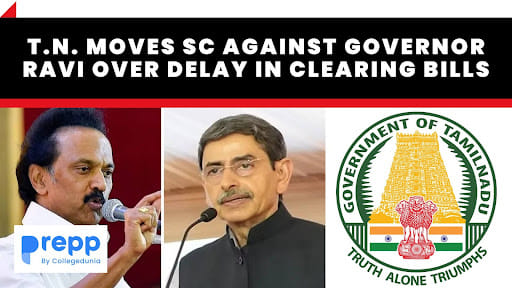
- The Tamil Nadu government has filed a writ petition in the Supreme Court against the Governor of Tamil Nadu, R.N. Ravi, accusing him of creating a constitutional crisis by not assenting to Bills passed by the state legislature and hindering the day-to-day governance of the state.
- The government alleges that the Governor's inaction has led to an administrative standstill and has positioned himself as a political opponent to the elected state government.
Table of Contents
What are the Allegations Against the Governor?
- Creating a Constitutional Deadlock: By not promptly considering and giving assent to Bills passed by the Tamil Nadu Legislative Assembly, the Governor is accused of creating a deadlock that disrupts the function of the state government.
- Stymieing Governance: The Governor's delay or failure to act on various government functions is alleged to be impeding day-to-day governance, which could potentially bring the state's administration to a standstill.
- Acting as a Political Rival: The Governor is accused of positioning himself as an adversary to the legitimately elected state government rather than fulfilling his constitutional role as a neutral figure.
- Withholding Assent and Approvals: He is alleged to have not signed remission orders, day-to-day files, appointment orders, and approvals for recruiting, which are essential for the functioning of the state administration.
- Blocking Corruption Investigations: The Governor is accused of failing to grant approval to prosecute Ministers and MLAs involved in corruption and has also reportedly not sanctioned the transfer of investigations to the Central Bureau of Investigation (CBI) as directed by the Supreme Court.
- Non-Cooperation with State Administration: The Governor is claimed to be creating an adversarial attitude by not cooperating with the state administration, particularly in appointments to the Tamil Nadu Public Service Commission (TNPSC).
What are the Demands of the State?
- Declaration of Governor's Actions as Illegal: The state has requested the Supreme Court to declare the inaction, omission, delay, and failure to comply with constitutional mandates by the Governor as illegal and arbitrary.
- Imposition of a Deadline: The state has sought an order from the court to fix a deadline or an "outer time limit" for the Governor to consider and act on the Bills and government orders that are pending with his office.
- Resolution of Appointment Delays: The state has pointed out specific delays, such as the pending appointments of the Chairman and members of the Tamil Nadu Public Service Commission (TNPSC), and is seeking intervention for these appointments to be carried out.
- Sanction for Prosecution in Corruption Cases: The state is demanding that the Governor grant sanction for prosecution and investigation into cases of corruption involving public servants, which he has reportedly failed to do.
Important Constitution Provisions
- Article 154: It vests the executive power of the state in the Governor and allows him or her to exercise it directly or through officers subordinate to him.
- Article 163: This article states that the Governor shall act on the aid and advice of the Council of Ministers with the Chief Minister at the head in the exercise of his functions, except in so far as he is by or under the Constitution required to exercise his functions or any of them in his discretion.
- Article 166: It deals with the conduct of business of the Government of a State and provides that orders and other instruments made and executed in the name of the Governor shall be authenticated in such a manner as may be specified in rules to be made by the Governor.
- Article 200: It gives the Governor the power to assent to a bill, withhold assent, or return the bill (if it is not a money bill) with a request for reconsideration. It does not prescribe any time limit for the Governor to act on the bills presented.
- Article 213: This allows the Governor to promulgate ordinances during recess of the legislature, which have the same force and effect as laws enacted by the legislature.
- Judicial Reviews and Writ Petition: The judiciary has the power to review the actions of the Governor if they are challenged as being unconstitutional through writ petitions under Article 32 of the Constitution for violations of fundamental rights, or Article 226 for any other rights.
Important SC Judgements
|
What are Roles and Responsibilities of the Governor?
- The Governor in the Indian political system is the constitutional head of a state, similar to the President who is the constitutional head of the Republic of India.
- Appointed by the President, the Governor’s roles and responsibilities encompass various dimensions – executive, legislative, and judicial, among others.
- The Governor’s role is largely of a ceremonial head at the state level but with important duties and responsibilities that can have significant implications for state administration, particularly in situations where the use of discretionary power is called upon.
| Executive Powers |
|
| Legislative Powers |
|
| Financial Powers |
|
| Judicial Powers |
|
| Discretionary Powers |
|
| Emergency Powers |
|
| Other Functions |
|
| Fifth Schedule and Sixth Schedule Powers |
|
Conclusion
The Tamil Nadu government seeks intervention from the Supreme Court to resolve this constitutional crisis. The government's plea to the Supreme Court aims to end the standoff and restore smooth administration in the state.
(*Click this link to read prelims specific weekly current affairs articles)
FAQs
Question: What are the executive powers of a Governor?
Answer:
The executive powers of a governor are:
- The Governor appoints the Chief Minister and, on the advice of the Chief Minister, appoints the members of the Council of Ministers.
- They can appoint the State Election Commissioner and also the Chairman and members of the State Public Service Commission.
- They are responsible for making important appointments in the state like the Advocate General and the Vice-Chancellors of state universities.
Question: What are the Fifth Schedule and Sixth Schedule Powers of a Governor?
Answer:
The Governor has special responsibilities under the Fifth Schedule for the administration of scheduled areas and tribal areas.
In states with Sixth Schedule areas, the Governor has a unique role where they have the discretion to organize and re-organize the autonomous districts.
UPSC Mains Practice Question:
|
MCQs
Question: Consider the following statements: (UPSC 2023)
Statement-I: In India, prisons are managed by State Governments with their own rules and regulations for the day-to-day administration of prisons.
Statement-II: In India, prisons are governed by the Prisons Act, 1894 which expressly kept the subject of prisons in the control of Provincial Governments.
Which one of the following is correct in respect of the above statements?
(a) Both Statement-I and Statement-II are correct and Statement-II is the correct explanation for Statement-I
(b) Both Statement-I and Statement-II are correct and Statement-II is not the correct explanation for Statement-I
(c) Statement-I is correct but Statement-II is incorrect
(d) Statement-I is incorrect but Statement-II is correct
Answer: (b) See the Explanation
According to the articles of the Indian Constitution, 'prisons'/'persons confined inside' are a 'State' subject.
The obligation for jail management and administration rests completely with state governments, which are the only ones with the authority to enact suitable legislative provisions in this regard. As a result, states have the primary role, obligation, and authority to amend existing jail laws, rules, and regulations. Hence, statement 1 is correct.
The Prisons Act of 1894 was the first piece of law in India that supervised the management and administration of prisons. It defined a "prison" as "any jail or place used permanently or temporarily for the detention of prisoners under the general or special orders of a State Government," excluding police custody and subsidiary jails. Hence, statement 2 is correct.
Therefore, option (b) is the correct answer.
Question: Which one of the following suggested that the Governor should be an eminent person from outside the State and should be a detached figure without intense political links or should not have taken part in politics in the recent past? (UPSC 2019)
(a) First Administrative Reforms Commission (1966)
(b) Rajamannar Committee (1969)
(c) Sarkaria Commission (1983)
(d) National Commission to Review the Working of the Constitution (2000)
Answer: (c) See the Explanation
The Sarkaria Commission made suggestions for Governor selection. In June 1983, the Union Government established a commission headed by Justice R.S. Sarkaria to examine the issue of center-state relations. On October 27, 1987, the commission delivered its report to then-prime minister Rajiv Gandhi.
Therefore, option (c) is the correct answer.
Question: Which of the following are the discretionary powers given to the Governor of a State? (UPSC 2014)
- Sending a report to the President of India for imposing the President’s rule
- Appointing the Ministers
- Reserving certain bills passed by the State Legislature for consideration of the President of India
- Making the rules to conduct the business of the State Government
Select the correct answer using the code given below.
(a) 1 and 2 only
(b) 1 and 3 only
(c) 2, 3 and 4 only
(d) 1, 2, 3 and 4
Answer: (b) See the Explanation
The Governor has the same responsibilities as the President, but for the State. The Governor has the following discretionary powers:
- He/she has the authority to select a candidate for chief minister when no party has a clear majority.
- He/she might refuse to sign a bill and instead send it to the President for approval. Certain bills passed by the State Legislature can be reserved for consideration by the President of India. Hence, statement 3 is correct.
- He/she has the authority to disregard the opinion of the council of ministers if the President expressly authorizes it under Article 353.
- Article 356 further stipulates that the President may call President control in a state based on the governor's report. Hence, statement 1 is correct.
- According to Article 164, the Governor appoints the Chief Minister and other Ministers, as well as the Advocate General for the State. However, this does not fall under the purview of discretionary authority.
Therefore, option (b) is the correct answer.
Download the PREPP App and attempt FREE IAS Exam Mock Tests and get complete study material!

Full Test - 04: UPSC CSE Prelims CSAT (Paper-II)
Full Test - 03: UPSC CSE Prelims CSAT (Paper-II)
UPSC CSE Prelims 2026 GS Paper 1 Question Paper (24-May-2026)
UPSC CSE Prelims 2026 CSAT Paper 2 Question Paper (24-May-2026)

17 February 2025 | The Hindu Must Read Articles | Current Affairs

16 February 2026 | The Hindu Must Read Articles | Current Affairs

13 February 2026 | The Hindu Must Read Articles | Current Affairs









Comments