Though Not Elected, Judges Have Vital Role To Play In Evolution Of Societies: CJI
Relevance: Prelims; GS2 - Indian Constitution; Judiciary; Governance
(Source: The Hindu, 25/10/2023)
Click here for Daily Current Affairs
Why in the news?
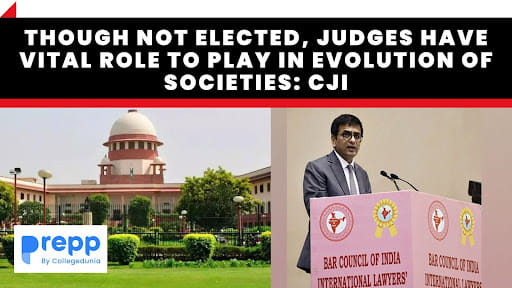
- Recently, Chief Justice of India D.Y. Chandrachud, addressed criticism about judges venturing into the executive's domain during 3rd Comparative Constitutional Law discussion co-hosted by the Georgetown University Law Center, Washington and the Society for Democratic Rights (SDR), New Delhi, titled 'Perspectives from the Supreme Courts of India and the United States.'
- He stressed that judges, despite being unelected, play a vital role in stabilizing rapidly changing societies due to technology.
Table of Contents
Key Highlights of the Conference
- The Chief Justice of India highlighted the evolving role of courts as central hubs for civil society engagement and social transformation.
- People now turn to the courts not solely for specific legal outcomes but also to contribute to constitutional change and advocacy.
- He emphasized that judges bear a fundamental duty to address historical discrimination through the peaceful means of the constitution, facilitating societal transformation.
- The Chief Justice also noted the global challenge of the rule of law yielding to violence in many societies. Judges play a crucial role in upholding stability by using the constitution and their platform to foster dialogue, reason, and deliberation.
- The Indian Constitution's core values of fraternity, equality, brotherhood, and unity among citizens were underscored.
- Furthermore, the CJI justified a recent judgment, wherein the court refrained from interfering with the Special Marriage Act and deferred the decision on marriage equality for queer couples to the parliament.
About the Judicial System in India
- The judicial system in India is organized into three levels: the Supreme Court, the High Court, and the Subordinate Courts.
- The Judiciary is an essential part of the government, and under a Constitution that guarantees separation of powers between the centre and the state as well as an independent Judicial System, the job of the Judiciary becomes even more vital.
What is the function of the Judiciary?
- Provide Justice: The first and foremost function of the judiciary is to give justice to the people, whenever they may approach it. It awards punishment to those who after trial are found guilty of violating the laws of the state or the rights of the people.
- Safeguard the Rights of People: The judiciary has the supreme responsibility to safeguard the rights of the people. A citizen has the right to seek the protection of the judiciary in case his rights are violated or threatened to be violated by the government or by private organizations or fellow citizens.
- Constitution's Guardian: India's highest court, the Supreme Court, serves as the Constitution's guardian. The court resolves questions of jurisdiction between the federal government and state governments, as well as between the legislature and the executive branch. The judiciary declares any statute or executive order that breaches any section of the constitution invalid or null and void.
- Advisory functions: In India, the SC also serves as an advisor. It has the authority to issue advisory opinions on constitutional issues. When there are no conflicts and the executive wishes it, this is done.
Role of Judges in India's Judiciary
- Adjudication: Judges are primarily responsible for adjudicating legal disputes and ensuring that justice is served. They interpret and apply the law to resolve disputes between parties, whether they are individuals, organizations, or the government.
- Upholding the Constitution: Judges play a crucial role in upholding the Constitution of India. They have the authority to review and strike down laws or government actions that are found to be in violation of the constitutional principles.
- Interpreting Laws: Judges are responsible for interpreting statutes, legal precedents, and legal principles to make decisions in cases. They provide clarity on how the law should be applied in specific situations.
- Protecting Fundamental Rights: Judges safeguard the fundamental rights of citizens by ensuring that laws and government actions do not infringe upon these rights. They can issue writs like Habeas Corpus and Mandamus to protect individual liberties.
- Ensuring Fair Trials: Judges are responsible for ensuring that trials are conducted fairly, impartially, and in accordance with due process. They make decisions on issues like evidence admissibility, witnesses, and trial procedures.
- Judicial Review: Judges have the power of judicial review, which allows them to examine the constitutionality of laws and government actions. This is a crucial check and balance in the Indian system of government.
- Promoting Access to Justice: Judges work to ensure that justice is accessible to all, regardless of their background, by interpreting the law in a manner that promotes equity and fairness.
Important Judgements which has played a vital role in Evolution of Societies
- Same Sex Marraige: Recently, the Supreme Court has ruled against legalising same sex marriage in India. It was stated tha marriage, according to the court, is an institution set up under law and same-sex couples do not have a right to participate in it unless the law permits them to do so.
- Vishaka and State of Rajasthan (1997): This case dealt with sexual harassment at the workplace. In the judgement, the SC gave a set of guidelines for employers as well as other responsible persons or institutions, to immediately ensure the prevention of sexual harassment.
- Nirbhaya Case (2014): This case let to the introduction of Criminal Law (Amendment) Act, 2013 and definition of rape under the Protection of Children from Sexual Offences Act, 2012, the Indian Evidence Act, 1872, Indian Penal Code, 1860 and Code of Criminal Procedures, 1973.
- Triple Talaq Judgement (2016): The SC outlawed the backward practice of instant ‘triple talaq’, which permitted Muslim men to unilaterally end their marriages by uttering the word “talaq” three times without making any provision for maintenance or alimony.
- Lily Thomas vs Union of India (2000): The Supreme Court held that the second marriage of a Hindu man without divorcing the first wife, even if the man had converted to Islam, is void unless the first marriage had been dissolved according to the Hindu Marriage Act.
Appointment of Supreme Court Judges
Appointment of High Court Judges
Constitutional Provisions for Appointment of Judges
|
(*Click this link to read prelims specific weekly current affairs articles)
FAQs
Question: What is the judicial system in India?
Answer:
The Indian judicial system is a single integrated system. The Constitution of India divides the Indian judiciary into superior judiciary (the Supreme Court and the High Courts) and the subordinate judiciary (the lower courts under the control of the High Courts).
Question: Question: Who appoints the Judges of the Supreme Court?
Answer:
According to Article 124 of the Indian constitution, the President with the consultation of the Chief Justice of India can appoint the judges of the Supreme Court.
Question: What is article 217 ?
Answer:
Article 217 of the Constitution of India provides the appointment and conditions of the office of a judge of a High Court.
UPSC Mains Practice Question:
|
MCQ
Question: Who/Which of the following is the custodian of the Constitution of India? (UPSC 2015)
(a) The President of India
(b) The Prime Minister of India
(c) The Lok Sabha Secretariat
(d) The Supreme Court of India
Answer: (d) See the Explanation
The Supreme Court of India is the custodian of the Constitution of India.
Therefore, option (d) is the correct answer.
Download the PREPP App and attempt FREE IAS Exam Mock Tests and get complete study material!

Full Test - 04: UPSC CSE Prelims CSAT (Paper-II)
Full Test - 03: UPSC CSE Prelims CSAT (Paper-II)
UPSC CSE Prelims 2026 GS Paper 1 Question Paper (24-May-2026)
UPSC CSE Prelims 2026 CSAT Paper 2 Question Paper (24-May-2026)

17 February 2025 | The Hindu Must Read Articles | Current Affairs

16 February 2026 | The Hindu Must Read Articles | Current Affairs

13 February 2026 | The Hindu Must Read Articles | Current Affairs









Comments