Thirty Meter Telescope (TMT) – Science & Technology Notes
The Thirty Metre Telescope (TMT) is a one-of-a-kind project to build one of the world's most advanced large telescopes. The project is the result of an international collaboration between India, Canada, China, Japan, and US research institutes. When fully operational, it will aid in the discovery of previously unknown and even unexpected details about our vast Universe. In this article, we will discuss in detail regarding Thirty Meter Telescope which will be helpful for UPSC exam preparation.
Table of Contents
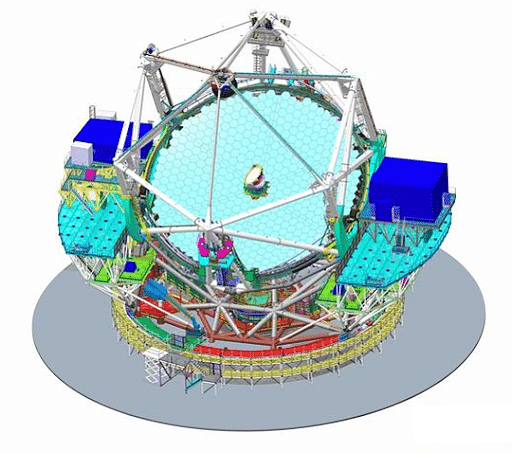
Illustration of Thirty Meter Telescope
What is a Thirty Meter Telescope?
- The Thirty Metre Telescope is part of a new generation of extremely large telescopes that will allow us to see deeper into space and observe cosmic objects with unprecedented sensitivity and detail.
- Its 30m diameter prime-mirror will allow it to observe wavelengths ranging from ultraviolet to mid-infrared with up to 80 times the sensitivity of today's largest telescopes.
- Modern adaptive optics systems will compensate for the blurring effects of the Earth's atmosphere, delivering images at infrared wavelengths more than 12 times sharper than the famed Hubble Space Telescope and four times sharper than JWST.
- TMT will enable astronomers to address fundamental questions in astronomy ranging from understanding star and planet formation to unravelling the history of galaxies and the development of large-scale structure in the universe by observing in wavelengths ranging from the ultraviolet to the mid-infrared.
- The Thirty-Meter Telescope (TMT) project is a collaboration of the United States, Canada, Japan, China, and India.
- TIO's vision is to revolutionise our understanding of our universe while also advancing programmes that support astronomy and education in a way that is culturally and environmentally responsible.
Controversy around Site Location – Mauna Kea, Hawaii
|
| Other Relevant Links | |
|---|---|
| Space Organisations | Space race/Space junk |
| South Asia Satellite: Significance | Solar Mission- ADITYA |
| Spitzer Space Telescope | Chandra X-Ray Observatory |
| Multi Application Solar Telescope | Resourcesat-2A |
| Astrosat | Sunspot |
| Magnetars | Neutron stars |
| Air-breathing propulsion system | Space Junk |
| Graveyard Orbit | Supercluster of galaxies known as “Saraswati” |
Who is building TMT?
- TMT International Observatory LLC (TIO) is designing and developing the Thirty Metre Telescope.
- TIO is a non-profit international collaboration between the following:
- California Institute of Technology
- University of California
- National Institutes of Natural Sciences, Japan
- National Astronomical Observatories, China
- Department of Science and Technology, India
- National Research Council, Canada
- The Association of Universities for Research in Astronomy (AURA) is a TIO Associate, and the Gordon and Betty Moore Foundation has provided significant funding for TMT.
Significance of TMT
TMT will be a one-of-a-kind tool for probing many outstanding astronomical open questions.
- It will research into exoplanetary systems, including their formation, evolution, and interconnections, in order to answer questions like "Is there life outside our solar system?" "What can other planetary systems tell us about our own?"
- It will connect the new frontiers of gravitational wave detection, time domain astronomy, and cutting-edge telescopes to answer fundamental physics and cosmology questions like the basic properties of matter.
- It will help in decoding the interconnections of gas, stars, and black holes in galaxies that shape the galaxies' evolving life cycle.
- The Thirty Metre Telescope International Observatory (TIO) aims to advance scientific knowledge while connecting partner countries and their citizens, who account for more than half of the world's population.
- TMT is expected to revolutionise many research topics that the Subaru Telescope and other telescopes have begun, such as the search for the farthest galaxies and the first stars in the early Universe, efficient spectroscopic observation of many galaxies and stars, and direct imaging and spectroscopic observation of extrasolar planets.
Challenges related to TMT
- Even before it was completed, the $2 billion project was met with protests and challenges.
- Although the Supreme Court of Hawaii approved the telescope's construction in 2018, progress was hampered twice: once before the court's decision in 2015 and again after the decision in 2019.
- In 2019, the scientists at the site were granted access to Mauna Kea's other telescope facilities.
- The project is already five years behind schedule.
- The project's delay has also had an impact on manufacturing and production.
- With the problems with TMT installation and construction on Mauna Kea, finding another suitable site for its construction is a further impediment to the project.
India and TMT
- India is proposing to contribute $200 million to the project, which is roughly one-tenth of the total cost.
- On this project, the Department of Atomic Energy and the Department of Science and Technology will collaborate.
- The TMT project also includes the Inter-University Centre for Astronomy and Astrophysics in Pune, the Indian Institute of Astrophysics in Bangalore, and the Aryabhatta Research Institute of Observational Sciences in Nainital.
- Indian organisations will design the telescope censors, actuators, and mechanical support structure.
- In addition, 492 mirrors will be added to the telescope, with India contributing 83 of them.
Conclusion
The Thirty Metre Telescope, which aims to advance scientific knowledge while fostering connections between partner countries and their citizens, is expected to provide facilities with even greater capabilities for gathering observations required to answer new and emerging questions in astronomy and physics in general.
| Other Relevant Links | |
|---|---|
| Science & Technology Policy in India | Scientific Policy Resolution 1958 |
| Science & Technology Policy of 1983 | Science & Technology Policy of 2003 |
| Science, Technology and Innovation Policy 2013 | New Initiatives Aligned with the National Agenda |
| India and World collaboration in science projects | Technology Vision Document 2035 |
FAQs
Question: What is the purpose of the Thirty Meter Telescope (TMT)?
Answer: The TMT is designed to provide unprecedented views of the universe by observing celestial objects in great detail, facilitating breakthroughs in astronomy and astrophysics.
Question: Where is the Thirty Meter Telescope (TMT) being constructed?
Answer: The TMT is being constructed at Mauna Kea, a dormant volcano in Hawaii, chosen for its clear skies and minimal light pollution.
Question: Why is the construction of TMT controversial?
Answer: The construction is controversial due to its location on Mauna Kea, which is a sacred site to Native Hawaiians, leading to protests from local communities.
Question: What is the key technological advancement of the TMT?
Answer: The key advancement is its large aperture (30 meters), which allows it to capture more light, making it one of the most powerful optical and infrared telescopes ever built.
Question: How will the TMT contribute to the field of astronomy?
Answer: The TMT will enable detailed observation of distant galaxies, exoplanets, and other celestial bodies, advancing our understanding of the universe's origins and evolution.
MCQs
1. What is the primary scientific goal of the Thirty Meter Telescope (TMT)?
A) To improve communication technology
B) To study distant celestial objects
C) To monitor climate change
D) To observe solar activities
Answer: (B) See the Explanation
Explanation: The primary goal of the TMT is to study distant celestial objects with unprecedented detail, which will lead to advancements in our understanding of the universe.
2. Where is the Thirty Meter Telescope (TMT) being built?
A) Arizona, USA
B) Mauna Kea, Hawaii
C) Chile
D) Antarctica
Answer: (B) See the Explanation
Explanation: The TMT is being built on Mauna Kea in Hawaii, a location chosen for its favorable conditions for astronomical observation.
3. What makes the TMT technologically advanced compared to other telescopes?
A) Its ability to capture infrared signals
B) Its 30-meter diameter, allowing for more light gathering
C) Its ability to operate on a global network
D) Its ability to measure gravitational waves
Answer: (B) See the Explanation
Explanation: The TMT's 30-meter diameter allows it to capture more light, making it one of the most advanced telescopes in the world in terms of optical and infrared observation.
4. What is a major environmental concern related to the construction of TMT?
A) Destruction of coral reefs
B) Pollution of groundwater
C) Disruption of Mauna Kea's ecosystem and sacred status
D) Increase in air traffic
Answer: (C) See the Explanation
Explanation: The construction of the TMT has raised concerns due to its location on Mauna Kea, which is a sacred site for Native Hawaiians and an environmentally sensitive area.
5. Which of the following is a scientific field that will benefit from the TMT?
A) Geology
B) Astrophysics
C) Oceanography
D) Meteorology
Answer: (B) See the Explanation
Explanation: The TMT will primarily benefit the field of astrophysics by enabling deeper observations of distant galaxies, exoplanets, and the overall structure of the universe.
GS Mains Questions and Model Answers
Q1: Discuss the significance of the Thirty Meter Telescope (TMT) for the field of astronomy and its global implications.
Answer: The Thirty Meter Telescope (TMT) represents a leap forward in optical and infrared astronomy. Its large aperture, at 30 meters, allows for far greater resolution and sensitivity than current telescopes. It will provide unprecedented views of distant galaxies, black holes, and exoplanets. This will revolutionize our understanding of the universe’s formation and the conditions for life beyond Earth. The TMT is also expected to contribute to the global scientific community by collaborating with other observatories, expanding our knowledge of space, and providing new insights into fundamental questions in cosmology and astrophysics.
Q2: What are the environmental and cultural challenges faced by the construction of the Thirty Meter Telescope (TMT) at Mauna Kea, Hawaii?
Answer: The TMT construction at Mauna Kea has sparked controversy due to both environmental and cultural concerns. Mauna Kea is a sacred site for Native Hawaiians, and many protest the desecration of this land for a scientific facility. Furthermore, the region is an ecologically sensitive area, with unique flora and fauna that could be impacted by construction. These issues have led to widespread protests, legal challenges, and debates on the balance between scientific progress and cultural preservation. The controversy underscores the need for respectful engagement with indigenous communities and sustainable development practices.
Q3: Analyze the technological advancements that the Thirty Meter Telescope (TMT) brings to modern astronomy.
Answer: The TMT is a major technological advancement in modern astronomy, primarily due to its large aperture (30 meters), which significantly increases its light-gathering power. This allows the telescope to capture more detailed images of distant objects, including exoplanets and galaxies far beyond the reach of previous telescopes. Additionally, the TMT will use advanced adaptive optics, which compensate for the Earth's atmospheric distortion, producing clearer images. The combination of these technologies positions the TMT as one of the most powerful ground-based telescopes, enabling breakthroughs in our understanding of the universe, from studying the formation of stars to exploring the possibility of life on exoplanets.
Previous Year Questions on Thirty Meter Telescope (TMT)
1. UPSC CSE Prelims 2018:
Question: The Thirty Meter Telescope (TMT) is proposed to be constructed at which of the following locations?
A) Mauna Kea, Hawaii
B) Canary Islands
C) Mount Everest, Nepal
D) Atacama Desert, Chile
Answer: (A)
Explanation: The TMT is proposed to be constructed at Mauna Kea, Hawaii, due to its clear skies and minimal light pollution, making it an ideal location for astronomical observations.
2. UPSC CSE Prelims 2020:
Question: What is the primary objective of the Thirty Meter Telescope (TMT)?
A) To monitor the Sun's activity
B) To observe distant stars and galaxies
C) To track meteorological changes
D) To detect space debris
Answer: (B)
Explanation: The primary objective of the TMT is to observe distant stars, galaxies, and other celestial objects with unprecedented clarity, which will help further our understanding of the universe.
Download the PREPP App and attempt FREE IAS Exam Mock Tests and get complete study material!

Full Test - 04: UPSC CSE Prelims CSAT (Paper-II)
Full Test - 03: UPSC CSE Prelims CSAT (Paper-II)
UPSC CSE Prelims 2026 GS Paper 1 Question Paper (24-May-2026)
UPSC CSE Prelims 2026 CSAT Paper 2 Question Paper (24-May-2026)

17 February 2025 | The Hindu Must Read Articles | Current Affairs

16 February 2026 | The Hindu Must Read Articles | Current Affairs

13 February 2026 | The Hindu Must Read Articles | Current Affairs









Comments