The Stance of the Maldives President-elect on India
Primary Source: The Hindu
Click here for Daily Current Affairs
Prepp Prelims Booster: India-Maldives Relations
Prepp Mains Booster: Bilateral, Regional and Global Groupings and Agreements involving India and/or affecting India’s interests
Why in the news?
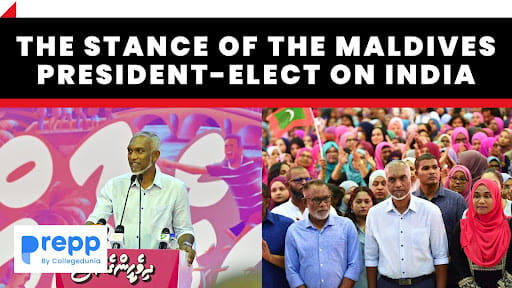
- Mohamed Muizzu, the President-elect of the Maldives, has declared his intention to remove Indian troops from the country, highlighting a commitment to national sovereignty.
- The article discusses the existing Indian military presence in the Maldives and the reasons behind Muizzu's stance.
Table of Contents
Indian Military in the Maldives
- The Maldives hosts 75 Indian military personnel for the operation of aircraft and helicopters gifted by India for various critical operations.
- These military assets have been in the Maldives since before President Ibrahim Mohamed Solih’s term and were intended for non-military assistance such as medical evacuations and search and rescue.
Why is Muizzu Opposed to Indian Military Presence?
- Sovereignty Concerns: Muizzu has expressed a strong desire to safeguard Maldivian independence and sovereignty, which he believes is compromised by the presence of foreign troops on Maldivian soil, including those of India.
- Pre-election Commitments: He campaigned on an ‘India Out’ platform, which was part of the main opposition bloc’s stance against the outgoing President Ibrahim Mohamed Solih's 'India first' policy.
- Geopolitical Alignments: The political camp Muizzu represents, which includes his former boss President Abdulla Yameen, has historically had a pro-China tilt. During Yameen's administration, the Maldives-India relations were strained, and there was a preference for stronger ties with China.
- Media and Public Perception: The international media’s portrayal of the Maldives' elections as a referendum on India-China influence has put additional pressure on Muizzu to affirm his stance on this geopolitical rivalry, thereby demonstrating his commitment to a foreign policy that does not overly rely on India.
- Demonstrating Consistency: By reiterating his position on the removal of Indian military presence, Muizzu can show consistency with his political narrative and campaign promises, which is important for maintaining the trust of his supporters.
- Balancing Foreign Relations: Muizzu has voiced that while he appreciates the benefits of foreign assistance, particularly from China, he would not favor military presence from any country, aiming for a balanced approach to international relations.
‘India First’ Policy
‘India Out’ Policy
|
Economic Challenges and Debt Crisis of Maldives
- High Levels of External Debt: The Maldives has incurred significant external debt, which includes loans taken for infrastructure projects and development initiatives.
- Repayment Schedule: The Maldives is preparing to service approximately $570 million annually in 2024 and 2025 for its external debt obligations. In 2026, the debt service requirement will peak at a record $1.07 billion, as reported by the World Bank.
- Dependence on Tourism: The economy of the Maldives is heavily reliant on tourism, which is susceptible to global economic trends and external shocks such as pandemics or natural disasters.
- Global Economic Conditions: Fluctuating global economic conditions, including changes in interest rates and investment flows, can affect the Maldives’ economic stability, especially given its small, open economy that is integrated into global markets.
- Chinese Loans and Investments: A significant portion of the Maldives' external debt is owed to China, accrued from investments in infrastructure projects.
What is India’s Strategic Interest in Maldives?
- Maritime Security: The Maldives is situated in the central Indian Ocean, along major sea lanes of communication. Ensuring the security of these lanes is critical for India’s trade and energy routes.
- Regional Influence: India aims to maintain its preeminent position in South Asia and the Indian Ocean Region.
- Counter-Chinese Presence: China's increasing economic and political influence in the Maldives, part of its broader Belt and Road Initiative, is viewed by India as a strategic encroachment in its traditional sphere of influence.
- Economic Investments: India has committed $1.4 billion towards socio-economic development in the Maldives, reflecting an interest in the economic stability and prosperity of the island nation, which in turn contributes to regional stability.
- Diplomatic Leverage: Maintaining a significant role in the Maldives' affairs provides India with diplomatic leverage in multilateral forums, such as the United Nations, where small island states can influence voting and regional groupings.
- People-to-People Ties: The Maldives is home to a number of Indian expatriates, and there are strong cultural and people-to-people ties between the two countries.
- Environment and Climate Change: As a low-lying island nation, the Maldives is susceptible to the impacts of climate change—a concern that India shares.
- 'Colombo Security Conclave': India, along with the Maldives and other regional partners, is a member of the Colombo Security Conclave, which is focused on maritime cooperation.
- This conclave is crucial for collective security aspirations, indicating the strategic importance of the Maldives in India’s vision for regional security architecture.
Significance of India-Maldives Relationship
Security
- India and the Maldives are both located in the Indo-Pacific region.
- Stability in the Maldives is crucial for regional security and for the protection of India’s regional interests.
- India acts as the first line of defense for the Maldives against maritime threats such as piracy, terrorism, trafficking, narcotics, etc.
Economic
- Maldives' location places it between important international shipping lanes between the Gulf of Aden and Gulf of Hormuz in West Asia and the Strait of Malacca in Southeast Asia that handle vital commodities including energy.
- Additionally, its close proximity to India makes it significant to the success of India’s blue economy policy.
Multilateralism
- India and Maldives are aligned on various global issues including issues faced by countries of the Global South.
- The two countries are also members of multilateral forums like the Commonwealth and NAM.
Trade and Tourism
- In 2021, India-Maldives bilateral trade exceeded $300 million.
- India is a significant source of tourism for the Maldives (12% in 2023), which is a major contributor to the island nation’s economic growth.
- Maldives also contributes a significant part of India’s revenues from medical tourism.
- In March 2022, India & Maldives agreed to an open skies arrangement which will further improve connectivity between the two countries.
- Maldives is the first nation with which India has set up an Air Travel Bubble, which will facilitate the movement of people from both countries for employment, tourism, medical emergencies, etc.
Challenges in India-Maldives Relationship
Political Instability
- The Maldives has regularly suffered from political instability. As a result, India has had to adopt a cautious approach as part of its neighbourhood policy in order to balance its aspirations of regional stability and democracy.
India Out
- In 2020, the Maldivian opposition launched protests with the theme “India Out” against the MoU on maritime security between India and Maldives to construct a Coast Guard harbour base at the Uthuru Thilafalhu atoll.
- Although construction was inaugurated in 2023, it has been impacted by the India Out protests.
- The protests also opposed the helicopters loaned by India and the presence of the Indian troops to operate them.
- China has opposed Indian presence in the Maldives and expressed support for the India Out campaign which will allow it to expand its security and defense influence in the crucial IOR region.
Radicalization
- India has expressed concern over the increasing radicalization of the Maldives by extremist groups like ISIS.
- The political upheaval and socioeconomic crisis in the Maldives is a major security concern for the Maldives and the Indo-Pacific region as a whole, including India.
China’s Influence
- China's geopolitical aggressiveness in the South Asian region has seen it attempt to expand its strategic footprint in South Asia in the Maldives through initiatives like the String of Pearls and the Maritime Silk Route.
- India has also expressed concerns about the development of China-controlled ports and military facilities in Indian Ocean region countries like Sri Lanka, Pakistan, and Maldives which is a major challenge to India’s strategic interests and regional security.
- Maldives' foreign policy has shifted from its traditional pro-India stance to a China-friendly policy, creating apprehensions in the neighbourhood about growing Chinese influence.
- China’s policy of interference in internal politics as well as its support to conservative elements in the Maldives and its debt trap strategy which India fears could lead to Chinese hegemony in the Maldives.
- The India-Out approach which is likely to be adopted by the new President-Elect of the Maldives is another major concern for India.
Way Forward
- Diplomatic Engagement: Continued high-level diplomatic engagement between India and the Maldives is essential.
- Economic Cooperation: India could offer more investments and economic aid to the Maldives, which would help with the latter's debt servicing and infrastructure development, while also enhancing India's influence.
- Security Collaboration: India and the Maldives should continue their collaboration on security matters, including maritime security, counter-terrorism, and anti-piracy operations, through joint exercises and information sharing.
- Addressing Geopolitical Concerns: India should address any Maldivian concerns regarding the presence of its military personnel in a transparent manner, ensuring that such a presence is aligned with Maldivian sovereignty and consent.
- Multilateral Cooperation: Working together in regional and international forums like SAARC, the United Nations, and the Indian Ocean Rim Association (IORA) to promote shared interests and stability in the region.
- Leverage the Colombo Security Conclave: Utilize this platform to enhance maritime cooperation, intelligence sharing, and humanitarian assistance and disaster relief (HADR).
Conclusion
The actual foreign policy decisions of President-elect Muizzu will only become clear once he assumes office. Muizzu will need to navigate the geopolitical intricacies and the impending economic challenges while honoring his electoral promises and maintaining necessary international relations.
(*Click this link to read prelims specific weekly current affairs articles)
FAQs
Question: What is ‘India Out’ Policy?
Answer:
The 'India Out' policy refers to a political campaign and sentiment in the Maldives that calls for the removal of Indian military presence and influence from the country. This perspective is often expressed by certain political factions within the Maldives who are concerned about India's growing footprint in the archipelago, especially in terms of security and military cooperation.
Question: What is medical tourism?
Answer:
Medical tourism or medical value travel (MVT) is the practice of traveling across international borders to seek medical services including elective or complex surgeries. According to the NITI Aayog, the Indian economy could earn an additional $9 billion by 2026 from MVT and wellness tourism.
Question: What is ‘Colombo Security Conclave’?
Answer:
The ‘Colombo Security Conclave’ is a maritime cooperation initiative that includes the Maldives, India, Sri Lanka, and Mauritius. The Conclave signifies the shared security interests within the region, highlighting the strategic importance of the Indian Ocean and the collective security aspirations of the member countries.
UPSC Mains Practice Question:
|
MCQs
Question: As per the Human Development Index given by UNDP, which one of the following sequences of South Asian countries is correct, in the order of higher to lower development? (UPSC 2003)
(a) India–Sri Lanka–Pakistan–Maldives
(b) Maldives–Sri Lanka–India–Pakistan
(c) Sri Lanka–Maldives–India–Pakistan
(d) Maldives–India–Pakistan–Sri Lanka
Answer: (b) See the Explanation
As per the Human Development Index given by UNDP, in 2003, the Maldives was ranked 84th, Sri Lanka 89th, India 124th, and Pakistan 138th.
At present Maldives is ranked 90th, Sri Lanka is 73rd, India is 132nd, and Pakistan 161st.
Therefore, option (b) is the correct answer.
Question: The ‘Colombo Security Conclave’ is significant because it:
(a) Demonstrates the Maldives' alignment with China's military objectives.
(b) Is a military alliance against India's regional interests.
(c) Reflects the intertwined security interests of regional countries including India, Sri Lanka, and the Maldives.
(d) Is a trade agreement between the Maldives and India.
Answer: (c) See the Explanation
The ‘Colombo Security Conclave’ is a maritime cooperation initiative that includes the Maldives, India, Sri Lanka, and Mauritius. It is not an anti-India military alliance, nor is it a trade agreement. The Conclave signifies the shared security interests within the region, highlighting the strategic importance of the Indian Ocean and the collective security aspirations of the member countries.
Therefore, option (c) is the correct answer.
Download the PREPP App and attempt FREE IAS Exam Mock Tests and get complete study material!

Full Test - 04: UPSC CSE Prelims CSAT (Paper-II)
Full Test - 03: UPSC CSE Prelims CSAT (Paper-II)
UPSC CSE Prelims 2026 GS Paper 1 Question Paper (24-May-2026)
UPSC CSE Prelims 2026 CSAT Paper 2 Question Paper (24-May-2026)

17 February 2025 | The Hindu Must Read Articles | Current Affairs

16 February 2026 | The Hindu Must Read Articles | Current Affairs

13 February 2026 | The Hindu Must Read Articles | Current Affairs









Comments