The Other Oil Imports India Needs To Worry About
Relevance: GS3 - Indian Economy and issues relating to planning, mobilization, of resources, growth, development and employment, Food processing and related industries in India- scope’ and significance, location, upstream and downstream requirements, supply chain management. GS2 - Government policies and interventions for development in various sectors and issues arising out of their design and implementation.
(Source: Indian Express, 11/20/2023)
Click here for Daily Current Affairs
Why in the news?
- This article discusses the trends in the production and import of edible oils by India and how the import of edible oils can impact the Indian economy.
- Edible oils have experienced significant price volatility over the past 2-3 years due to various global events, making it necessary for the concerned authorities to adopt steps to promote the domestic production of edible oils.
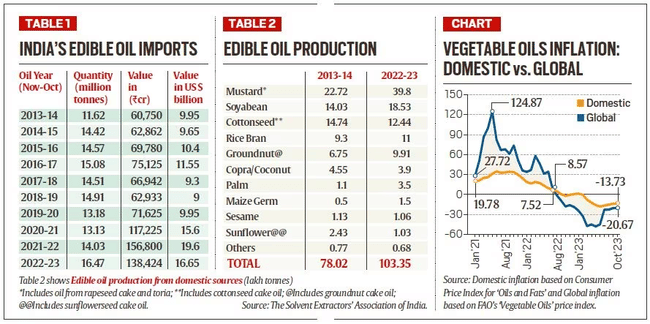
Trends in edible oil imports and production in India
Imports
- Over the last ten years, India’s edible oil imports have increased by 1.5 times while the value of the imports has doubled in rupee terms in the same period.
- According to the Solvent Extractors Association of India, the imports of vegetable oils grew to 16.5 million tonnes (mt) by October 2023 from 14 mt in the 2021-22 oil year.
- However, the value of imports fell in both dollar (from $19.6 billion to $16.7 billion) and rupee (Rs 156,800 crore to Rs 138,424 crore) terms due to the fall in global prices.
- Between 2012-14 and 2022-23, Indian edible oil imports have risen from 11.6 mt to 16.5 mt.
- Edible oil imports in 2022-23 consisted of:
- Palm: 9.8 mt from Indonesia, Malaysia, and Thailand
- Soyabean: 3.7 mt from Argentina, and Brazil
- Sunflower: 3 mt from Russia, Ukraine, and Argentina
- The majority of imports are crude oils which are shipped in tankers and processed in giant refineries. Refining consists of
- De-gumming i.e. removing gums, waxes, and other impurities
- Neutralization i.e. removing free fatty acids
- Bleaching i.e. removing color
- De-odourisation i.e. removing volatile compounds
- Import of edible oils is under Open General License (OGL). In order to harmonize the interests of farmers, processors, and consumers, the Government reviews the duty structure of edible oils from time to time.
Production
- In 2022-23, domestic production accounted for just 38.6% of the total availability of edible oils in India (26.8 mt).
- Edible oil produced from domestically grown oilseeds and other alternatives such as cottonseed, rice bran, and maize was around 10.3 mt.
- In 2004-05, domestic output (7 mt) exceeded imports (5 mt).
- This meant that India had a self-sufficiency ratio of around 60% in edible oils.
- In the previous year, the availability of edible oils exceeded actual consumption requirements of 24-25 mt.
- According to estimates, availability is estimated to reach 30-32 mt by 2029-30.
- However, this could mean imports rising beyond 20mt if efforts are not undertaken to boost domestic production.
- In such a situation, India’s self-sufficiency ratio could drop to lower than 33%.
India’s edible oil profile
- Mustard and soybean are the two largest contributors to India’s edible oil production followed by cottonseed and rice bran.
- Cotton:
- The kapas or raw un-ginned cotton harvested by farmers contains 36% lint, 62% seed, and 2% waste.
- Cottonseed contains around 13% oil.
- As a result of Bt technology (GM), yields have increased leading to higher production of cottonseed oil from 0.5 mt to 1.5 mt between 2002-03 and 2013-14.
- However, with the recent drop in cotton output and yield due to the diminishing effectiveness of Bt technology and the arrival of new pests, oil production has dropped to 1.25 mt in 2022-23.
- Rice bran: There has been an increase in the production of bran and germ from rice and maize due to the increased output of the two crops over the last ten years.
- Oilseeds:
- Mustard: Mustard accounts for 39% of the total oil production in the country with production expected to grow by 4.3% (CAGR) between 2023 and 2028.
- Groundnut: Although groundnut oil production has grown, the majority of it is used for exports or direct consumption leaving less for oil extraction.
- Other oilseeds: There has been a decline in the domestic output of coconut, sesame, sunflower, and safflower with cheaper imported oils available.
Why are the rising imports of edible oils a concern?
- India’s high dependence on imports to meet its edible oil demand makes it susceptible to international price fluctuations.
- In India, inflation in edible oils has been consistent with global inflation despite being less volatile than the latter.
- The vegetable oils price index of the UN Food and Agriculture Organization grew from 98.7 points (August 2020) to 251.8 points (March 2022).
- However, in the aftermath of the Russian invasion of Ukraine in March 2022, the index fulled to 120 points by October 2023.
- This has led to the landed prices of imported oils dropping from $1,828 to $910 per tonne for crude palm and from $2,125 to $1,005 for sunflower since March 2022.
- As a result, retail edible oil inflation in India has been negative since February 2023.
Way forward
- Increased domestic production of edible oils will help protect Indian farmers from global price volatility.
- Introduction of technology: Farmers must be encouraged to adopt new forms of technology in the production of edible oils.
- This can include the introduction of GM hybrids and other varieties of crops that are amenable to herbicide application.
- Tariffs: The government can support farmers by providing price support in terms of procurement or tariff policy.
- However, farmers are not sufficiently incentivized to switch towards oilseed or pulse cultivation as minimum support price (MSP)-based procurement is available only for wheat and paddy
National Mission on Edible Oils
|
Conclusion
- India's escalating reliance on edible oil imports, coupled with global price volatility, poses a substantial economic risk. To mitigate this vulnerability, concerted efforts are imperative, encompassing technological advancements in oilseed cultivation, incentivizing farmers through supportive policies, and fortifying domestic production. Proactive measures are indispensable to safeguard against international market fluctuations and bolster India's self-sufficiency in edible oils.
(*Click this link to read prelims specific weekly current affairs articles)
FAQs
Question: What is the ginning of cotton?
Answer:
The process of separating fibers from the seeds of cotton is called ginning of cotton. Ginning can be performed either using hands or machines.
Question: What is the UN FAO?
Answer:
The UN Food and Agriculture Organization (UN FAO) is a specialized agency of the UN that leads international efforts to defeat hunger. It is headquartered in Rome with the World Food Programme and the International Fund for Agricultural Development (IFAD).
|
UPSC Mains Practice Questions Q.1) Explain the changes in cropping patterns in India in the context of changes in consumption patterns and marketing conditions. (UPSC GS3 2023) Q.2) What are the present challenges before crop diversification? How do emerging technologies provide an opportunity for crop diversification? (UPSC GS3 2021) Q.3) How can biotechnology help to improve the living standards of farmers? (UPSC GS3 2019) |
MCQs
Question: Consider the following statements: (UPSC CSE 2018)
- The quantity of imported edible oils is more than the domestic production of edible oils in the last five years.
- The Government does not impose any customs duty on all imported edible oils as a special case.
Which of the statements given above is/are correct?
(a) 1 only
(b) 2 only
(c) Both 1 and 2
(d) Neither 1 nor 2
Answer: (a) See the Explanation
- India contributes around 10% of worldwide production of global oilseed production. However, the demand for edible oils is significantly higher than the domestic production, leading to dependence on imports. Hence statement 1 is correct.
- The government imposes customs duty on edible oils to safeguard the interests of the domestic oil-crushing industry. Hence statement 2 is not correct.
Therefore, option (a) is the correct answer.
Question: Other than resistance to pests, what are the prospects for which genetically engineered plants have been created?
- To enable them to withstand drought.
- To increase the nutritive value of the produce.
- To enable them to grow and do photosynthesis in spaceships and space stations.
- To increase their shelf life
Select the correct answer using the codes given below: (UPSC CSE 2012)
- 1 and 2 only
- 3 and 4 only
- 1, 2 and 4 only
- 1, 2, 3 and 4
Answer: (b) See the Explanation
- Genetically modified crops (GM crops) are plants whose DNA have been modified using genetic engineering methods with the aim of introducing a new trait to the plant which does not occur naturally in the species.
- Some potential applications of GM crop technology are:
- Stress Tolerance – Tolerance to high and low temperatures, salinity, and drought. Hence statement 1 is correct.
- Nutritional enhancement – Higher vitamin content; more healthful fatty acid profiles. Hence statement 2 is correct.
- There is no such prospect that enables GM crops to grow and do photosynthesis in spaceships and space stations. Hence statement 3 is incorrect.
- Scientists have been able to create certain genetically modified crops that stay fresh for a month longer than usual. Hence statement 4 is correct.
Therefore, option (c) is the correct answer.
Question: With reference to the cultivation of Kharif crops in India in the last five years, consider the following statements:
- Area under rice cultivation is the highest.
- Area under the cultivation of jowar is more than that of oilseeds.
- Area of cotton cultivation is more than that of sugarcane.
- Area under sugarcane cultivation has steadily decreased.
Which of the statements given above are correct? (UPSC CSE 2019)
- 1 and 3 only
- 2, 3 and 4 only
- 2 and 4 only
- 1, 2, 3 and 4
Answer: (a) See the Explanation
- The area under rice crop was 43.86 million hectares during 2014-15. While the area under wheat was around 30 Million hectares in 2017-18. Hence statement 1 is correct.
- Area under cultivation of Jowar is 5.14 million hectares in 2016-17 while that under oilseed was 26.21 million hectares in 2016-17. Hence statement 2 is incorrect.
- The area under cotton cultivation in India is 10.85 million hectares. Hence statement 3 is correct.
- Area under Sugarcane has increased in India from 4.42 million hectares in 2008-09 to 5.04 million hectares in 2012-13 to 4.39 million hectares in 2016-17. Hence statement 4 is incorrect.
Therefore, option (a) is the correct answer.
Download the PREPP App and attempt FREE IAS Exam Mock Tests and get complete study material!

Full Test - 04: UPSC CSE Prelims CSAT (Paper-II)
Full Test - 03: UPSC CSE Prelims CSAT (Paper-II)
UPSC CSE Prelims 2026 GS Paper 1 Question Paper (24-May-2026)
UPSC CSE Prelims 2026 CSAT Paper 2 Question Paper (24-May-2026)

17 February 2025 | The Hindu Must Read Articles | Current Affairs

16 February 2026 | The Hindu Must Read Articles | Current Affairs

13 February 2026 | The Hindu Must Read Articles | Current Affairs









Comments