The New Flare Up in Myanmar
(Source: Indian Express, 11/18/2023)
Click here for Daily Current Affairs
Why in the news?
- Recently, the Ministry of External Affairs expressed deep concern over the ongoing conflict in Myanmar's Chin State, near India's border in Mizoram.
What is the ongoing conflict exactly?
- On October 27,2023, Offensive surprise operations were carried out by anti-military rebel forces in the areas of Shan state of North Myanmar. This was named Operation 1027.
- Rebel group initiating the attacks was the Three Brotherhood Alliance comprising the Myanmar National Democratic Alliance Army (MNDAA), Ta'ang National Liberation Army, and Arakan Army.
- Attacks were carried out on several police posts and Chinshwehaw, which lies on the China-Myanmar border, which is an important trade point and source of revenue for the Myanmar junta.
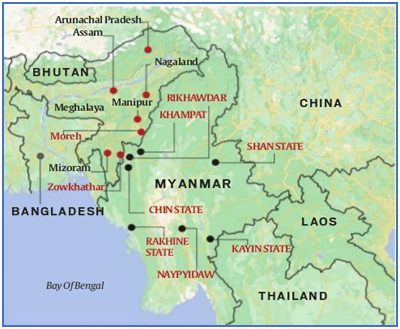
Current developments:
- Operation 1027
- Initiated on October 27 by the Three Brotherhood Alliance (MNDAA, Ta’ang National Liberation Army, and Arakan Army) in Shan State, North Myanmar.
- Seized control of crucial border towns and checkpoints, including Chinshwehaw, which is a critical point on the China-Myanmar border trade route, and a significant revenue source for the junta.
- Rebels advancing towards Laukkai, the capital of Shan state’s Kokang region, active for more than three decades.
- Local resistance forces leading conflicts in various parts of Myanmar:
- Rakhine State in West Myanmar.
- Kayin State in South-East Myanmar.
- Sagaing region in North West Myanmar bordering Manipur.
- Chin State in West Myanmar bordering Mizoram.
How current development is different from earlier:
- Unprecedented coordination among the Three Brotherhood Alliance (MNDAA, Ta’ang National Liberation Army, and Arakan Army), led to successful operations and the capture of extensive territory.
- Economic impact: Rebels' capture of crucial border towns, including Chinshwehaw on the China-Myanmar border trade route, directly impacts the junta's revenue.
- Widespread fighting in various regions, including Rakhine, Kayin, Sagaing, and Chin States, challenges the junta's authority on multiple fronts from the earlier localized conflicts.
- Infuriated China: An incident on October 20, where guards at a Kokang Border Guard Force (BGF) compound killed multiple Chinese and Thai individuals, allegedly including undercover Chinese police, led to China's strong disapproval and anger.
- Weakening position of Myanmar military:With failure to control the rebellion despite prolonged fights including air strikes, military and police personnels are allegedly surrendering to the Chin rebel groups.
Background: Myanmar conflict
|
India-Myanmar relation:
- Geopolitical Crossroads:
- It is the only Southeast Asian country sharing both a land border (1,624 km) with northeastern India and a maritime boundary (725 km) in the Bay of Bengal.
- India’s foreign policy goals:
- Myanmar, being the intersection of India's "Neighborhood First" and "Look East" policies, serves as a crucial element in India's regional diplomacy in the Indo-Pacific.
- Land Bridge between South Asia and Southeast Asia:
- Myanmar acts as a land bridge, connecting South Asia and Southeast Asia, contributing to regional connectivity and engagement.
- India’s Soft power:
- "5 B's" - Buddhism, Business, Bollywood, Bharatnatyam, and Burma teak often indicative of India-Myanmar relations.
- Countering cheque book diplomacy of China:
- Development of Sittwe port in Rakhine state as part of India’s SAGAR vision.
- This further extends to Kaladan Multimodal project connecting Kolkata port with Myanmar’s Sittwe Port by sea, Sittwe to Paletwa via river Kaladan, Paletwa to the border of India, and Myanmar via road and further ahead to Lawngtlai, Mizoram by road.
- International groupings:
- Recognizing its significance, Myanmar was granted observer status in SAARC in August 2008.
- Myanmar is also important to India's strategy in BIMSTEC, ASEAN, and Mekong Ganga Cooperation.
- Defence cooperation:
- India-Myanmar Bilateral Army Exercise (IMBAX) enhances military relations.
- India-Myanmar also carry out collaborative efforts to address insurgency in India's northeast, emphasizing regional security.
Impact of recent conflict on India:
- Delicate Diplomacy:
- India maintains a delicate balance, expressing concern for the democratic interruption in Myanmar while engaging with the junta to protect vital interests.
- It poses a challenge to India’s Look East policy.
- Refugee Influx:
- An immediate concern for India is the influx of Myanmarese nationals into Northeast border states, especially Mizoram, amid ongoing volatility in Manipur.
- Border Towns Capture:
- Anti-junta forces capturing key towns near the only two border crossing points with India, namely Rikhawdar in Mizoram and Khampat in Sagaing, raises security concerns and impacts regional stability.
- Strategic Infrastructure:
- The capture of Khampat, located around 60 km from Moreh in Manipur, is significant as it is part of the proposed India-Myanmar-Thailand trilateral highway project, affecting India's strategic infrastructure plans.
Conclusion:
- The recent flare-up in Myanmar, marked by Operation 1027 and unprecedented coordination among rebel groups, poses significant challenges for the junta and has direct implications for India's diplomatic, security, and strategic interests. China's disapproval further complicates the dynamics. It poses a challenge not only for India but for the whole global geopolitics.
(*Click this link to read prelims specific weekly current affairs articles)
FAQs
Question: What is Operation 1027 in Myanmar?
Answer:
Operation 1027, initiated on October 27 by the Three Brotherhood Alliance (MNDAA, Ta’ang National Liberation Army, and Arakan Army), involved surprise attacks in Shan State, capturing extensive territory.
Question: What is the historical background of the Myanmar conflict?
Answer:
Myanmar gained independence in 1948 and transitioned from military rule in 2011. The 2021 military coup disrupted the democratic progress initiated in 2015, leading to a series of critical issues, including the Rohingya crisis.
Question: What is the Look East policy?
Answer:
In order to recoup from the loss of the strategic partner, the USSR, after the end of the Cold War in 1991, India sought to strengthen ties with the United States and its Southeast Asian allies.
In this pursuit, former Prime Minister of India P V Narasimha Rao introduced the Look East policy in 1992 to give India's involvement with South-East Asia a strategic boost.
|
UPSC Mains Practice Questions Q.1) How does illegal transborder migration pose a threat to India’s security? Discuss the strategies to curb this, bringing out the factors which give impetus to such migration. (UPSC GS2 2014) |
MCQs
Question: Consider the following pairs Community sometimes in the affairs of mentioned in the news :
- Kurd : Bangladesh
- Madhesi : Nepal
- Rohingya : Myanmar
Which of the pairs given above is/are correctly matched? (UPSC CSE 2016)
(a) Only 1 and 2
(b) Only 2
(c) Only 2 and 3
(d) Only 3
Answer: (c) See the Explanation
- Kurds are an ethnic group primarily located in the Middle East, spanning across eastern and southeastern Turkey, western Iran, northern Iraq, and northern Syria. They are not associated with Bangladesh, which is a country in South Asia. Therefore 1 is incorrectly matched.
- The Madhesi people are an ethnic group living in the southern Terai region of Nepal, near the border with India. They have been in the news due to issues related to representation and rights in Nepal.Therefore 2 is correctly matched.
- The Rohingya people are a minority ethnic group in Myanmar, particularly in the western state of Rakhine. They have faced significant humanitarian challenges and have been in the news due to displacement and refugee crises.Therefore 3 is correctly matched.
Therefore, option (c) is the correct answer.
Download the PREPP App and attempt FREE IAS Exam Mock Tests and get complete study material!

Full Test - 04: UPSC CSE Prelims CSAT (Paper-II)
Full Test - 03: UPSC CSE Prelims CSAT (Paper-II)
UPSC CSE Prelims 2026 GS Paper 1 Question Paper (24-May-2026)
UPSC CSE Prelims 2026 CSAT Paper 2 Question Paper (24-May-2026)

17 February 2025 | The Hindu Must Read Articles | Current Affairs

16 February 2026 | The Hindu Must Read Articles | Current Affairs

13 February 2026 | The Hindu Must Read Articles | Current Affairs









Comments