The Massive Displacement in Congo
Primary Source: The Hindu
Click here for Daily Current Affairs
Why in the news?
- The UN International Organization for Migration (IOM) has reported around 6.9 million internally displaced people in the Democratic Republic of Congo (DRC).
- Nearly a million have been displaced in North Kivu due to conflicts with the M23 rebel group.
Table of Contents
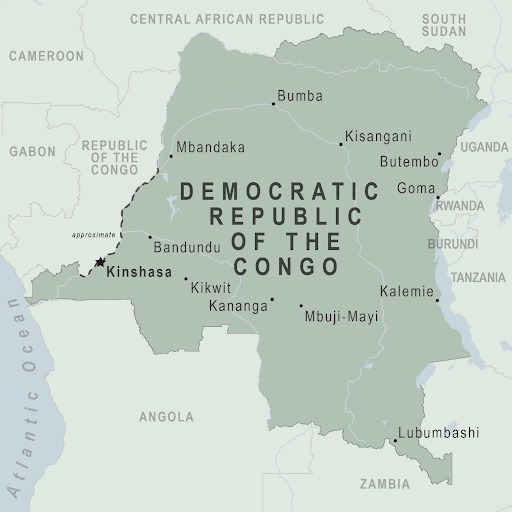
Democratic Republic of Congo (DRC) – Location
- The Democratic Republic of the Congo (DRC) is located in Central Africa.
- It is the second-largest country in Africa by area and the largest in Sub-Saharan Africa.
- The DRC is bordered by nine different countries:
- To the north, it is bordered by the Central African Republic and South Sudan.
- To the east, it shares borders with Uganda, Rwanda, Burundi, and Tanzania (across Lake Tanganyika).
- To the south, it is bordered by Zambia and Angola.
- To the west, it has a short coastline on the Atlantic Ocean and is bordered by the Republic of the Congo.
UN International Organization for Migration
|
Historical Background of the Conflict
- The conflict in the Democratic Republic of Congo (DRC) has its origins in two civil wars that occurred in the 1990s, specifically in 1996 and 1998.
- The aftermath of the Rwandan genocide in 1994, where ethnic Hutu extremists killed around a million Tutsis and moderate Hutus, heavily influenced the instability in the region.
- Since the genocide, the eastern region of the DRC, which borders Rwanda, has been plagued by insurgency and violence carried out by numerous militant groups.
- The violence in the eastern provinces has been characterized by battles over territory and natural resources, extrajudicial killings by security forces, and escalating tensions with neighboring countries.
- The DRC and Rwanda have accused each other of backing opposing rebel factions, with DRC claiming Rwanda supports the ethnic Tutsi-led M23, and Rwanda alleging DRC supports Hutu-led rebel groups.
Current Conflict Dynamics
- M23 Movement: The conflict dynamics in the DRC have been exacerbated by the resurgence of the M23 movement, which is a Tutsi-led rebel group. This group has intensified its military campaign, launching frequent attacks and seizing control of towns in the eastern provinces since November 2021.
- Ceasefire Failure: Attempts at establishing peace, including a ceasefire mediated between the DRC and Rwanda in November 2022, have failed. The M23 rebel group declared non-compliance with the ceasefire agreement.
- East African Force and UN Peacekeeping: Peacekeeping efforts, including the deployment of the East African Force and the UN peacekeeping forces, have not been successful in achieving their objectives, which included overseeing the withdrawal of rebel groups.
- Advancement of Rebels: The M23 has continued to advance in the region since January 2023, gaining more territory and contributing to the instability and displacement of populations.
- Regional Tensions: The conflict is also fueled by tensions with neighboring countries, particularly Rwanda, with mutual accusations of support for rebel factions adding to the regional complexities.
Major Actors in the Conflict
- M23 Rebel Group: The Mouvement du 23 Mars (M23) is a primarily Tutsi rebel group that has been active in the eastern DRC and is one of the primary sources of the current conflict.
- Allied Democratic Forces (ADF): Originating from Uganda, this Islamist rebel group has been operating in the eastern DRC since the late 1990s and declared allegiance to the Islamic State in 2019.
- Cooperative for Development of the Congo (CODECO): An armed group claiming to protect the Lendu ethnic group's interests against the Hema community and the Congolese army.
- Rwandan Government: Accused by the DRC of supporting the M23 rebels, which Rwanda denies, insisting that the DRC supports Hutu militias.
- Congolese Government: Led by President Felix Tshisekedi, it has faced accusations from Rwanda of supporting anti-Rwandan Hutu militias.
- East African Community (EAC): A regional bloc that has attempted to intervene in the conflict by deploying troops from member countries like Kenya, South Sudan, Burundi, and Uganda.
- United Nations Peacekeeping Forces: Deployed in the DRC to maintain peace and security, their effectiveness has been questioned in light of ongoing conflict and protests against their presence.
- Protesters and Civil Society: Local populations and civil society organizations that have protested against both regional and international forces for their perceived failure to quell the insurgency.
Causes of Displacement
- Ethnic Intolerance and Insurgency: After the Rwandan genocide, Hutu refugees formed militias in the DRC, leading to reprisals by Tutsi militias. This ongoing cycle of ethnic-based militia violence has resulted in significant displacement.
- Multiple Rebel Groups and Violence: The presence of various armed groups, each with its own agenda, has led to widespread killings, sexual violence, and human rights abuses, forcing people to flee their homes for safety.
- Political Uncertainty: The political landscape in the DRC has been unstable, with elections often bringing more turmoil. The peripheral areas are particularly affected, where ethnic chiefdoms and local grievances are not inclusively addressed, leading to conflicts and displacement.
- Regional Tensions: The involvement of neighboring countries, either through direct intervention or support for different militias, has added to the instability and forced populations to move to avoid the conflict zones.
- Humanitarian Crisis: The violence has resulted in a massive humanitarian crisis, with people lacking food, shelter, and basic services, further driving displacement.
- International Response: The perceived inadequacy of the international community's response, coupled with insufficient funding for humanitarian assistance, exacerbates the situation, leaving the displaced with few options for support.
Way Forward
- Political Dialogue: Encouraging inclusive dialogue between the government, rebel groups, and community leaders to address grievances and find political solutions.
- Strengthen Governance: Improving governance and state authority across the country, particularly in peripheral regions, to address issues of representation and local governance.
- Regional Cooperation: Engaging with neighboring countries to reduce regional tensions and end the cycle of supporting proxy militias.
- Security Sector Reform: Reforming the security forces to ensure they protect civilians and are not involved in human rights abuses, which can exacerbate conflict.
- Humanitarian Assistance: Increasing international humanitarian aid and ensuring it reaches the affected populations, while also addressing the root causes of food insecurity.
- Development Programs: Implementing long-term development programs to create sustainable livelihoods, which can mitigate the appeal of joining armed groups.
- Accountability for Atrocities: Ensuring accountability for war crimes and human rights abuses as a deterrent against future violations.
- UN and International Involvement: Strengthening the mandate and presence of UN peacekeeping forces to effectively protect civilians and support the implementation of peace agreements.
- Support for Elections: Providing support for free, fair, and secure elections to ensure the peaceful transfer of power and reflect the will of the Congolese people.
Conclusion
The situation in the DRC is a complex mix of ethnic tension, political instability, and regional geopolitics leading to a severe humanitarian crisis. There is a critical need for more robust international engagement and support to address the displacement and humanitarian issues in the DRC.
(*Click this link to read prelims specific weekly current affairs articles)
FAQs
Question: Where is Democratic Republic of Congo (DRC) located?
Answer:
The Democratic Republic of the Congo (DRC) is located in Central Africa. It is the second-largest country in Africa by area and the largest in Sub-Saharan Africa.
Question: How did the conflict in Democratic Republic of Congo (DRC) start?
Answer:
The conflict in the Democratic Republic of Congo (DRC) has its origins in two civil wars that occurred in the 1990s, specifically in 1996 and 1998. The aftermath of the Rwandan genocide in 1994, where ethnic Hutu extremists killed around a million Tutsis and moderate Hutus, heavily influenced the instability in the region.
Question: What is UN International Organization for Migration (IOM)?
Answer:
The UN International Organization for Migration (IOM) is an intergovernmental organization that provides services and advice concerning migration to governments and migrants, including internally displaced persons, refugees, and migrant workers.
MCQs
Question: Which of the following is/are the neighbouring countries of Democratic Republic of Congo (DRC)?
1) Zambia
2) Angola
3) Cameroon
4) Burundi
Select the correct option from below:
(a) Only one
(b) Only two
(c) Only three
(d) All four
Answer: (c) See the Explanation
The DRC is bordered by nine different countries:
- To the north, it is bordered by the Central African Republic and South Sudan.
- To the east, it shares borders with Uganda, Rwanda, Burundi, and Tanzania (across Lake Tanganyika).
- To the south, it is bordered by Zambia and Angola.
- To the west, it has a short coastline on the Atlantic Ocean and is bordered by the Republic of the Congo.
Therefore, option (c) is the correct answer.
Question: Which factor has been a primary contributor to the displacement crisis in the DRC?
(a) The economic downturn in Sub-Saharan Africa.
(b) Ethnic intolerance and insurgency following the Rwandan genocide.
(c) Climate change-induced natural disasters.
(d) Industrial expansion in rural areas.
Answer: (b) See the Explanation
The displacement crisis in the DRC is mainly due to ongoing ethnic and inter-ethnic tensions that trace back to the Rwandan genocide, leading to the formation of militias and rebel groups that have perpetrated violence and human rights abuses.
Therefore, option (b) is the correct answer.
Download the PREPP App and attempt FREE IAS Exam Mock Tests and get complete study material!

Full Test - 04: UPSC CSE Prelims CSAT (Paper-II)
Full Test - 03: UPSC CSE Prelims CSAT (Paper-II)
UPSC CSE Prelims 2026 GS Paper 1 Question Paper (24-May-2026)
UPSC CSE Prelims 2026 CSAT Paper 2 Question Paper (24-May-2026)

17 February 2025 | The Hindu Must Read Articles | Current Affairs

16 February 2026 | The Hindu Must Read Articles | Current Affairs

13 February 2026 | The Hindu Must Read Articles | Current Affairs









Comments