The Legality Of Using White Phosphorus
Relevance: GS3 - External State & Non-State Actors; Challenges To Internal Security.
(Source: The Hindu, 10/27/2023)
Click here for Daily Current Affairs
Why in the news?
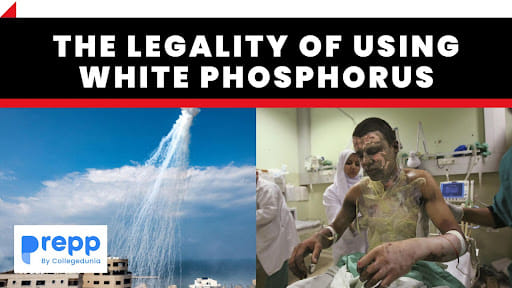
Recently, Human Rights Watch accused Israel of using white phosphorus munitions in Gaza, raising concerns about the potential risks posed to civilians.
Table of Contents
Key Highlights from the Earlier Allegations
- In the 2008-2009 Gaza War, there were allegations that the Israel Defense Forces (IDF) struck the Gaza Strip with sub-munitions containing white phosphorus.
- The Israeli government, which had earlier denied this, later acknowledged that it did use white phosphorus in 2009, but only in uninhabitable areas, for the purpose of signaling and marking.
- The Israel military, in the case of Yoav Hass and others v. Chief of Staff (2013), agreed to abandon white phosphorus use except in specified situations communicated to the court.
What is White Phosphorus?
- White phosphorus is a waxy, yellowish-to-clear chemical with a pungent, garlic-like odour. It is a highly combustible chemical that burns quickly and brightly when exposed to air.
- Its chemical reaction with atmospheric oxygen can create intense heat (about 815°C), light, and smoke.
- It spontaneously combusts upon contact with oxygen and is frequently utilized by armed forces for battlefield illumination, smoke screens, and as an incendiary agent. Once ignited, white phosphorus is highly resistant to extinguishing.
Impact of White Phosphorus
- Severe Burns: It can cause extremely painful burns upon contact with the skin. These burns can be deep and difficult to heal, often reaching down to the bone. Infection is a significant concern with these burns, and particles of white phosphorus embedded in the body can reignite when exposed to air, making treatment and recovery even more challenging.
- Inhalation Hazards: Inhaling white phosphorus particles or smoke can lead to respiratory damage and harm to internal organs. This can cause long-term health issues and complications for those exposed.
- Long-Term Suffering: Survivors of white phosphorus exposure often experience a lifetime of suffering. The injuries can result in impaired mobility and leave behind painful and disfiguring scars that can significantly impact a person's quality of life.
- Environmental Damage: It can also devastate the environment, which ignites fires that are difficult to control, especially in windy conditions. These fires can damage infrastructure and property, destroy crops, and kill livestock. The environmental consequences can be long-lasting and extend beyond the immediate human toll.
When were white phosphorus munitions first used?
- White phosphorus munitions were first used by Irish nationalists in the late 19th century, in a formulation known as "Fenian fire." The term "Fenian" was a collective reference to Irish nationalists.
- During World War I, British and Commonwealth forces extensively utilized white phosphorus in various forms, including grenades, bombs, shells, and rockets.
- Since then, white phosphorus munitions have been employed in conflicts worldwide, ranging from their use during the Normandy invasion in World War II to their presence in the US invasion of Iraq in 2004 and the protracted Nagorno-Karabakh conflict.
- Russia also faced allegations of employing white phosphorus bombs during the invasion of Ukraine in the previous year.
What are the military uses of white phosphorus?
- Creating Smoke: White phosphorus is used in military applications primarily for creating smokescreens, which serve to obscure troop movements on the ground.
- This smokescreen is a visual obscurant, and it can also interfere with infrared optics and weapons tracking systems, providing protection for forces against guided missiles.
- Munitions containing white phosphorus can be employed in two main ways. They can be ground-burst to create a more concentrated smoke for specific purposes, or they can be air-burst to cover a larger area.
- Incendiary Weapon: White phosphorus can be used as an incendiary weapon. For example, during the second battle of Fallujah in Iraq in 2004, US forces used white phosphorus munitions to compel concealed combatants to abandon their positions.
What is the legal status of white phosphorus munitions?
Protocol III of the Convention on Certain Conventional Weapons (CCW):
- This protocol regulates the use of incendiary weapons, which includes white phosphorus munitions.
- Article 1 of this protocol defines an "incendiary weapon" as a munition primarily designed to set fire to objects or cause burn injuries to persons through the action of flame, heat, or a combination thereof.
- However, it includes an exemption for munitions that may cause unintended incendiary effects, such as illuminants, tracers, smoke, or signaling systems.
- White phosphorus munitions are often considered to fall within this exemption because their primary purpose is not to cause burn injuries but to produce illuminating and smokescreen effects.
Chemical Weapons Convention (CWC):
- The CWC is a treaty that comprehensively bans the use of chemical weapons. White phosphorus is a chemical agent, but it is not covered by the CWC when used as an incendiary weapon rather than for chemical warfare.
- This means that its use for the purpose of producing smoke, illumination, or signaling is not considered a violation of the CWC.
International Humanitarian Law (IHL):
- White phosphorus use is subject to the principles of IHL, including distinction, proportionality, and the prohibition of indiscriminate attacks.These principles aim to minimize harm to both civilians and combatants in armed conflicts.
- It is essential that the use of white phosphorus complies with these principles to avoid causing excessive harm to civilians compared to the military advantage sought.
Customary International Law:
- The use of white phosphorus munitions in populated areas has raised significant ethical and legal concerns.
- Customary international law, which reflects widely accepted state practice and opinio juris (belief in the legal obligation), may further contribute to the legal status of white phosphorus use in armed conflict.
Way Ahead
- It is imperative to enhance Protocol III of the CCW to establish more precise regulations concerning the utilization of white phosphorus and analogous multi-purpose munitions.
- Such an enhancement would result in a legally binding agreement among states, aiming to prevent the exploitation of ambiguities in existing laws and to streamline enforcement efforts.
- The imperative of adhering to international law, treaties, and protocols becomes evident when considering the legal ramifications of deploying white phosphorus in armed conflicts. It underscores the significance of these international frameworks in mitigating harm to both civilian populations and the environment.
- Disregarding these legal principles could lead to worldwide censure, investigations, and potential prosecution for war crimes, underscoring the pressing need for unambiguous and stringent regulatory measures.
(*Click this link to read prelims specific weekly current affairs articles)
FAQs
Question: What is White Phosphorus?
Answer:
White phosphorus is a waxy, yellowish-to-clear chemical with a pungent, garlic-like odour. It is a highly combustible chemical that burns quickly and brightly when exposed to air.
Question: What is the Chemical Weapons Convention (CWC)?
Answer:
The Convention aims to eliminate an entire category of weapons of mass destruction by prohibiting the development, production, acquisition, stockpiling, retention, transfer or use of chemical weapons by States Parties.
Question: What is the Convention on Certain Conventional Weapons (CCW)?
Answer:
The Convention on Certain Conventional Weapons (CCW) imposes restrictions on the use of incendiary weapons, including white phosphorus, with the aim of safeguarding civilians. Protocol III under the CCW specifically addresses incendiary weapons and their regulation.
MCQ
Question: With reference to ‘Organization for the Prohibition of Chemical Weapons (OPCW)’, consider the following statements: (UPSC 2016)
- It is an organization of the European Union in working relation with NATO and WHO.
- It monitors the chemical industry to prevent new weapons from emerging.
- It provides assistance and protection to States (Parties) against chemical weapons threats.
Which of the statements given above is/are correct?
(a) 1 only
(b) 2 and 3 only
(c) 1 and 3 only
(d) 1, 2 and 3
Answer: (b) See the Explanation
- Organization for the Prohibition of Chemical Weapons (OPCW) is the Hague-based autonomous body, which works within the framework of the United Nations, was established in 1997 by the Chemical Weapons Convention to carry out its mandate. Hence, statement 1 is not correct.
- OPCW Member States share the collective goal of preventing chemistry from ever again being used for warfare, thereby strengthening international security. Hence, statement 2 is correct.
- To this end, the Convention contains four key provisions: destroying all existing chemical weapons under international verification by the OPCW monitoring chemical industry to prevent new weapons from re-emerging; providing assistance and protection to States Parties against chemical threats; and fostering international cooperation to strengthen implementation of the Convention and promote the peaceful use of chemistry. Hence, statement 3 is correct.
Therefore, option (b) is the correct answer.
Download the PREPP App and attempt FREE IAS Exam Mock Tests and get complete study material!
Live Test : UPSC IAS : GS - Modern History - Subject Knowledge Test

Live Test : UPSC CSE Prelims CSAT (Paper-II) (Oct 14 - 17)
Full Test - 04: UPSC CSE Prelims CSAT (Paper-II)
Full Test - 03: UPSC CSE Prelims CSAT (Paper-II)
UPSC CSE Prelims 2026 GS Paper 1 Question Paper (24-May-2026)
UPSC CSE Prelims 2026 CSAT Paper 2 Question Paper (24-May-2026)

17 February 2025 | The Hindu Must Read Articles | Current Affairs

16 February 2026 | The Hindu Must Read Articles | Current Affairs

13 February 2026 | The Hindu Must Read Articles | Current Affairs









Comments