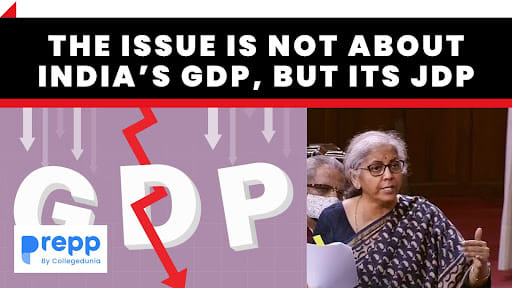
The Issue Is Not About India’s GDP, But Its JDP
Relevance: GS 3 - Economic Development, issues relating to planning, mobilization, of resources, growth, development and employment.
(Source: The Hindu, 08/19/23)
Click here for Daily Current Affairs
Why in the news?
This article highlighted that India’s GDP growth has not led to a proportional increase in the number of jobs.
Table of Contents
The issue is job potential
- The Paradox of Growing MGNREGA Demand: Despite India's robust economic growth, the demand for minimum wage work provided by the Mahatma Gandhi National Rural Employment Guarantee Act (MGNREGA) scheme is on the rise.
- While India's real GDP has achieved an annualized growth rate of 5.3% under the Modi government, the demand for MGNREGA work has surged at a slightly higher rate of 5.4% annually.
- Dissonance Between GDP Growth and Job Creation: Analysis of data from the Reserve Bank of India shows that in the decade 1980 to 1990, every percentage point of GDP growth produced two lakh formal jobs.
- However, this job creation ratio declined significantly in subsequent decades, halving to just one lakh jobs per percentage point of GDP growth in the 1990s and further diminishing thereafter.
- Flawed Economic Rationale: India's recent foray into semiconductor manufacturing, although strategically motivated, lacks a robust economic justification due to its automated nature.
- Industries like traditional manufacturing and semiconductors, marked by high automation, fail to generate substantial employment, despite contributing to GDP.
- Social divide: The formal service sector jobs generated by GDP growth largely favor individuals from higher castes, magnifying disparities.In stark contrast, a significant 80% of workers enrolled in the MGNREGA program belong to oppressed castes like Dalits, tribals, and backward castes.
The Mines and Minerals Bill, India’s future
- Transition to Electric Mobility: The new Mines and Minerals (Development and Regulation) Amendment Bill, 2023, Bill could boost India's economy amid the global shift to electric vehicles driven by minerals like lithium and cobalt.
- India's vast mineral deposits remain largely unexplored, India has not explored even 10% of its potential mineral deposits below the earth.
- Inclusive Job Creation: Unlike sectors like semiconductor manufacturing, mining can be socially more inclusive by absorbing large numbers of people from the oppressed castes (Other Backward Classes, Scheduled Castes and Scheduled Tribes) in the workforce.
- Challenges: lack of access to the latest mining technologies, environmental concerns and previous incidents of labour exploitation in mines,the new MMA Bill lacks details
Change the discourse
There is a need for a shift in the economic discourse from merely pursuing high GDP growth to prioritizing job creation.
(*Click this link to read prelims specific weekly current affairs articles)
FAQs
Question: What is Jobless growth?
Answer:
Jobless growth is a situation when the economy is able to produce more goods and services without a simultaneous increase in employment opportunities.
Question: What is MGNREGA?
Answer:
The Mahatma Gandhi National Rural Employment Guarantee Act, which is previously known as the National Rural Employment Guarantee Act was introduced on 7th September 2005. The act is for generating employees and social security in India. The act aims to cover all districts of India except the district which have a 100% urban population.
Question: What is Automation?
Answer:
Automation is the use of technology to perform tasks with where human input is minimized.
UPSC Mains Practice Question:
|
MCQ
Question: Increase in absolute and per capita real GNP do not connote a higher level of economic development, if (UPSC-2018)
(a) industrial output fails to keep pace with agricultural output.
(b) agricultural output fails to keep pace with industrial output.
(c) poverty and unemployment increase.
(d) imports grow faster than exports.
Answer: (c) See the Explanation
- An increase in absolute and per capita real GNP (Gross National Product) may not necessarily indicate higher economic development if poverty and unemployment are on the rise. Economic development should lead to improvements in living standards and overall well-being, which include reduced poverty and unemployment rates. If GNP grows while poverty and unemployment rates also increase, it suggests that the benefits of economic growth are not being distributed evenly and the overall development is not inclusive.
- Therefore, option (c) is the correct answer.
Download the PREPP App and attempt FREE IAS Exam Mock Tests and get complete study material!

Full Test - 04: UPSC CSE Prelims CSAT (Paper-II)
Full Test - 03: UPSC CSE Prelims CSAT (Paper-II)
UPSC CSE Prelims 2026 GS Paper 1 Question Paper (24-May-2026)
UPSC CSE Prelims 2026 CSAT Paper 2 Question Paper (24-May-2026)

17 February 2025 | The Hindu Must Read Articles | Current Affairs

16 February 2026 | The Hindu Must Read Articles | Current Affairs

13 February 2026 | The Hindu Must Read Articles | Current Affairs









Comments