The fate of chips will determine the fate of nations (UPSC Current Affairs)
Relevance: GS 2 - Government policies and interventions for development in various sectors and issues arising out of their design and implementation; GS3 - Science and Technology- developments and their applications and effects in everyday life.
(Source:The Hindu)
Click here for Daily Current Affairs
Why in the news?
- Recently,the Union Cabinet approved changes to the Central Government's Production Linked Incentive (PLI) scheme for semiconductors.
- An uniform fiscal support of 50 percent of project cost for semiconductor fabs across technology nodes and display manufacturing will be provided.
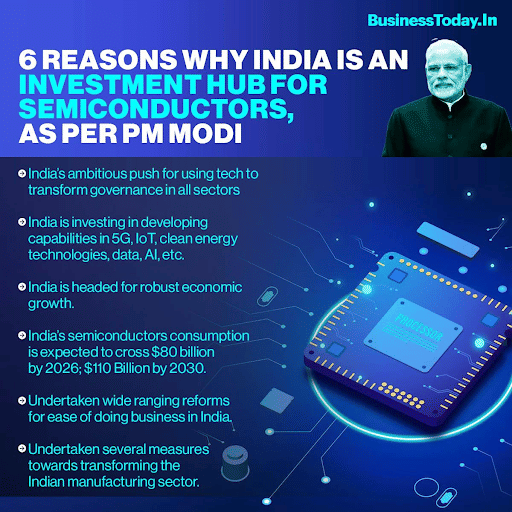
Significance of Semiconductor Chips
- Mobile phones: Every messages, photos, and calls—is reliant on one or more chips.
- Weapons: One of the reasons Russia appears to be struggling to win the war in Ukraine is that it is relying more on force than intelligence.
- Ukraine acquired precision-guided missiles from its western allies, which is being employed to combat Russia. Chips are used to power these missiles.
- Automobiles: Due to the chip scarcity, Toyota briefly halted production at assembly lines at five domestic group sites in Japan. A car's radio touchscreen infotainment system and air conditioning systems both employ chips. Chips are also necessary for the safety features of a car since they enable features like airbags, seatbelt tensioners, ABS and stabilisation systems, and even the e-Call "rescue" system to function.
- The famous Entity List maintained by the U.S. government ensures that China and Russia won't be able to access this technology and gain an advantage in the chip race.
Challenges
- Supply chain: The pandemic has highlighted the vulnerability of the global semiconductor manufacturing supply chain. Only a few countries currently produce chips: Taiwan, South Korea, the United States, Japan, the Netherlands, and China.
- Trade war:The scenario is made worse by the world's excessive reliance on East Asia for fab manufacture, the rising cost of silicon, and the trade war between the United States and China.
- Steady electricity and billions of gallons of clean water:Indian States that are striving to attract investors for chip production must also keep in mind that setting up a chip unit requires consistent electricity and billions of gallons of clean water, neither of which any of them can now provide.
- Long time to break even: Even if it operates all year long, a semiconductor manufacturing factory costs $15 billion to $20 billion and takes years to break even.
Way Forward
- R&D: The Indian Institute of Science and other top research institutes should be urged to work hard on R&D in chip production and design.
- Minimal entry barriers: The government has to concentrate on new technologies with minimal entry barriers and no disproportionate benefit for incumbents, such as LiDAR and phased array.
- Raw Material: The development of raw material supply capacities requires similar work. The India Electronics and Semiconductor Association is looking into the possibility of beginning to supply refined raw materials, including as gases and minerals, to the fab and ATMP (Assembly, Testing, Marking, and Packaging) sector.
- Pre-agreements: It would be great to engage into an arrangement with the buyers of such semiconductors, such as car makers, to assure that whatever is made is consumed because the first manufacturing would be in mature technology. Getting existing fab firms to come on their own is preferable since they bring their customer base.
- The gas, minerals, and mining industries in India would benefit from this, and prospects for the semiconductor equipment, replacement parts, and service industries will also increase.
- India can assure that it becomes atmanirbhar by working assiduously on developing cutting-edge technology.
India Semiconductor MissionA specialised and independent business division inside the Digital India Corporation, the India Semiconductor Mission (ISM) intends to create a thriving semiconductor and display ecosystem to support India's growth as a major centre for electronics manufacturing and design.Components of India Semiconductor Mission
|
(*Click this link to read prelims specific weekly current affairs articles)
Some Important FAQs
Question: What is a semiconductor?
Answer:
Semiconductors are materials with conductivity intermediate between conductors (typically metals) and non-conductors or insulators (such as most ceramics). Semiconductors can be pure elements like silicon or germanium, or they can be compounds like gallium arsenide or cadmium selenide. They are also known as integrated circuit or, more commonly, chips and they are possibly the tiniest yet most exact product ever manufactured on a global scale.
Question: What is a semiconductor fab?
Answer:
A semiconductor fab is a manufacturing plant in which raw silicon wafers are turned into integrated circuits.
Question: What are uses of semiconductors?
Answer:
A semiconductor is a vital part of electronics that controls how electricity flows through a device. These are frequently utilized in a variety of electronic devices, including automobiles, smartphones, medical equipment, aircraft, and weapons
MCQs
Question: Applications of semiconductors can be found in which of the following?
- Missiles
- Automobiles
- Smart Phones
Which of the above statements is/are correct?
(a) 1 and 2 only
(b) 2 and 3 only
(c) 1 and 3 only
(d) 1,2 and 3
Answer: (d) See the Explanation
- A semiconductor is a vital part of electronics that controls how electricity flows through a device. These are frequently utilised in a variety of electronic devices, including automobiles, smartphones, medical equipment, aircraft, and weapons
- Ukraine acquired precision-guided missiles from its western allies, which is being employed to combat Russia. Chips are used to power these missiles.
- Therefore, option (d) is the correct answer.
Download the PREPP App and attempt FREE IAS Exam Mock Tests and get complete study material!

Full Test - 04: UPSC CSE Prelims CSAT (Paper-II)
Full Test - 03: UPSC CSE Prelims CSAT (Paper-II)
UPSC CSE Prelims 2026 GS Paper 1 Question Paper (24-May-2026)
UPSC CSE Prelims 2026 CSAT Paper 2 Question Paper (24-May-2026)

17 February 2025 | The Hindu Must Read Articles | Current Affairs

16 February 2026 | The Hindu Must Read Articles | Current Affairs

13 February 2026 | The Hindu Must Read Articles | Current Affairs









Comments