The Expansion of Settlements into Flood Prone Areas
Primary Source: The Hindu
Click here for Daily Current Affairs
Prepp Prelims Booster: Urban Flooding, Climate Change, Flood Zones,Climate change,World Bank Reports
Prepp Mains Booster: Disaster and Disaster Management, Environmental Pollution & Degradation, Factors Behind Increasing Human Settlements in Flood Zones, Flood Management
Why in the news?
- A World Bank-led study published in Nature journal highlighted a significant increase in human settlements in flood-prone areas since 1985.
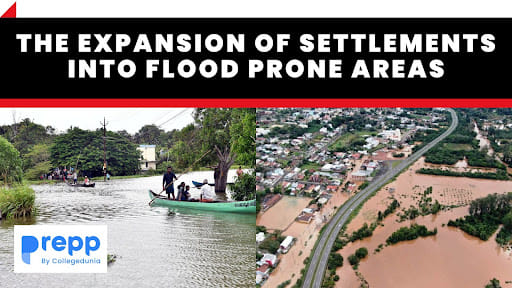
- Summer monsoons caused extensive flooding in Indian cities like Bengaluru, Gurugram, and Mumbai.
- Urban floods have led to substantial economic losses, with a State Bank of India report estimating damages up to Rs 15,000 crore due to floods and cyclones in 2023.
Table of Contents
Key Findings – World Bank Study
- Increased Settlements in Flood-Prone Areas: The study found that human settlements in areas at high risk of flooding have more than doubled over the last four decades, primarily due to the rapid and unchecked expansion of cities.
- Regional Differences: There are variations in the rate of settlement expansion into flood-prone areas by region. East Asia has experienced the highest rate of such expansion, while Sub-Saharan Africa and North America have had the least.
- Middle-Income Countries at Higher Risk: Middle-income countries, including India (categorized as a low-middle-income country by the World Bank), show a higher tendency of urban settlement in flood-prone zones compared to low- and high-income countries.
- India's Global Position: While India is not among the top 20 countries with the most settlements exposed to flood hazards, it is a significant contributor to global settlements and ranks third after China and the United States in this regard. Additionally, it is third among countries with new settlements expanding into flood-prone areas between 1985 and 2015.
- Data Granularity Issues: There are concerns about the granularity of the data used for the study. The EM-DAT database records mass disasters but is not a detailed floodplain record, which might limit the ability to analyze flood-prone areas with high precision.
What is Urban Flooding?
- Urban flooding is the inundation of land or property in a built environment, particularly in more densely populated areas, caused by rainfall overwhelming the capacity of drainage systems, such as storm sewers.
- Unlike flooding in rural areas, which can spread over large areas, urban flooding is confined to smaller areas, often in specific neighborhoods or city streets.
- The consequences of urban flooding are often severe, including damage to infrastructure, homes, and businesses, disruption of transportation systems, contamination of water supplies, and sometimes loss of life.
- Managing urban flooding requires integrated approaches that include proper urban planning, investment in infrastructure, and the adoption of sustainable drainage and landscape management practices.
Causes of Urban Flooding
- High Intensity Rainfall: Short periods of intense rainfall can lead to flash floods, as the water is unable to percolate into the ground quickly enough and the drainage systems cannot cope with the volume of water.
- Inadequate Drainage: Many urban areas have drainage systems that are inadequate for the demands placed upon them, especially in older or poorly maintained infrastructures.
- Impermeable Surfaces: Urban areas have a high proportion of impermeable surfaces such as concrete and asphalt, which prevent water from naturally soaking into the ground.
- Lack of Natural Waterways: The channelization of creeks and the construction over natural waterways can obstruct the natural flow of water, leading to flooding.
- Poor Urban Planning: In some cases, cities expand rapidly without adequate planning for drainage and flood management, which can lead to development in flood-prone areas.
- Climate Change: Increasingly, urban flooding is exacerbated by climate change, which is associated with more frequent and severe weather events, including intense rainfall.
- Blocked Drains and Waterways: Litter, debris, and sediment can block drains and channels, reducing their effectiveness and leading to water backing up.
Concerns Regarding Urban Planning
- Unsustainable Urban Expansion: Cities have expanded rapidly into areas without adequate consideration of natural topography and hydrology, leading to development in flood-prone zones.
- Overlooking Topography: New localities often disregard the natural lay of the land, such as valleys and ridges, which are inherently more susceptible to flooding, resulting in greater risk and damage during flood events.
- Impervious Surfaces: The increase in concrete cover reduces the ground’s ability to absorb rainfall, exacerbating runoff and the potential for flooding.
- Inadequate Drainage Infrastructure: Urban areas, especially those that have expanded quickly, may lack sufficient stormwater management systems, making them more susceptible to flooding.
- Governance and Regulatory Challenges: Environmental regulations, when applied, tend to focus on large infrastructure projects, often overlooking smaller-scale developments that collectively contribute to the area’s flood risk.
- Violation of Regulations: There is a common issue of non-compliance with existing government regulations, where construction occurs in ecologically sensitive areas or floodplains without appropriate approvals or oversight.
- Recognition of Risk Areas: There is a need for a clear identification and acknowledgment of flood-prone areas to inform and guide sustainable urban expansion and planning.
Expansion of Urban Settlements – Global Context
- As per the study led by the World Bank, there is a marked increase in urban settlements in areas prone to flooding.
- Over four decades, since 1985, there has been more than a doubling of human settlements in such vulnerable zones.
- The study utilized satellite data to examine flood patterns and urban expansion, revealing significant spatial variations in the trends of such developments.
- East Asia was identified as the region with the highest rate of urban settlement expansion into flood-prone areas, while Sub-Saharan Africa and North America were among the regions with the least expansion into such hazardous zones.
- Middle-income countries were found to have more urban settlement in flood-prone zones compared to low- and high-income countries, positioning India as a significant example, being classified as a low-middle-income country.
- While India is not among the top 20 countries most exposed to flood hazards, it is a major contributor to global urban settlements and is significantly expanding into flood-prone areas, ranking third after China and Vietnam in this regard.
Socioeconomic Disparities
- Impact on Low-Income Groups: The informal settlements, which often house lower-income groups, are disproportionately located in low-lying, flood-prone areas.
- Inequality in Urban Expansion: Both elite and poor populations are expanding into flood-prone zones. However, the risk is greater for those in informal housing due to the lack of resilient infrastructure.
- Governance and Regulation Challenges: There is an indication that environmental regulations, when applied, tend to focus on large infrastructure projects rather than medium and small-scale modifications that affect localities.
- Violations of Regulations: The government regulations are often violated, with instances such as the construction of eco-tourism resorts on forest land and buildings on floodplains.
Governance Challenges
- Inadequate Urban Planning: The rapid and haphazard urbanization in India, particularly in flood-prone areas, points to a lack of foresight in urban planning.
- Inefficient Data Utilization: There is a challenge in employing accurate and granular data for assessing flood risks in urban and peri-urban areas.
- Environmental Regulation Compliance: Governance issues also arise from the selective application of environmental regulations.
- Socioeconomic Disparities: The disproportionate impact of floods on different socioeconomic classes, especially the informal low-income housing, underscores a governance failure to protect vulnerable populations.
- Ineffective Enforcement of Regulations: The widespread violation of environmental and urban regulations indicates a governance issue in enforcement mechanisms.
- Recognition of Locality-Specific Risks: The governance approach tends to overlook the fact that flooding is a locality-level issue, often leading to a 'one size fits all' strategy in urban planning and disaster management that fails to address the unique risks of specific localities.
- Inclusive Adaptation Strategies: There is a need for governance that promotes adaptation strategies inclusive of all income groups.
- Infrastructure Management: The governance challenge extends to urban infrastructure management, particularly in creating and maintaining storm-water management systems that are adequate for the increased risk of flooding due to urban expansion.
Recommendations for Mitigation
- Scientific Mapping of Flood-Prone Areas: There is a need for accurate and scientific mapping of areas that are vulnerable to flooding to understand the extent and frequency of the risk.
- Storm-Water Management Plans: Improved storm-water management systems are necessary, with a focus on installing more efficient storm-water drains to collect and divert rainwater in flood-prone areas.
- Regulation and Governance: Urban governance processes need to address the expansion into flood-prone areas by enforcing environmental regulations, not just for large infrastructure projects but also for medium- and small-scale developments.
- Protecting and Upgrading Low-Income Housing: Urban governments should make existing housing in flood-prone areas more resilient.
- Awareness of Expansion into Flood-Prone Areas: Recognizing and understanding that urban expansion is happening in flood-prone areas is a vital first step towards sustainable urban planning that mitigates associated risks.
- Differentiated Adaptation Strategies: Adaptation measures must take into account the differences between low-income residents and unauthorized structures for the elite.
- Confront Market Forces: There should be a confrontation of market forces that tend to push urban expansion into flood-prone areas.
- Local-Level Focus: Rather than viewing flooding as a generalized issue, it should be addressed at the locality level, recognizing that some areas are more prone to flooding than others due to their specific geographical and developmental conditions.
- Resilient Urban Design: Urban design and construction should consider topography and ecological sustainability, minimizing the concretization of areas that impede natural water flow.
- Community Engagement: Engage with communities, especially those in informal settlements, to ensure that their needs and knowledge are incorporated into planning and that they have secure housing options.
- Enforce Regulations: Enforce existing government regulations strictly to prevent unauthorized construction on floodplains and other ecologically sensitive areas.
Conclusion
Urban areas will inevitably expand into flood-prone regions, but recognizing this is key to sustainable planning. Differentiation in adaptation strategies for low-income housing and unauthorized structures is needed.
(*Click this link to read prelims specific weekly current affairs articles)
FAQs
Question: Which regions globally have seen the highest rate of settlement expansion in flood-prone areas, and how does India compare according to the World Bank study?
Answer:
The World Bank study mentioned in the article indicates that East Asia has experienced the highest rate of settlement expansion into flood-prone areas. India, while not among the top 20 countries most exposed to flood hazards, is the third highest contributor to global settlements and is expanding into flood-prone zones significantly, following China and Vietnam.
Question: What is urban flooding?
Answer:
Urban flooding is the inundation of land or property in a built environment, particularly in more densely populated areas, caused by rainfall overwhelming the capacity of drainage systems, such as storm sewers. Unlike flooding in rural areas, which can spread over large areas, urban flooding is confined to smaller areas, often in specific neighborhoods or city streets.
Question: What are the main reasons for the increase in urban floods in India?
Answer:
Recent studies have shown that the increase in urban floods in India is due to a combination of factors. Primarily, the rapid and unsustainable urbanization that leads to expansion into flood-prone areas, climate change exacerbating monsoon patterns, and inadequate urban planning that fails to consider the environmental risks, especially in terms of storm-water management and local topography.
UPSC Mains Practice Question:
|
MCQs
Question: As per the World Bank study, which region has the highest expansion into flood-prone areas?
(a) East Asia
(b) Sub-Saharan Africa
(c) North America
(d) South Asia
Answer: (a) See the Explanation
According to the World Bank study, both Sub-Saharan Africa and North America have the least expansion into flood-prone areas, contrasting with East Asia, which has the highest rate.
Therefore, option (a) is the correct answer.
Question: Consider the following statements regarding urban planning measures to protect low-income housing from flood risks:
1) Construct more storm-water drains.
2) Map flood-prone areas scientifically.
3) Upgrade and protect low-income housing.
How many of the above statements are correct?
(a) Only one
(b) Only two
(c) All three
(d) None
Answer: (c) See the Explanation
Multiple measures are necessary to mitigate the risks of urban floods, especially to protect low-income housing. These measures include better storm-water management, such as constructing more storm-water drains, scientific mapping of flood-prone areas to guide urban expansion, and making housing more resilient to floods, which entails upgrading and protecting low-income housing.
Therefore, option (c) is the correct answer.
Download the PREPP App and attempt FREE IAS Exam Mock Tests and get complete study material!

Full Test - 04: UPSC CSE Prelims CSAT (Paper-II)
Full Test - 03: UPSC CSE Prelims CSAT (Paper-II)
UPSC CSE Prelims 2026 GS Paper 1 Question Paper (24-May-2026)
UPSC CSE Prelims 2026 CSAT Paper 2 Question Paper (24-May-2026)

17 February 2025 | The Hindu Must Read Articles | Current Affairs

16 February 2026 | The Hindu Must Read Articles | Current Affairs

13 February 2026 | The Hindu Must Read Articles | Current Affairs









Comments