Taiwan, A Malacca Blockade And India’s Options
(Source: The Hindu, 11/09/2023)
Click here for Daily Current Affairs
Why in the news?
- This article discusses what India’s options are if the conflict over Taiwan escalates and the challenges associated with them.
- China has claimed Taiwan as part of its territory and has adopted increasingly aggressive measures to intimidate Taiwan which has led to tensions with the U.S.A., a Taiwan ally.
Table of Contents
Crisis in Taiwan
Historical basis
- Under the Qing dynasty, Taiwan was controlled by China but was ceded to Japan following China’s loss in the first Sino-Japanese war in 1895.
- Following Japan’s defeat in World War II in 1945, China regained control of Taiwan but the civil war between the nationalists and communists escalated and the nationalists fled to Taiwan in 1949.
- Consequently, Taiwan was ruled by the Kuomintang party led by Chinag Kai-shek.
- However, China claims Taiwan as a Chinese province despite Taiwan’s argument that it was never a part of the People’s Republic of China (PRC).
Present status
- China has carried out numerous military drills around Taiwan as part of attempts to assert its claims of sovereignty.
- In 2023, Chinese fighter jets crossed the median line of the Taiwan Strait (the unofficial barrier between the two sides) and through the Bashi Channel, which separates Taiwan from the Philippines.
- Only 13 countries recognize Taiwan as a sovereign country at present due to China's diplomatic pressure.
- The USA has expressed its commitment to Taiwan’s independence and has maintained strong ties with Taipei including defense sales.
- The USA has recently signed off on a $80m grant to Taiwan for the purchase of American military equipment.
- However, the USA has not officially accorded any recognition to Taiwan and maintained a “One China Policy” since the 1970 while claiming that it would retaliate if China invaded Taiwan.
What can India do if China invades Taiwan?
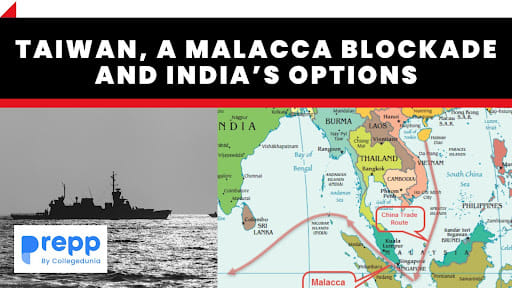
- India could take action in the Strait of Malacca or the Andaman Sea if the conflict escalates.
- This would mean a naval blockade would have to be placed against commercial shipping or China’s key trade and energy sea lines or Chinese naval vessels.
- However, this is not feasible as commercial shipping and naval vessels enjoy the right to freedom of navigation on the high seas.
- It is not yet clear whether India’s strategic partners, particularly the South-East Asian countries, would support an interdiction of Chinese vessels in the Strait of Malacca during a bilateral conflict between India and China.
- Even the U.S.A.’s support is likely to be dependent on whether the U.S. is itself involved in a conflict with China.
- Although the U.S.-China conflict over Taiwan would affect the entire Indian Ocean which India sees itself as the first responder of, India’s primary role in the conflict is likely to be defensive.
- India will have to undertake a proactive defense of its territories and the security of sea lines of communication with its strategic partners in the IOR.
- India’s focus is likely to be centered around its continental borders with China, where tensions have flared since the Doklam standoff of 2017 and the 2020 border clashes near Pangong Tso Lake.
What are the constraints faced by India to this strategy?
- International law: Countries can challenge blockades imposed by countries away from its geography under international law.
- China could challenge any blockade imposed in the Andaman Sea or Strait of Malacca.
- Importance of the strait for other nations: The trade conducted via the Strait of Malacca is not just crucial for China.
- It is also the economic lifeline of other countries in the region including Japan, South Korea, and India.
- A blockade could be counterproductive as it would halt crucial supplies to friendly nations as well.
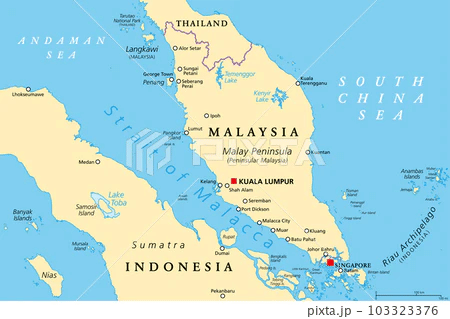
- Lack of support from regional partners: The Strait of Malacca is around 500 miles long and subject to the sovereign control of other states like Indonesia, Malaysia, Thailand and Singapore who would also be adversely impacted by a blockade.
- Other countries of the region which are also likely to be impacted by the blockade may not endorse the move despite close ties.
- Complexity: It is an extremely complex task to identify the flag, registration, insurance, and ownership of cargo in commercial shipping.
- These factors could be multinational in nature and can also be altered conveniently through transshipment at any port in Southeast Asia.
- Alternate options: In case the shipping lanes of the Strait of Malacca are choked, an alternate route can be taken by commercial shipping vessels to reach China via the Sunda or Lombok Straits.
- A blockade would also be ineffective since the large crude carriers carrying crude or natural gas to China prefer to use the Sunda Strait which is deeper than the Strait of Malacca.
- Chinese oil reserves: China also possesses huge onshore and floating Strategic Petroleum Reserves (SPR) and is also acquiring overland energy supplies from Russia and Central Asia.
- These supplies will help China avoid the effects of any blockade that aims to choke its energy and oil supplies.
- Escalation of conflict: Any naval blockades or unilateral action against a country’s naval vessels would be treated as a declaration of war.
- This could escalate the conflict beyond the maritime domain which could have adverse consequences for the region as a whole.
- China’s veto power at UNSC: China may also use its permanent seat in the United Nations Security Council and its regional influence over smaller nations in the region to defeat such action.
Has blockade been effective?
- Naval blockades and sanctions imposed during the First and Second World Wars led to skirmishes.
- In the First World War, Germany retaliated against the British blockade using its U-boats or submarines.
- The sinking of U.S. merchant vessels in the 1916 Battle of Jutland led to the U.S’s entry into the First World War.
- In the Second World War, the U.S. had embargoed Japan’s energy supplies which is believed to have played a role in Japan’s decision to attack Pearl Harbour in 1941.
- Any interruptions to commercial shipping could lead to tensions between countries and escalate into military clashes.
- This is evident in the tensions between Iran and the USA in the Strait of Hormuz.
- Iran’s attempts to disrupt the passage of internationally flagged oil tankers has escalated with the U.S. deploying naval and air assets to confront Iranian vessels.
Conclusion
- India’s has traditionally responded to Chinese military threats on its borders on its own.
- However, the strengthening India-U.S. partnership in the economic, high-tech, and military sectors means that the USA views India as an anchor for regional stability.
- A robust India with a strong economy, nuclear deterrence capability and a credible military can contribute to multi-polarity in the Indo-Pacific.
Malacca Strait
|
(*Click this link to read prelims specific weekly current affairs articles)
FAQs
Question: What is a Naval blockade?
Answer:
A naval blockade is the act of actively preventing a country or region from receiving or sending out food, supplies, weapons, or communications, and people by the sea route.
Question: What are the basin countries of the Malacca Strait?
Answer:
The basin countries of the Strait of Malacca are Indonesia, Malaysia, Thailand, and Singapore.
UPSC Mains Practice Question:
|
MCQs
Question: Between India and East Asia, the navigation-time and distance can be greatly reduced by which of the following ? (UPSC 2011)
- Deepening the Malacca straits between Malaysia and Indonesia.
- Opening a new canal across the Kra Isthmus between the Gulf of Siam and Andaman Sea.
Which of the statements given above is/are correct ?
(a) 1 only
(b) 2 only
(c) Both 1 and 2
(d) Neither 1 nor 2
Answer: (b) See the Explanation
- Opening a new canal in Kra Isthums can reduce the navigation time and distance. Hence statement 2 is correct.
- The Malacca strait is the main shipping channel between the Indian Ocean and the Pacific Ocean and links India, China, Japan and South Korea.
- The deepening of the strait would certainly help in “Increasing the volume of the business” because ships of larger sizes can pass through it. Hence statement 1 is incorrect.
- Broadening the Strait will help reduce the navigation time and distance. Therefore, option (b) is the correct answer.
Question: Which one of the following can come across if one travels through the Strait of Malacca? [2010]
(a) Bali
(b) Brunei
(c) Java
(d) Singapore
Answer: (d) See the Explanation
The Malacca strait is between the Indonesian island of Sumatra and the Malaya Peninsula. Singapore lies on the tip of the Malay Peninsula.
Therefore, option (d) is the correct answer.
Download the PREPP App and attempt FREE IAS Exam Mock Tests and get complete study material!

Full Test - 04: UPSC CSE Prelims CSAT (Paper-II)
Full Test - 03: UPSC CSE Prelims CSAT (Paper-II)
UPSC CSE Prelims 2026 GS Paper 1 Question Paper (24-May-2026)
UPSC CSE Prelims 2026 CSAT Paper 2 Question Paper (24-May-2026)

17 February 2025 | The Hindu Must Read Articles | Current Affairs

16 February 2026 | The Hindu Must Read Articles | Current Affairs

13 February 2026 | The Hindu Must Read Articles | Current Affairs









Comments