Sutlej-Yamuna Link (SYL) canal project - Geography Notes
Satluj Yamuna Link Canal, or SYL for short, is a 214-kilometer-long canal in India that connects the Sutlej and Yamuna rivers. The proposal, however, ran into difficulties and was referred to the Supreme Court of India. It was defined as the sharing of river water between the states of Punjab and Haryana. This article will explain to you the Sutlej-Yamuna Link (SYL) canal project which will be helpful in Geography preparation for the UPSC Civil service exam.
|
Table of Contents |
Sutlej-Yamuna Link (SYL) canal project
- A 214-kilometer canal in India that links the Sutlej and Yamuna rivers is known as the Satluj Yamuna Link Canal, or SYL for short.
- But there were issues with the proposal, so it was sent to the Indian Supreme Court.
- The canal is 85% finished, with the Haryana government finishing its portion. It has built 92 kilometers of the canal on its land.
- Haryana would greatly benefit from obtaining water from the Ravi-Beas in Punjab.
- The canal's significance is that once completed, it will allow the two states to share the waters of the rivers Ravi and Beas.
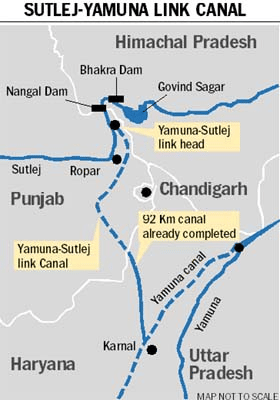
Sutlej-Yamuna Link (SYL) canal project
Sutlej-Yamuna Link (SYL) canal project - Background
- The SYL Canal was inaugurated in 1982 by then-Prime Minister Indira Gandhi with a groundbreaking ceremony in Kapoori village in Patiala district.
- The problem dates back to 1966 when Punjab was reorganized and Haryana was formed.
- According to riparian principles, Punjab was opposed to sharing the waters of the two rivers with Haryana.
- A 214-kilometer stretch was planned, with 122 kilometers in Punjab and 92 kilometers in Haryana.
- However, the Akalis launched an agitation against the canal's construction in the form of the Kapoori Morcha.
- In July 1985, Prime Minister Rajiv Gandhi and the then-chief of the Akali Dal signed an agreement establishing a new tribunal to assess the water.
- The Eradi Tribunal presided over by a Supreme Court Judge, was established to reassess water availability and sharing.
- The tribunal recommended in 1987 that Punjab and Haryana shares be increased to 5 MAF and 3.83 MAF, respectively.
- The Punjab Assembly passed the Punjab Termination of Agreements Act in 2004, terminating its water-sharing agreements and putting the construction of SYL in Punjab in jeopardy.
- In 2016, the Supreme Court began hearings on a presidential reference (Article 143) to determine the legality of the 2004 Act and declared that Punjab had broken its promise to share river waters. As a result, the act was declared constitutionally invalid.
Sutlej-Yamuna Link (SYL) canal project - Dispute
- The Punjab Chief Minister recently warned the Centre of political unrest in the state if the Sutlej-Yamuna Link (SYL) canal project is allowed to proceed.
- Punjab has staked claims to the Yamuna's waters and has reiterated the need for a water-sharing tribunal.
- The Haryana Assembly has passed a resolution calling for the completion of the Sutlej Yamuna Link Canal (SYL), bringing the contentious issue of river water sharing between Haryana and Punjab back into focus.
Argument of Punjab
- Many areas in Punjab may become dry after 2029, and the state has already over-exploited its groundwater for irrigation purposes, as it fills the Centre's granaries with wheat and paddy worth Rs 70,000 crore each year.
- Water is over-exploited in approximately 79% of the state's area, and the government claims that sharing water with any other state is impossible in such a situation.
Argument of Haryana
- Haryana claims that providing irrigation is difficult for the state, and that there is a drinking water shortage in southern Haryana, where groundwater has been depleted up to 1,700 feet.
- Haryana has argued that it is being denied its rightful share of the water as determined by a tribunal by citing its contribution to the central food pool.
Sutlej-Yamuna Link (SYL) canal project - Current situation
- In 2020, the Supreme Court directed the Chief Ministers of both states to negotiate and settle the SYL canal issue at the highest political level, with the Centre acting as a mediator.
- Punjab has requested a new time-bound assessment of water availability from a tribunal.
- Punjab claims that no adjudication or scientific assessment of river waters has occurred in the state to date.
- Ravi-Beas water availability has also decreased, from an estimated 17.17 MAF in 1981 to 13.38 MAF in 2013. All of this would be determined by a new tribunal.
Conclusion
The 214-kilometer-long Satluj Yamuna Link Canal, or SYL for short, links the Sutlej and Yamuna rivers in India. The Haryana government has completed its portion of the canal, bringing it to 85% completion. On its land, 92 kilometers of the canal have been constructed. It would be very advantageous for Haryana to obtain water from the Punjabi Ravi-Beas. By establishing a permanent tribunal with Supreme Court appellate jurisdiction over its rulings, the water disputes can be resolved or balanced.
FAQs
Question: What is the Sutlej-Yamuna Link (SYL) Canal Project?
Answer: The Sutlej-Yamuna Link (SYL) Canal is a proposed canal project aimed at transferring water from the Sutlej River to the Yamuna River. The project was conceived to address the water scarcity issues in the regions of Haryana and Rajasthan by ensuring the equitable distribution of river waters between Punjab, Haryana, and Rajasthan, as per the agreements made in the Indus Water Treaty. The SYL Canal was envisioned as a critical component of the water-sharing arrangements between these states. However, it has faced significant opposition from Punjab, which argues that its water resources are being unfairly diverted, leading to long-standing political and legal disputes between the states involved.
Question: Why was the SYL Canal project initiated?
Answer: The SYL Canal project was initiated to resolve the disputes over water distribution between the northern Indian states of Punjab, Haryana, and Rajasthan. Following the partition of India, the division of river waters between the two countries created significant water scarcity in certain regions. In 1966, the Punjab Reorganization Act was passed, which required the construction of the SYL Canal to ensure equitable sharing of water from the Sutlej River to Haryana and Rajasthan, while also preserving the interests of Punjab. The project was aimed at resolving regional imbalances in water distribution and ensuring sustainable irrigation for agricultural activities in Haryana and Rajasthan.
Question: What were the major challenges faced by the SYL Canal project?
Answer: The SYL Canal project has faced numerous challenges, both political and technical. The primary issue has been the opposition from Punjab, which contends that the diversion of water from the Sutlej River will adversely affect its own agricultural needs. This has led to numerous legal and political disputes, including several Supreme Court rulings on the matter. Another challenge has been the completion of the canal infrastructure itself, with construction work facing delays due to protests, legal cases, and land acquisition problems. Environmental concerns have also been raised about the long-term impacts of diverting water from the Sutlej River, which may affect the local ecosystem and agricultural productivity in the region.
Question: How has the SYL Canal project impacted the relationship between Punjab, Haryana, and Rajasthan?
Answer: The SYL Canal project has significantly strained the relationship between the states of Punjab, Haryana, and Rajasthan. The primary point of contention is the water-sharing dispute, as Punjab has opposed the canal's construction, fearing that it would lead to an unfair distribution of water resources. The project has caused political unrest, with widespread protests in Punjab, which led to the destruction of canal infrastructure. The legal and political battles have further deepened divisions, with successive state and central governments struggling to find an amicable solution. These tensions have made the SYL Canal a prominent and contentious issue in Indian politics, affecting the region’s socio-economic and political environment.
Question: What is the current status of the SYL Canal project?
Answer: As of now, the Sutlej-Yamuna Link (SYL) Canal project remains incomplete and mired in controversy. While the canal’s construction was started in the 1980s, its progress has been stalled due to legal battles, protests, and political opposition, particularly from Punjab. Despite several orders from the Supreme Court of India to complete the project, the construction of the canal has not resumed in full scale. The issue remains unresolved, and efforts to find a consensus between the concerned states continue to be hindered by ongoing disputes. The project’s future is uncertain as the matter continues to be discussed in political and judicial forums.
MCQs
1. What was the main objective of the Sutlej-Yamuna Link (SYL) Canal project?
A) To divert water to Punjab from Haryana
B) To resolve the water-sharing dispute between Punjab, Haryana, and Rajasthan
C) To supply water to Rajasthan exclusively
D) To help in the irrigation of Gujarat
Answer: (B) See the Explanation
Explanation: The SYL Canal project was initiated to resolve the water-sharing dispute between Punjab, Haryana, and Rajasthan, with the goal of providing equitable distribution of water from the Sutlej River to the other two states.
2. Which state has opposed the construction of the SYL Canal?
A) Haryana
B) Rajasthan
C) Punjab
D) Uttar Pradesh
Answer: (C) See the Explanation
Explanation: Punjab has opposed the construction of the SYL Canal, fearing that it would divert too much water from the Sutlej River and affect its agricultural needs.
3. What is the primary reason for the delay in the completion of the SYL Canal project?
A) Legal disputes
B) Lack of financial resources
C) Poor planning
D) Environmental issues
Answer: (A) See the Explanation
Explanation: The primary reason for the delay in the completion of the SYL Canal project has been the ongoing legal disputes and political opposition, particularly from Punjab, which has challenged the project on various grounds.
4. Which river's water is intended to be transferred to the Yamuna River through the SYL Canal?
A) Ganga
B) Sutlej
C) Ravi
D) Brahmaputra
Answer: (B) See the Explanation
Explanation: The Sutlej River's water is intended to be transferred to the Yamuna River through the SYL Canal as part of the water-sharing agreement between Punjab, Haryana, and Rajasthan.
5. What legal action has been taken regarding the SYL Canal project?
A) The project was declared unconstitutional
B) Several Supreme Court orders have been issued to complete the project
C) The project was canceled by the central government
D) The matter was referred to international courts
Answer: (B) See the Explanation
Explanation: Several Supreme Court orders have been issued directing the completion of the SYL Canal project, but the work has been stalled due to political and legal challenges.
GS Mains Questions and Model Answers
Q1: Analyze the socio-political implications of the Sutlej-Yamuna Link Canal project. How has it affected the relations between Punjab, Haryana, and Rajasthan?
Answer: The Sutlej-Yamuna Link Canal project has had significant socio-political implications, particularly in the context of water-sharing disputes between Punjab, Haryana, and Rajasthan. While the project was intended to provide equitable distribution of water from the Sutlej River to Haryana and Rajasthan, Punjab has strongly opposed the construction of the canal. The opposition arises from fears that it would lead to a significant reduction in water availability for Punjab, affecting its agricultural economy. The legal and political battles over the SYL Canal have intensified regional tensions, with the project becoming a contentious issue in state and national politics. The dispute has hindered cooperation between the three states, affecting regional harmony and creating long-standing legal and diplomatic challenges.
Q2: Discuss the role of the SYL Canal project in addressing India's water scarcity issues. What are the challenges and opportunities associated with inter-state water sharing?
Answer: The SYL Canal project was designed to address regional water scarcity by facilitating the equitable sharing of water between Punjab, Haryana, and Rajasthan. As India faces growing water stress due to factors like climate change, population growth, and over-extraction, inter-state water sharing becomes increasingly important. However, the project has encountered significant opposition and legal hurdles, primarily due to concerns about resource allocation and regional fairness. The challenges associated with inter-state water sharing include conflicting interests, legal disputes, and the need for coordinated management. Opportunities lie in creating a fair and efficient water distribution system, improving water conservation techniques, and fostering cooperation among states to ensure sustainable water use across the country.
Q3: Evaluate the environmental and economic impacts of the Sutlej-Yamuna Link Canal project on the regions involved. How can these impacts be mitigated?
Answer: The Sutlej-Yamuna Link Canal project has potential environmental and economic impacts on the regions involved. Environmentally, the diversion of water from the Sutlej River could affect the local ecosystem, including riverine habitats and agricultural productivity in Punjab. Economically, the project aims to boost agricultural output in Haryana and Rajasthan by ensuring a steady supply of water for irrigation, which could improve food security and the livelihoods of farmers. However, the project must also account for the long-term sustainability of water resources and environmental conservation. To mitigate these impacts, there is a need for effective water management practices, including efficient irrigation techniques, water recycling, and protection of the river ecosystem to balance development with environmental sustainability.
Previous Year Questions on SYL Canal Project
1. UPSC CSE Prelims 2020:
Question: What is the primary aim of the Sutlej-Yamuna Link Canal project?
A) To transfer water from the Sutlej to the Yamuna
B) To irrigate Punjab’s agricultural fields
C) To provide drinking water to Rajasthan
D) To reduce water usage in Haryana
Answer: (A)
Explanation: The Sutlej-Yamuna Link Canal project aims to transfer water from the Sutlej River to the Yamuna River, ensuring the equitable distribution of water to the states of Punjab, Haryana, and Rajasthan.
2. UPSC CSE Mains 2018 (GS Paper 2):
Question: "Discuss the political, legal, and environmental challenges associated with the Sutlej-Yamuna Link Canal project. How can these challenges be addressed?"
Answer: The Sutlej-Yamuna Link Canal project faces several political, legal, and environmental challenges. Politically, there is significant opposition from Punjab, which believes that the project will adversely affect its water resources. Legally, there have been numerous court cases regarding the implementation of the project. Environmentally, the diversion of water may disrupt the local ecosystem and agricultural productivity. To address these challenges, a cooperative approach is needed, involving dialogue between the states, judicial intervention to resolve disputes, and sustainable water management practices to minimize environmental damage. Legal and environmental safeguards should be incorporated into the planning and execution phases of the project to ensure fairness and sustainability.
Download the PREPP App and attempt FREE IAS Exam Mock Tests and get complete study material!

Live Test : UPSC CSE Prelims CSAT (Paper-II) (Oct 20 - 23)
Full Test - 04: UPSC CSE Prelims CSAT (Paper-II)
Full Test - 03: UPSC CSE Prelims CSAT (Paper-II)
UPSC CSE Prelims 2026 GS Paper 1 Question Paper (24-May-2026)
UPSC CSE Prelims 2026 CSAT Paper 2 Question Paper (24-May-2026)

17 February 2025 | The Hindu Must Read Articles | Current Affairs

16 February 2026 | The Hindu Must Read Articles | Current Affairs

13 February 2026 | The Hindu Must Read Articles | Current Affairs









Comments