Supercluster of Galaxies: Saraswati – Science & Technology Notes
A group of Indian astronomers have discovered the Saraswati supercluster of galaxies, which is the size of 20 million billion suns. This is one of the largest known structures in the universe's neighbourhood, located 4,000 million light-years away from Earth and dating back more than 10 billion years. Its mass spans a distance of 600 million light years. In this article, we will discuss in detail regarding Supercluster of Galaxies: Saraswati which will be helpful for UPSC exam preparation.
Table of Contents
What is a Supercluster?
- Superclusters are the most massively coherent structures in the universe.
- They are a chain of galaxies and galaxy clusters held together by gravity, often stretching to several hundred times the size of galaxies clusters made up of tens of thousands of galaxies.
- A cluster could contain between 1000 and 10,000 galaxies. A supercluster could contain 40 to 43 clusters.
- Our galaxy is a member of a supercluster known as the Laniakea supercluster.
| Other Relevant Links | |
|---|---|
| Space Organisations | Space race/Space junk |
| South Asia Satellite: Significance | Solar Mission- ADITYA |
| Spitzer Space Telescope | Chandra X-Ray Observatory |
| Multi Application Solar Telescope | Thirty Metre Telescope |
| Resourcesat-2A | Astrosat |
| Sunspot | Magnetars |
| Neutron stars | Air-breathing propulsion system |
| Space Junk | Graveyard Orbit |
What is Supercluster Saraswati?
- The supercluster ‘Saraswati’ was discovered by a team from the Inter University Centre for Astronomy & Astrophysics (IUCAA) and the Indian Institute of Science Education and Research (IISER) in Pune, along with members from two other Indian universities, as part of an international project called the Sloan Digital Sky Survey (SDSS).
- The Saraswati Supercluster is located 1.2 gigaparsecs away, or 4 billion light-years away, in the constellation Pisces.
- It is one of the largest structures discovered in the Universe, spanning over 650 million light-years and containing more than 40 confirmed galaxy clusters weighing more than 2 x 10¹⁶ solar masses.
- In the entire Universe, there are only a few known superclusters of this size.
- Saraswati was discovered using extensive spectroscopic observations made over a large band of sky known as stripe 82.
- Statistical methods were later used to spatially link galaxies, revealing the Saraswati supercluster.
- It is surrounded by vast galactic voids and contains over 40 confirmed galaxy clusters.
- Inside Saraswati, the most massive clusters form a wall-like array with strong filamentary features that evolve over time.
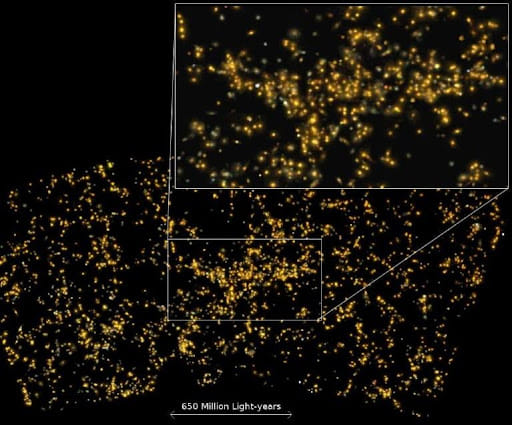
Saraswati Supercluster
What is Sloan Digital Sky Survey (SDSS)?
|
Significance of Supercluster Saraswati
- The discovery is forcing astronomers to reconsider the early stages of the universe's evolution.
- It also provides crucial information about the enigmatic dark matter and dark energy.
- The Saraswati supercluster clearly stands out in the sky as an extremely rare object, possibly among the mega superclusters larger than 500 million light years.
- A massive structure of this scale evolves very slowly.
- As a result, it may reflect the entire history of galaxy formation as well as the primordial initial conditions that seeded it.
Conclusion
The Saraswati Supercluster epitomizes India's growing influence in cosmic research, symbolizing the nation's ascent as a key player in decoding the universe's enigmas. As Indian astronomers collaborate to unravel the universe's mysteries and construct a cosmic narrative, the Saraswati Supercluster reminds us of the vast realms awaiting exploration within the cosmic expanse. As there are only four or five known superclusters of this size in the entire Universe, it has the potential to solve many mysteries while also revealing hidden problems to the scientific community.
| Other Relevant Links | |
|---|---|
| Science & Technology Policy in India | Scientific Policy Resolution 1958 |
| Science & Technology Policy of 1983 | Science & Technology Policy of 2003 |
| Science, Technology and Innovation Policy 2013 | New Initiatives Aligned with the National Agenda |
| India and World collaboration in science projects | Technology Vision Document 2035 |
FAQs
Question: What is the Saraswati Supercluster of Galaxies?
Answer: The Saraswati Supercluster is a vast group of galaxies located approximately 4 billion light-years from Earth. It is one of the largest known structures in the universe, containing thousands of galaxies bound together by gravity.
Question: How was the Saraswati Supercluster discovered?
Answer: The Saraswati Supercluster was discovered using advanced data from the Sloan Digital Sky Survey (SDSS) and other astronomical observations. It was identified by analyzing galaxy redshifts and large-scale cosmic structures.
Question: Where is the Saraswati Supercluster located?
Answer: The Saraswati Supercluster is located approximately 4 billion light-years away from Earth, in the direction of the constellation Leo, in the deep regions of the universe.
Question: What makes the Saraswati Supercluster unique?
Answer: The Saraswati Supercluster is unique due to its size and the large number of galaxies it contains, making it one of the largest known cosmic structures. It challenges existing theories of the universe’s formation.
Question: What are the implications of studying the Saraswati Supercluster?
Answer: Studying the Saraswati Supercluster helps scientists understand the formation and evolution of large-scale cosmic structures. It provides insight into the distribution of dark matter and the behavior of galaxies within superclusters.
MCQs
1. What is the Saraswati Supercluster?
A) A massive black hole
B) A star cluster
C) A group of galaxies bound by gravity
D) A nebula
Answer: (C) See the Explanation
Explanation: The Saraswati Supercluster is a vast group of galaxies bound together by gravity. It is one of the largest structures known in the universe and contains thousands of galaxies.
2. How far is the Saraswati Supercluster from Earth?
A) 1 million light-years
B) 4 billion light-years
C) 10 million light-years
D) 100 million light-years
Answer: (B) See the Explanation
Explanation: The Saraswati Supercluster is located about 4 billion light-years from Earth, making it one of the most distant known structures in the universe.
3. What makes the Saraswati Supercluster significant?
A) Its proximity to Earth
B) Its massive size and number of galaxies
C) It contains a supermassive black hole
D) Its presence in the Milky Way
Answer: (B) See the Explanation
Explanation: The Saraswati Supercluster is significant because of its immense size and the large number of galaxies it contains, making it one of the largest known cosmic structures.
4. What technology was used to discover the Saraswati Supercluster?
A) Hubble Space Telescope
B) Sloan Digital Sky Survey
C) James Webb Space Telescope
D) LIGO
Answer: (B) See the Explanation
Explanation: The Saraswati Supercluster was discovered using the Sloan Digital Sky Survey (SDSS), which provided detailed data on galaxy redshifts and large-scale structures in the universe.
5. What does the study of the Saraswati Supercluster help scientists understand?
A) The formation of black holes
B) The distribution of dark matter and galaxy evolution
C) The behavior of stars in supernovae
D) The nature of dark energy
Answer: (B) See the Explanation
Explanation: Studying the Saraswati Supercluster provides insights into the distribution of dark matter and the evolution of galaxies within superclusters, helping scientists better understand cosmic structures.
GS Mains Questions and Model Answers
Q1: Discuss the significance of discovering large-scale cosmic structures like the Saraswati Supercluster in the study of the universe.
Answer: The discovery of large-scale cosmic structures like the Saraswati Supercluster is significant in the study of the universe as it helps to unravel the complexities of galaxy formation and evolution. The Saraswati Supercluster, being one of the largest known cosmic structures, provides crucial insights into the behavior of galaxies in clusters and superclusters, the role of dark matter in shaping large-scale structures, and the overall distribution of matter in the universe. Understanding such structures challenges and refines existing cosmological models, offering a clearer picture of the universe’s past, present, and future evolution.
Q2: How do the properties of the Saraswati Supercluster challenge existing cosmological theories?
Answer: The Saraswati Supercluster, due to its massive size and the large number of galaxies it contains, poses challenges to existing cosmological theories regarding the distribution of matter in the universe. Theories of galaxy formation and large-scale structure evolution must be reassessed to account for such enormous structures. The study of this supercluster also raises questions about the role of dark matter in galaxy clustering and the behavior of gravitational forces over vast distances. This discovery necessitates a revision of models that explain how galaxies and superclusters evolve over billions of years.
Q3: What technologies have enabled the discovery of superclusters like Saraswati, and what are their implications for future cosmic research?
Answer: The discovery of superclusters like Saraswati has been made possible through advanced astronomical technologies such as the Sloan Digital Sky Survey (SDSS), which provides high-resolution data on galaxy redshifts and large-scale structures. The use of these technologies allows scientists to map out the universe in unprecedented detail, identifying distant galaxies and superclusters. As these technologies continue to evolve, they will enable even more precise measurements of cosmic structures, leading to a deeper understanding of the universe’s origins, its large-scale distribution, and the nature of dark matter and dark energy.
Previous Year Questions on Cosmology and Large-Scale Structures
1. UPSC CSE Mains 2020 (GS Paper 1):
Question: "Explain the concept of large-scale structures in the universe and their significance in cosmological studies."
Answer: Large-scale structures in the universe, such as superclusters and galaxy filaments, are crucial in understanding the distribution of matter and the formation of cosmic entities. These structures give insight into the universe’s evolution, from the Big Bang to the present day. The study of large-scale structures helps in understanding the role of dark matter, gravity, and the expansion of the universe. Superclusters like Saraswati challenge current models of galaxy formation and provide valuable data to refine existing cosmological theories.
2. UPSC CSE Mains 2018 (GS Paper 1):
Question: "What is the role of dark matter in the formation and distribution of superclusters like Saraswati?"
Answer: Dark matter plays a crucial role in the formation and distribution of superclusters like Saraswati by influencing the gravitational pull between galaxies. Dark matter’s gravitational effects are responsible for the large-scale clumping of matter in the universe, creating dense regions where galaxies form and cluster together. Understanding how dark matter behaves within superclusters is essential for advancing our knowledge of galaxy formation and large-scale structure dynamics. Studies of superclusters like Saraswati provide insights into how dark matter shapes the distribution of galaxies across the universe.
Download the PREPP App and attempt FREE IAS Exam Mock Tests and get complete study material!

Full Test - 04: UPSC CSE Prelims CSAT (Paper-II)
Full Test - 03: UPSC CSE Prelims CSAT (Paper-II)
UPSC CSE Prelims 2026 GS Paper 1 Question Paper (24-May-2026)
UPSC CSE Prelims 2026 CSAT Paper 2 Question Paper (24-May-2026)

17 February 2025 | The Hindu Must Read Articles | Current Affairs

16 February 2026 | The Hindu Must Read Articles | Current Affairs

13 February 2026 | The Hindu Must Read Articles | Current Affairs









Comments