Sunspot – Science & Technology Notes
Sunspots are dark, planet-sized areas of strong magnetic fields on the sun's surface. They have the potential to cause eruptive disturbances such as solar flares and coronal mass ejections (CMEs). NASA's Solar Dynamics Observatory (SDO) recently observed a massive Sunspot group known as AR2770. In this article, we will discuss in detail regarding Sunspots which will be helpful for UPSC exam preparation.
Table of Contents
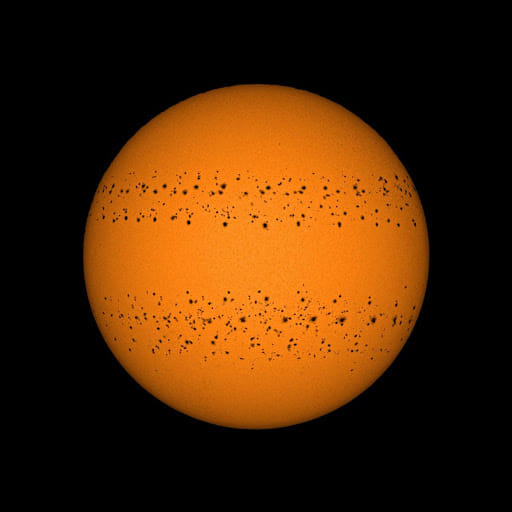
Sunspots
What are Sunspots?
- Sunspots are cooler areas of the Sun's surface caused by massive changes in the magnetic field of the Sun.
- Because they moved across the Sun's surface, some astronomers suspected they were small planets in orbit, while others suspected they were simply flaws in telescopes.
- Sunspot sizes vary greatly. A spot must be approximately twice the size of the Earth to be visible without magnification.
- In comparison, the largest group on record, from 1947, would have required approximately 141 'Earths' to cover it.
- The duration of their appearance varies as well. Some are only visible for a few hours, but one was observed for six months in 1943.
- Sunspots are a common occurrence on our Sun during the years leading up to solar maximum.
- Solar maximum, also known as solar max, is the peak of solar activity in the Sun's solar cycle, which lasts approximately 11 years.
- The temperature of a sunspot remains extremely high—around 6,500 degrees Fahrenheit.
- Sunspots are areas on the Sun where the magnetic field is approximately 2,500 times stronger than that of Earth, much stronger than anywhere else on the Sun.
- The magnetic pressure rises as a result of the strong magnetic field, while the surrounding atmospheric pressure falls.
- This lowers the temperature relative to its surroundings because the concentrated magnetic field prevents hot, new gas from the Sun's interior from reaching the surface.
- Sunspots typically consist of a dark region called the 'umbra' surrounded by a lighter region called the 'penumbra'.
- The umbra, or central dark region, is approximately 6,300 degrees Fahrenheit (3,500 degrees Celsius), while the surrounding photosphere is approximately 10,000 degrees Fahrenheit (5,500 degrees Celsius).
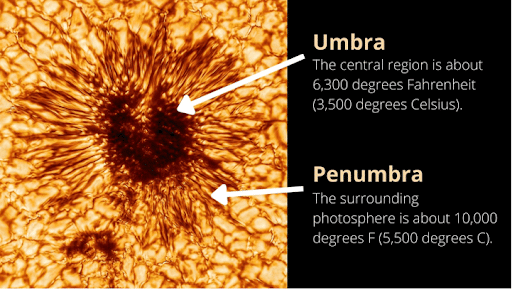
Umbra & Penumbra Region
| Other Relevant Links | |
|---|---|
| Space Organisations | Space race/Space junk |
| South Asia Satellite: Significance | Solar Mission- ADITYA |
| Spitzer Space Telescope | Chandra X-Ray Observatory |
| Multi Application Solar Telescope | Thirty Metre Telescope |
| Resourcesat-2A | Astrosat |
| Magnetars | Neutron stars |
| Air-breathing propulsion system | Space Junk |
| Graveyard Orbit | Supercluster of galaxies known as “Saraswati” |
What causes sunspots?
- The widely accepted theory, proposed by H. Babcock in 1961, suggests that they are caused by changes in the magnetic field of the Sun.
- A 'differential rotation' is created because the Sun's rotation period is faster at the equator than at the poles.
- As the Sun rotates, the magnetic field becomes increasingly 'wound up', stretching the magnetic field between the poles and the equator.
- In the magnetic field, this stretching results in the formation of tubes or tunnels.
- The loops rise and break the surface, preventing superheated gases beneath from convection.
- As a result, areas of lower temperature are formed, which are visible as dark spots.
Cycle of Sunspot
- Heinrich Schwabe discovered in 1843 that the number of sunspots has a cyclical period of about 11 years.
- This cycle can be plotted in two ways.
- One method is to simply count the number of spots and then plot the numbers against a time scale to determine the periodicity.
- The 'Butterfly Diagram' is another method. Sunspots appear primarily near the Sun's north and south poles at the start of a new sunspot cycle. More sunspots appear closer to the Sun's equator as the sunspot cycle progresses.
- Despite the fact that the 11-year cycle has been consistent in modern times, there was a time between 1645 and 1715 when there were almost no spots at all.
- The 'Maunder Minimum' is named after the British astronomer who discovered it from records in 1890.
- This could be part of a cyclical period, but it is impossible to know because it has only been a few hundred years and thus it is too early to tell.
- There are almost no sunspots at the beginning of each solar cycle, when the sun is at its calmest, known as solar minimum.
- However, as the sun approaches solar maximum, the number of dark spots increases dramatically, until the star is completely covered in them, at which point they begin to spit out increasingly frequent and powerful solar flares.
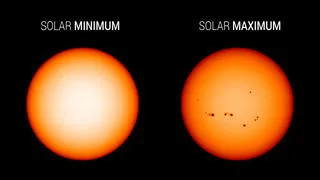
Solar Minimum and Solar Maximum
What are Solar Flares and Coronal Mass Ejections?
- Solar flares are caused by changes in magnetic fields on sunspots, which cause a massive explosion. Solar flares are frequently released into space.
- Solar flares are sometimes accompanied by Coronal Mass Ejections (CMEs), which are large bubbles of radiation and particles emitted by the Sun that explode into space at high speeds.
- The energy released by the solar flare explosion could be equivalent to a trillion 'Little Boy' atomic bombs dropped on Hiroshima and Nagasaki in 1945.
Effects of Solar Activity on Earth
- When charged particles from a CME reach areas close to Earth, they can cause auroras, which are bright lights in the sky.
- When a CME is particularly powerful, it can also disrupt power utility grids, resulting in power shortages and outages at their worst.
- The most powerful explosions in our solar system are solar flares and CMEs.
- Solar flares can have a significant impact on radio communications, GPS connectivity, power grids, and satellites.
Conclusion
The Sun's surface is a hive of activity. It contains electrically charged gases that produce areas of strong magnetic forces known as magnetic fields. The Sun's gases are constantly moving, causing the magnetic fields to tangle, stretch, and twist. This motion causes a lot of activity on the Sun's surface, which is known as solar activity. The Sun's surface can become extremely active at times. At times, things are a little quieter. The amount of solar activity changes as the solar cycle progresses. Because solar activity can have an impact on Earth, scientists closely monitor it every day.
| Other Relevant Links | |
|---|---|
| Science & Technology Policy in India | Scientific Policy Resolution 1958 |
| Science & Technology Policy of 1983 | Science & Technology Policy of 2003 |
| Science, Technology and Innovation Policy 2013 | New Initiatives Aligned with the National Agenda |
| India and World collaboration in science projects | Technology Vision Document 2035 |
FAQs
Question: What are sunspots?
Answer: Sunspots are temporary phenomena on the Sun's photosphere, appearing as spots darker than the surrounding areas due to their lower temperatures.
Question: Why are sunspots important in solar studies?
Answer: Sunspots are important as they indicate solar activity. Their number and distribution can help predict solar storms and affect space weather.
Question: What causes the formation of sunspots?
Answer: Sunspots are caused by intense magnetic activity on the Sun's surface, leading to cooler areas that appear darker than the surrounding regions.
Question: How long do sunspots last?
Answer: Sunspots can last anywhere from a few days to several months, depending on the activity cycle of the Sun.
Question: What is the Solar Cycle?
Answer: The Solar Cycle is an approximately 11-year cycle during which the Sun's magnetic activity, including sunspots, increases and decreases.
MCQs
1. What causes the formation of sunspots on the Sun?
A) Temperature difference between the Sun's layers
B) Gravitational forces from nearby planets
C) Magnetic activity on the Sun's surface
D) Sun's radiation patterns
Answer: (C) See the Explanation
Explanation: Sunspots are formed due to intense magnetic activity on the Sun's surface, which leads to cooler, darker areas compared to the surrounding regions.
2. How long does a typical solar cycle last?
A) 5 years
B) 11 years
C) 20 years
D) 100 years
Answer: (B) See the Explanation
Explanation: The Solar Cycle is approximately 11 years long, during which the Sun's magnetic activity, including sunspots, varies between maximum and minimum levels.
3. What is the effect of sunspots on Earth?
A) No effect
B) They affect the Earth's climate
C) They can cause solar flares and geomagnetic storms
D) They cause natural disasters on Earth
Answer: (C) See the Explanation
Explanation: Sunspots can lead to solar flares and coronal mass ejections, which may cause geomagnetic storms on Earth, affecting satellite communications and power grids.
4. Where do sunspots appear on the Sun?
A) At the poles
B) In the middle of the Sun's surface
C) Near the Sun's equator
D) On the Sun's atmosphere
Answer: (C) See the Explanation
Explanation: Sunspots typically appear in regions around the Sun's equator, where magnetic activity is most intense.
5. What is the typical temperature difference between a sunspot and the Sun’s surface?
A) 1000°C
B) 5000°C
C) 10000°C
D) 30000°C
Answer: (B) See the Explanation
Explanation: Sunspots are cooler than the surrounding Sun's surface, typically by about 3000 to 4000°C, making them appear darker.
GS Mains Questions and Model Answers
Q1: Discuss the significance of sunspots in understanding solar activity and space weather.
Answer: Sunspots are key indicators of solar activity. Their number and distribution vary during the 11-year solar cycle, influencing solar flares and coronal mass ejections (CMEs). These solar phenomena can affect space weather by causing geomagnetic storms that can disrupt satellite communications, GPS systems, and power grids on Earth. Understanding sunspots helps predict these solar events, providing early warning systems for potential disruptions. The study of sunspots is therefore essential for protecting technological infrastructure and understanding solar physics.
Q2: Explain the relationship between sunspots and the Solar Cycle.
Answer: The Solar Cycle, which lasts approximately 11 years, is marked by the increase and decrease in sunspot activity. During the solar maximum, sunspots are numerous, and solar flares and CMEs are more frequent. At solar minimum, sunspot numbers decrease, and solar activity wanes. The behavior of sunspots is closely monitored to understand the Sun's magnetic activity and to predict space weather events. This cycle influences the intensity of solar radiation and can impact Earth's climate and technology.
Q3: How do sunspots impact the Earth's climate and weather systems?
Answer: Sunspots influence the Earth's climate through their effect on solar radiation. During periods of high sunspot activity (solar maximum), increased solar radiation can slightly warm the Earth's atmosphere. Conversely, during periods of low sunspot activity (solar minimum), less radiation is emitted, which could contribute to cooling trends. However, sunspot activity is just one factor among many that influence Earth's climate. While sunspots may contribute to short-term climatic fluctuations, long-term climate change is driven by factors like greenhouse gas emissions and volcanic activity.
Previous Year Questions on Sunspots
1. UPSC CSE Mains 2019 (GS Paper 1):
Question: "What is the role of solar phenomena such as sunspots and solar flares in affecting space weather? Discuss their impact on Earth."
Answer: Solar phenomena such as sunspots and solar flares play a crucial role in space weather. Sunspots are indicators of the Sun's magnetic activity and can lead to solar flares, which release large amounts of energy. These solar flares, along with coronal mass ejections, can impact Earth's magnetic field, causing geomagnetic storms. Such storms can disrupt satellite communications, GPS systems, and even power grids. The understanding of these phenomena is critical to mitigating their potential risks to Earth’s technological infrastructure.
2. UPSC CSE Mains 2020 (GS Paper 1):
Question: "Explain the significance of sunspots in the study of solar cycles and their potential effects on Earth."
Answer: Sunspots are essential in understanding the solar cycle, which lasts approximately 11 years. They are areas of intense magnetic activity on the Sun's surface and can influence solar radiation, solar flares, and coronal mass ejections. These solar activities, driven by sunspot cycles, can affect space weather and Earth's technological systems. The Sun's activity, marked by sunspots, plays a role in influencing Earth's climate and impacts satellite operations, communication systems, and power infrastructure. Monitoring sunspot activity provides valuable insights into space weather predictions.
Download the PREPP App and attempt FREE IAS Exam Mock Tests and get complete study material!

Full Test - 04: UPSC CSE Prelims CSAT (Paper-II)
Full Test - 03: UPSC CSE Prelims CSAT (Paper-II)
UPSC CSE Prelims 2026 GS Paper 1 Question Paper (24-May-2026)
UPSC CSE Prelims 2026 CSAT Paper 2 Question Paper (24-May-2026)

17 February 2025 | The Hindu Must Read Articles | Current Affairs

16 February 2026 | The Hindu Must Read Articles | Current Affairs

13 February 2026 | The Hindu Must Read Articles | Current Affairs









Comments