Stocktaking Climate Finance - A Case Of Circles In Red Link
Relevance: GS3 - Environment and Conservation
(Source: The Hindu, 11/01/2023)
(*Click this link to read prelims specific weekly current affairs articles)
Why in the news?
- This article is based on ‘Stocktaking climate finance — a case of circles in red ink,’ which was published in ‘The Hindu,’ on 11/01/2023.
- It underscores climate finance's crucial role in global trust-building, highlighting several challenges.
Table of Contents
What is Climate Finance?
- Climate finance refers to the funds required for various initiatives, such as renewable energy projects, aimed at reducing the impact of climate change.
- It involves financial support from different sources, including governments, private companies, and alternative funding channels.
- Climate finance plays a vital role in maintaining trust in climate change negotiations. Issues around climate finance will be prominent at Conference of the Parties (COP 28) in Dubai (November 30–December 12).
- The Climate Change 2023: Synthesis Report highlights that the current temperature increase of 1.1°C is contributing to more frequent hazardous weather events.
- In the tussle about who is responsible for Climate change, developed and climate-vulnerable countries keep pushing for increased mitigation efforts by developing countries. At the same time Demand for $100 billion in climate finance is still not met which is expected to be completed by developed countries primarily.
Estimating Adequate Climate Finance
- Developed countries have a binding obligation to allocate financial resources to support developing country parties in addressing climate change, as outlined in Article 9 of the Paris Agreement on Climate Change.
- These developed nations are also mandated to include information about the financial resources they have already supplied and their anticipated levels of public financial support for developing countries in their Biennial Update Reports (BUR).
- At the 15th Conference of Parties (COP15) in Copenhagen in 2009, developed countries promised to gather $100 billion per year by 2020 to help developing countries combat climate change, in the context of meaningful mitigation actions and transparency on implementation.
- This commitment was officially agreed upon at COP16 in Cancun and was also confirmed and extended until 2025 during COP21 in Paris.
Challenges related to Climate Finance
- Struggle in Fulfilling Commitments: Developed countries are struggling to meet their financial commitments, as evidenced by their inability to mobilize the promised $100 billion per year by 2020. The United States provided just 5% of its fair share in 2020.
- Insufficient Funding: At the 26th United Nations Climate Change conference in Glasgow in 2021, the developed countries expressed disappointment as they fell short of their commitment, acknowledging that they had mobilized only $79.6 billion, instead of the intended $100 billion in climate finance.
- Impact on Developing Nations: Developing nations, as highlighted in their Nationally Determined Contributions (NDCs), express financial needs close to $6 trillion until 2030. The gap between needs and actual mobilized funds poses a significant concern for these nations.
- Unclear Burden-Sharing Formula: There is no agreed-upon approach among developed countries for sharing the burden of climate finance. This lack of consensus makes it challenging to predict how the required funds will be mobilized and distributed.
- Replenishment Process: Climate finance mechanisms like the Global Environment Facility and the Green Climate Fund rely on replenishment processes, which may not be reliable or adequate for addressing the growing climate finance needs.
Role of Climate Finance
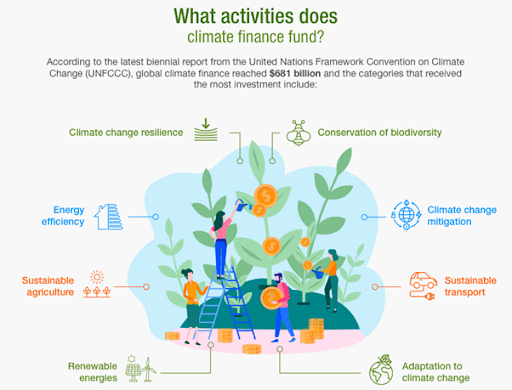
- Funding Mitigation and Adaptation: It provides essential financial resources to support both mitigation efforts (reducing greenhouse gas emissions) and adaptation measures (coping with the effects of climate change). This funding is essential for developing countries to implement climate actions effectively.
- Promoting Equity and Justice: It aims to rectify historical emissions imbalances by ensuring that developing countries, which are often the most affected by climate change, receive the necessary financial support.
- This aligns with the principles of Common but Differentiated Responsibilities and Respective Capabilities, acknowledging varying responsibilities among nations and addressing the historical disparities in emissions.
- Enhancing Global Cooperation: It fosters international collaboration and cooperation, which is essential for achieving global climate goals, such as those outlined in the Paris Agreement. By providing financial support, it helps build trust among nations and encourages them to work together towards a common goal.
- Encouraging Private Sector Investment: It serves as a catalyst for encouraging private sector investment in sustainable and climate-resilient projects. Public funding often leverages additional resources from the private sector, increasing the overall impact of climate actions and projects.
- Capacity Building: It provides support for technology transfer and capacity building in developing countries. This assistance helps these nations better respond to and prepare for climate-related challenges, thereby enhancing their ability to participate effectively in global climate efforts.
- Mobilizing Climate Action: By facilitating the flow of funds to climate-related projects, climate finance plays a pivotal role in the realization of national and international climate targets. It mobilizes action at various levels, helping countries achieve their climate goals and contributing to global efforts to combat climate change.
India and UNFCCC
|
Way Ahead
- Fulfill Existing Commitment: Developed countries must fulfill their existing commitments to provide climate finance, including meeting the $100 billion per year target, which is crucial for building trust among developing nations.
- Transparent Burden-Sharing: Establish a clear and transparent burden-sharing formula among developed countries to ensure equitable contributions to climate finance.
- Mandatory Contribution Framework: Implement a mandatory framework for developed nations to contribute to climate finance, supported by clear mobilization criteria.
- Global Cooperation: Promote global cooperation and urgency to respond collectively to climate finance needs, similar to past financial crises.
- Capacity Building: Prioritize capacity building in developing nations to enable a smooth transition to sustainable practices, including support for those in fossil fuel-dependent economies.
- Long-Term Planning: Develop long-term financing plans and strategies for addressing climate change. This includes integrating climate finance into national budgets and development plans.
(*Click this link to read prelims specific weekly current affairs articles)
FAQs
Question: What is Climate Finance?
Answer:
Climate finance refers to the funds required for various initiatives, such as renewable energy projects, aimed at reducing the impact of climate change. It involves financial support from different sources, including governments, private companies, and alternative funding channels.
Question: What is UNFCCC?
Answer:
The United Nations Framework Convention on Climate Change (UNFCCC), signed in 1992 at the United Nations Conference on Environment and Development also known as the Earth Summit, the Rio Summit or the Rio Conference.
Question: What is Intended Nationally Determined Contributions (INDC)?
Answer:
The Intended Nationally Determined Contributions (INDC) represent each nation's efforts to lower national emissions and prepare for the effects of climate change. The United Nations Framework Convention on Climate Change (UNFCCC) uses the phrase "intended nationally determined contributions" (INDCs).
MCQ
Question: With reference to ‘Global Climate Change Alliance’, which of the following statements is/are correct? (UPSC 2017)
- It is an initiative of the European Union.
- It provides technical and financial support to targeted developing countries to integrate climate change into their development policies and budgets.
- It is coordinated by World Resources Institute (WRI) and World Business Council for Sustainable Development (WBCSD).
Select the correct answer using the code given below:
(a) 1 and 2 only
(b) 3 only
(c) 2 and 3 only
(d) 1, 2 and 3
Answer: (a) See the Explanation
- The European Union (EU) established the Global Climate Change Alliance (GCCA) in 2007 to strengthen dialogue and cooperation with developing countries, particularly least developed countries (LDCs) and small island developing states (SIDS). Hence, statement 1 is correct.
- The GCCA also provides partner countries with technical and financial assistance in integrating climate change into their development policies and budgets, as well as in implementing projects that address climate change on the ground, promoting climate resilient, low-emission development. Hence, statement 2 is correct.
- By fostering effective climate change dialogue and cooperation, the Alliance contributes to ensuring that poor developing countries most vulnerable to climate change increase their capacity to adapt to the effects of climate change, thereby supporting the achievement of the Millennium Development Goals (MDGs).
- There is no mention of WRI or WBCSD on the GCCA's official partner's page, despite the fact that many other institutions, such as FAO and UNDP, are mentioned. Hence, statement 3 is incorrect.
Therefore, option (a) is the correct answer.
Download the PREPP App and attempt FREE IAS Exam Mock Tests and get complete study material!

Full Test - 04: UPSC CSE Prelims CSAT (Paper-II)
Full Test - 03: UPSC CSE Prelims CSAT (Paper-II)
UPSC CSE Prelims 2026 GS Paper 1 Question Paper (24-May-2026)
UPSC CSE Prelims 2026 CSAT Paper 2 Question Paper (24-May-2026)

17 February 2025 | The Hindu Must Read Articles | Current Affairs

16 February 2026 | The Hindu Must Read Articles | Current Affairs

13 February 2026 | The Hindu Must Read Articles | Current Affairs









Comments