Spitzer Space Telescope – Science & Technology Notes
Spitzer was the final mission in NASA's Great Observatories Programme, a family of four space-based observatories that each observed the Universe in a different light. The visible-light Hubble Space Telescope (HST), the Compton Gamma-Ray Observatory (CGRO), and the Chandra X-Ray Observatory (CXO) are among the other missions in the programme. NASA's Spitzer Space Telescope was turned off permanently on January 30, 2020, after nearly 16 years of exploring the universe in infrared light. In this article, we will discuss in detail regarding Spitzer Space Telescope which will be helpful for UPSC exam preparation.
Table of Contents
What is Spitzer Space Telescope?
- The Spitzer Space Telescope was named after physicist Lyman Spitzer, who advocated for orbiting observatories in the 1940s.
- Spitzer is a space telescope that was launched in 2003. It is a cryogenically cooled, space-borne infrared observatory capable of studying objects ranging from the Solar System to the far reaches of the Universe.
- It detects infrared light, which is frequently emitted by 'warm' objects that are not hot enough to emit visible light.
- Spitzer was designed to last at least 2.5 years, but it lasted more than 5.5 years in the cold phase.
- The coolant was finally depleted on May 15, 2009, and the Spitzer "warm mission" began.
- Spitzer continued to operate until January 30, 2020, providing imaging with two channels (at 3.6 and 4.5 microns) in one of its instruments (IRAC).
- In August 2016, the warm mission was renamed the "Spitzer Beyond" mission.
- NASA announced in May 2019 that the Spitzer mission would be terminated on January 30, 2020, with the remaining mission dubbed the "Spitzer Final Voyage."
- NASA's James Webb Space Telescope, which was launched in 2021, will study the universe at many of the same wavelengths as Spitzer.
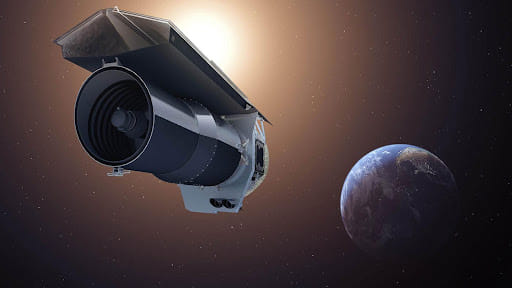
Illustration of Spitzer Space Telescope
| Other Relevant Links | |
|---|---|
| Space Organisations | Space race/Space junk |
| South Asia Satellite: Significance | Solar Mission- ADITYA |
| Chandra X-Ray Observatory | Multi Application Solar Telescope |
| Thirty Metre Telescope | Resourcesat-2A |
| Astrosat | Sunspot |
| Magnetars | Neutron stars |
| Air-breathing propulsion system | Space Junk |
| Graveyard Orbit | Supercluster of galaxies known as “Saraswati” |
Components & Working of Spitzer Space Telescope
- Spitzer was built to detect infrared radiation, which primarily consists of heat radiation. It was made up of two major parts:
- The Cryogenic Telescope Assembly, which housed Spitzer's three scientific instruments as well as the 85-centimeter telescope.
- The spacecraft was in charge of controlling the telescope, powering the instruments, handling scientific data, and communicating with Earth.
- It may appear to be a contradiction, but NASA's Spitzer Space Telescope needed to be both warm and cold at the same time to function properly.
- Everything in the Cryogenic Telescope Assembly had to be cooled to just a few degrees above absolute zero (-459°F, or -273°C).
- This was accomplished using an onboard tank of liquid helium, also known as cryogen.
- Meanwhile, electronic equipment in The Spacecraft portion required near-room temperature operation.
- Spitzer's highly sensitive instruments allowed scientists to peer into cosmic regions that optical telescopes cannot see, such as dusty stellar nurseries, galaxies' centres, and newly forming planetary systems.
- Spitzer's infrared vision also enabled astronomers to see cooler objects in space, such as failed stars (brown dwarfs), extrasolar planets, massive molecular clouds, and organic molecules that could hold the key to life on other planets.
Major Discoveries of Spitzer Space Telescope
1) Seven Earth size planets around a single star
- Spitzer pioneered research into exoplanet atmospheres (atmospheres of planets orbiting stars other than our Sun).
- It confirmed two and discovered five of the seven Earth-size exoplanets orbiting TRAPPIST-1 - the most terrestrial planets ever discovered orbiting a single star.
- Three of its seven planets were in the "habitable zone," where the temperature was possibly warm enough for liquid water to exist on the planets' surfaces.
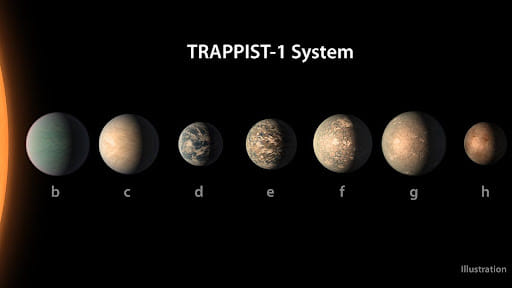
TRAPPIST-1 System
2) Big Baby Galaxies
- Spitzer has made significant contributions to the study of some of the most distantly formed galaxies ever studied.
- Because it takes billions of years for light from these galaxies to reach Earth, scientists see them as they were billions of years ago.
- Spitzer observed the most distant galaxies emitting light about 13.4 billion years ago, or less than 400 million years after the universe's birth.
- One of the most surprising discoveries in this field was the discovery of "big baby" galaxies, which were much larger and more mature than scientists expected early-forming galaxies to be.
3) Unprecedented Map of Milky Way
- In 2013, scientists assembled over 2 million Spitzer images gathered over a decade to create one of the most comprehensive maps of the Milky Way galaxy ever created.
- Viewing the Milky Way is difficult because dust obscures visible light, obscuring entire regions of the galaxy.
- Infrared light, on the other hand, can often penetrate dusty regions better than visible light, revealing hidden sections of the galaxy.
- Spitzer data studies of the Milky Way galaxy have provided scientists with improved maps of the galaxy's spiral structure and central "bar" of stars.
- Spitzer has assisted in the discovery of new remote sites of star formation and has revealed a higher abundance of carbon in the galaxy than previously thought.
4) Spotting Small Asteroids
- Spitzer's infrared vision enables it to study some of the most distant objects discovered to date.
- This space observatory, however, can also be used to study small objects that are closer to Earth.
- Spitzer, in particular, has assisted scientists in identifying and studying Near-Earth Asteroids (NEAs).
- NASA keeps track of these objects to ensure that none of them are on a collision course with our planet.
5) First light from an exoplanet
- Spitzer was the first telescope to detect light from a planet beyond our solar system. Exoplanets had previously only been observed indirectly.
- This achievement marked the beginning of a new era in exoplanet science and a significant step towards detecting possible signs of life on rocky exoplanets.
6) Most Distant Planet
- Spitzer assisted scientists in detecting one of the most distant planets ever discovered, approximately 13,000 light-years from Earth.
- The majority of previously discovered exoplanets are within 1,000 light years of Earth. The graph above depicts these relative distances.
- Spitzer accomplished this feat using a ground-based telescope and a planet-hunting technique known as microlensing.
- This method is based on gravitational lensing, a phenomenon in which light is bent and magnified by gravity.
7) Faraway Black Holes
- Most galaxies have supermassive black holes at their cores.
- Spitzer detected two of the most distant supermassive black holes ever discovered, providing insight into the evolution of galaxy formation in the universe.
- Galactic black holes are typically surrounded by dust and gas structures that feed and sustain them.
- Quasars are black holes and the discs that surround them. The light from the two quasars discovered by Spitzer travelled for 13 billion years to reach Earth, implying that they formed less than 1 billion years after the universe began.
8) First ‘taste’ of Exoplanet Atmospheres
- Spitzer was the first telescope to directly identify molecules in the atmospheres of exoplanets in 2007.
- The researchers used spectroscopy to identify chemical molecules in two different gas exoplanets.
- These "hot Jupiters" are called HD 209458b and HD 189733b, and they are made of gas (rather than rock), but they orbit much closer to their suns than the gas planets in our own solar system.
- The direct study of exoplanet atmosphere composition was a significant step towards the possibility of detecting signs of life on rocky exoplanets one day.
9) Solar System Smashups
- Spitzer has discovered evidence of a number of rocky collisions in distant solar systems.
- These kinds of collisions were common in the early days of our Solar System and helped to form planets.
10) Buckyballs in Space
- Buckyballs are spherical carbon molecules with the hexagon-pentagon pattern seen on a soccer ball's surface.
- Spitzer was the first telescope in space to detect Buckyballs. It discovered the spheres in the material surrounding Tc 1, a dying star or planetary nebula.
- Tc 1's central star was once similar to our Sun, but as it aged, it shed its outer layers, leaving only a dense white dwarf star.
- Buckyballs, according to astronomers, were formed in layers of carbon that were blown off the star.
- Follow-up research using Spitzer data has assisted scientists in learning more about the prevalence of these unique carbon structures in nature.
11) Largest known ring around Saturn
- Saturn's stunning ring system has been extensively photographed, but none of the portraits have revealed the planet's largest ring.
- The wispy structure is a diffuse collection of particles that orbits Saturn much further away than any other known ring.
- Phoebe, Saturn's most distant moon, circles within the ring and is most likely the source of its material.
- The ring's small particle count does not reflect much visible light, especially at Saturn's orbit where sunlight is weak, which is why it has remained hidden for so long.
- Spitzer detected the glow of cool dust in the ring, which has a temperature of about -316 degrees Fahrenheit or -192 degrees Celsius, or 80 Kelvin.
12) Growing Galactic Metropolis
- Spitzer detected a very distant collection of galaxies called COSMOS-AzTEC3 in 2011.
- This group of galaxies' light had travelled for more than 12 billion years to reach Earth.
- Astronomers believe that objects like this one, known as a proto-cluster, evolved into modern galaxy clusters, or groups of galaxies held together by gravity.
- COSMOS-AzTEC3 was the most distant proto-cluster ever discovered.
- It gives researchers a better understanding of how galaxies formed and evolved throughout the universe's history.
13) Hidden Cradles of Newborn Stars
- In most cases, infrared light can penetrate gas and dust clouds better than visible light. As a result, Spitzer has provided unprecedented views into star-forming regions.
- Spitzer captured this image of newborn stars peeking out from beneath their natal dust blanket in the Rho Ophiuchi dark cloud.
- This cloud, known as "Rho Oph" by astronomers, is one of the closest star-forming regions to our own Solar System.
- The nebula is about 410 light years away from Earth and is located near the constellations Scorpius and Ophiuchus in the sky.
14) First Exoplanet Weather Map
- In May 2009, scientists used Spitzer data to create the first-ever "weather map" of an exoplanet, which is a planet that orbits a star other than the Sun.
- This exoplanet weather map depicted temperature variations on the surface of HD 189733b, a giant gas planet.
- Furthermore, the study revealed that raging winds are most likely whipping through the planet's atmosphere.
Conclusion
Spitzer was able to detect the dynamics of some of the universe's most distant galaxies, but Webb, once launched, will look even further and help pinpoint how the first stars and galaxies formed. Although Spitzer was able to identify a few molecules in exoplanetary atmospheres, its successor will search for the chemical building blocks of living organisms on many more planets. Nonetheless, Spitzer was transformative, and it has left behind a massive data archive that will be mined for future discoveries.
| Other Relevant Links | |
|---|---|
| Science & Technology Policy in India | Scientific Policy Resolution 1958 |
| Science & Technology Policy of 1983 | Science & Technology Policy of 2003 |
| Science, Technology and Innovation Policy 2013 | New Initiatives Aligned with the National Agenda |
| India and World collaboration in science projects | Technology Vision Document 2035 |
FAQs
Question: What is the Spitzer Space Telescope?
Answer: The Spitzer Space Telescope was a space observatory launched by NASA in 2003. It was designed to observe the universe in infrared light, providing insights into the formation of stars, galaxies, and planetary systems. It played a crucial role in enhancing our understanding of the cosmos before its mission ended in 2020.
Question: What were the key objectives of the Spitzer Space Telescope?
Answer: The main objectives of the Spitzer Space Telescope were to study the formation of stars and planetary systems, explore the nature of distant galaxies, observe exoplanets, and investigate the structure and composition of interstellar dust and gas. Its ability to observe infrared light enabled it to peer through dust clouds and study cosmic phenomena that are invisible in visible light.
Question: How did the Spitzer Space Telescope contribute to the study of exoplanets?
Answer: Spitzer made significant contributions to the study of exoplanets by observing their atmospheres and identifying the presence of key molecules such as water vapor, methane, and carbon dioxide. It also helped detect the thermal emission of exoplanets and study their orbits and climates, further advancing our knowledge of planets outside our solar system.
Question: What were some of the major discoveries made by the Spitzer Space Telescope?
Answer: Some of the major discoveries made by Spitzer include the detection of exoplanets with atmospheres conducive to life, insights into the formation of supermassive black holes, and observations of distant galaxies, including those formed shortly after the Big Bang. Spitzer also provided detailed studies of star formation and the detection of water in space.
Question: Why was the Spitzer Space Telescope decommissioned?
Answer: The Spitzer Space Telescope was decommissioned in 2020 after completing its mission objectives. Its mission was extended multiple times, but the spacecraft eventually ran out of the fuel needed to keep it in its correct orbit. Despite its decommissioning, its legacy continues to influence astrophysical research through the data it collected over nearly two decades.
MCQs
1. What was the primary purpose of the Spitzer Space Telescope?
A) To study the universe in visible light
B) To study the universe in infrared light
C) To observe black holes in X-rays
D) To map the surface of Mars
Answer: (B) See the Explanation
The Spitzer Space Telescope was designed to observe the universe in infrared light, allowing it to see through cosmic dust and explore phenomena invisible in visible light.
2. Which of the following discoveries is associated with the Spitzer Space Telescope?
A) Detection of gravitational waves
B) Study of distant galaxies and exoplanets
C) Mapping the surface of Venus
D) Observing Jupiter's moons
Answer: (B) See the Explanation
The Spitzer Space Telescope is primarily known for its studies of distant galaxies, the detection of exoplanets, and observing the formation of stars and planetary systems.
3. Which scientific instrument aboard the Spitzer Space Telescope was crucial for its observations?
A) Ultraviolet Spectrometer
B) Infrared Spectrometer
C) Gamma-ray Detector
D) X-ray Spectrometer
Answer: (B) See the Explanation
The Infrared Spectrometer aboard the Spitzer Space Telescope was crucial for its observations, allowing it to detect and analyze infrared wavelengths of light emitted by cosmic objects.
4. What is one of the key reasons for the Spitzer Space Telescope's ability to study distant galaxies?
A) Its ability to detect visible light
B) Its ability to detect radio waves
C) Its ability to detect infrared light
D) Its ability to study cosmic rays
Answer: (C) See the Explanation
Spitzer's ability to detect infrared light allowed it to study distant galaxies, as infrared wavelengths can pass through cosmic dust clouds that obscure objects from visible light observation.
5. When was the Spitzer Space Telescope launched?
A) 1998
B) 2003
C) 2010
D) 2015
Answer: (B) See the Explanation
The Spitzer Space Telescope was launched in 2003 and was in operation for nearly two decades before being decommissioned in 2020.
GS Mains Questions and Model Answers
Q1: Discuss the contributions of the Spitzer Space Telescope to the field of astrophysics.
Answer: The Spitzer Space Telescope made significant contributions to astrophysics, particularly in the study of the formation of stars, galaxies, and planetary systems. Its ability to observe infrared light allowed it to penetrate cosmic dust, providing unparalleled views of areas that were previously hidden. Spitzer’s findings have enriched our understanding of distant galaxies, supermassive black holes, and exoplanets, including the detection of water vapor in exoplanet atmospheres. By observing the universe through infrared wavelengths, Spitzer has also provided valuable data on the early universe and the formation of the first galaxies, helping to shape our current understanding of the cosmos.
Q2: What role did the Spitzer Space Telescope play in the discovery and study of exoplanets?
Answer: The Spitzer Space Telescope played a pivotal role in the discovery and study of exoplanets. It contributed to detecting exoplanet atmospheres and identifying key molecules such as water vapor, methane, and carbon dioxide. Spitzer’s ability to detect infrared emissions allowed scientists to study the heat signatures of exoplanets, enabling them to examine planetary climates and orbital characteristics. The telescope's observations have provided important data for assessing the potential habitability of exoplanets and have advanced our understanding of planetary systems beyond our own.
Q3: Evaluate the significance of infrared astronomy in advancing our understanding of the universe, particularly through instruments like the Spitzer Space Telescope.
Answer: Infrared astronomy has been crucial in advancing our understanding of the universe by providing insights into regions of space that are obscured by dust and gas, which are often opaque to visible light. Instruments like the Spitzer Space Telescope have enabled astronomers to peer into these regions and observe the birth of stars and planetary systems, study the structure of galaxies, and investigate distant cosmic phenomena. Infrared astronomy has revealed the presence of exoplanets, provided data on their atmospheres, and helped scientists examine the early stages of galaxy formation. The success of Spitzer underscores the importance of infrared telescopes in the modern study of space.
Previous Year Questions on Space Exploration
1. UPSC CSE Prelims 2021:
Question: The Spitzer Space Telescope primarily observes the universe in which type of light?
A) X-rays
B) Gamma rays
C) Infrared light
D) Ultraviolet light
Answer: (C)
Explanation: The Spitzer Space Telescope primarily observes the universe in infrared light, enabling it to study distant galaxies, stars, and planetary systems that are hidden by cosmic dust.
2. UPSC CSE Mains 2020 (GS Paper 3):
Question: "Assess the contributions of space telescopes like the Spitzer Space Telescope to our understanding of the universe."
Answer: Space telescopes like the Spitzer Space Telescope have provided invaluable contributions to our understanding of the universe, especially in the areas of star formation, galaxy evolution, and exoplanet discovery. By observing infrared light, Spitzer was able to see through cosmic dust, providing a clearer view of regions like star-forming nebulae and distant galaxies. Its observations have led to the discovery of exoplanets, detected key molecules in their atmospheres, and shed light on the early universe. Spitzer’s data has significantly advanced our knowledge of the cosmos and continues to influence space exploration and astrophysical research.
Download the PREPP App and attempt FREE IAS Exam Mock Tests and get complete study material!

Full Test - 04: UPSC CSE Prelims CSAT (Paper-II)
Full Test - 03: UPSC CSE Prelims CSAT (Paper-II)
UPSC CSE Prelims 2026 GS Paper 1 Question Paper (24-May-2026)
UPSC CSE Prelims 2026 CSAT Paper 2 Question Paper (24-May-2026)

17 February 2025 | The Hindu Must Read Articles | Current Affairs

16 February 2026 | The Hindu Must Read Articles | Current Affairs

13 February 2026 | The Hindu Must Read Articles | Current Affairs









Comments