Spectrum Management – Science & Technology Notes
Spectrum management defines radiocommunication service allocations, technical specifications, and which services and technologies can operate in a country. It is a vital aspect of modern telecommunications, encompassing the strategic allocation, regulation, and efficient use of radio frequency spectrum. As such, it can influence the rate at which such technologies are deployed. In this article, we will discuss regarding Spectrum Management which will be helpful for UPSC exam preparation.
Table of Contents
What is Spectrum?
- The invisible radio frequencies that wireless signals travel over are referred to as the spectrum.
- Cell phones and wireline telephones, for example, require signals to connect from one end to the other.
- These signals are transmitted via airwaves (a medium for radio waves) and must be sent at specific frequencies to avoid interference.
- All of these airwaves are sold for a set period of time after which their validity expires, which is usually 20 years.
- The Union government owns all publicly available assets within the country's geographical boundaries, including airwaves.
- With the growing number of cell phone, wireline phone, and internet users, the need for more signal space arises from time to time.
| Other Relevant Links | |
|---|---|
| NASA: Asteroid impact and deflection assessment mission | Commercial use of Lithium-Ionbattery technology |
| Hyperspectral imaging satellite | Water propulsion system in CUBESAT |
| Neutrino Observatory | Indian Space Vision-2025 |
| Major Policy Initiatives National Optical Fibre network | Cyber Law |
| Internet, Types of Network and e- Governance | Spectrum Policy in India |
| Mobile Spectrum | Cloud Computing |
| Big Data | Encryption |
| Biometrics | Virtual Reality |
What is Spectrum Management?
- Spectrum management refers to the process of planning, allocating, and coordinating the use of radio frequencies for various wireless communication services.
- It involves ensuring the equitable distribution of spectrum resources, minimizing interference, and maximizing the efficient utilization of available frequencies.
- Spectrum management is far more complex than simply allocating frequencies. Spectrum reuse is both desirable and required.
- Spectrum management is the control of all aspects of electromagnetic radiation.
- The goal is to protect users from harmful interference while allowing optimal spectrum use.
Spectrum Management in India
- Spectrum management is an important component of the TRAI and refers to the process of regulating radio frequency use in order to promote efficient use and gain a net social benefit.
- The Wireless Planning and Coordination (WPC) is in charge of Frequency Spectrum Management, which includes licencing and catering to all wireless users in the country.
- It is divided into sections such as Licencing and Regulation (LR), New Technology Group (NTG), and Standing Advisory Committee on Radio Frequency Allocation (SACFA) and issues licences to establish, maintain, and operate wireless stations.
- SACFA makes recommendations on major frequency allocation issues, formulates frequency allocation plans, and makes recommendations on various International Telecommunication Union (ITU) issues.
Role of WPC
|
Spectrum Allocation Process
- The auction begins with the offering of Spectrum.
- A circle-wise list with a base price, available frequency bands, and quantum of Spectrum at each circle is circulated.
- The applicant must have a Unified licence with Access Services authorization for the circle in which you wish to bid.
- The applicant will be granted Spectrum bidding permission based on the Unified Licence.
- There are currently more than forty communication services in India, and all of these services operate at a specific frequency, which requires permission from the WPC to access.
- It is run in accordance with the Department of Telecommunications' National Frequency Action Plan for 2018.
- This plan grants various services, such as television broadcasting, cellular services, Wi-Fi, and so on, a frequency band in which to operate their services in India.
- Spectrum is allocated through an auction in SMRA format (in this format, the Proposed Service Provider bids on multiple lots, all of which are offered simultaneously and closed together, corresponding to the right to use a specific frequency band at a specific location).
- The SMRA auction process is divided into rounds, and the results of each round are made public.
- Each round allows bidders to fine-tune their strategies.
- Finally, when a bidder completes their bidding activity, that point serves as the auction's closing round.
- Following the 2G scam, the spectrum allocation and licencing processes were separated.
Authorized Person for Unified Licencing
- The Saral Sanchar portal streamlines the process of filing applications and issuing telecom licences; for licence granting and registrations for Unified licences, the infrastructure service Provider must only use the online portal.
- The Unified licencing services are available to entities registered in India. The current FDI regime allows for up to 100% FDI in the telecom sector via the automatic route.
- The applicant must be a company registered under Indian company law.
- The licence authorization and spectrum allocation are two separate things; separate forms must be filled out to obtain the Spectrum and licence.
Types of Spectrum Auctions
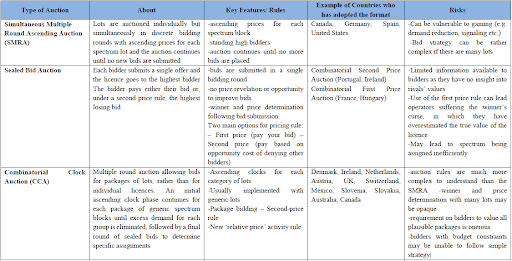
Auctions have become the preferred method of assignment in several countries since the 1990s. However, auction design is a topic of academic debate. The auction format chosen is critical because it can influence auction outcomes as well as the resulting competition. Following are some of the popular auction formats:
- Simultaneous Multiple-round Ascending Auctions (SMRA)
- Related lots are auctioned simultaneously in a series of rounds in SMRA, the most established auction format.
- One of the primary disadvantages of SMRA is the existence of 'aggregation risk,' which means that a bidder may end up with certain redundant blocks of spectrum.
- Combinatorial Clock Auctions (CCA)
- The CCA is a variant of the SMRA in which bidders compete for packages.
- It is a complex design that addresses the risks of SMRA while strengthening it.
- Sealed bid auctions
- The sealed bid auction allows regulators to include non-financial criteria in the selection process, but it does not allow bidders to see how other auction participants value spectrum.
Regulation of Spectrum
The proliferation of wireless communications and the advancement of new technologies have made spectrum management and allocation a critical task. Governments and regulators must strike a balance between resource mobilisation and public welfare. The three fundamental models for spectrum regulation are as follows:
Command and Control Model
- The command-and-control model is the least flexible, whereas the generic licencing regime is the most flexible.
- The government allocates spectrum under command and control based on network, rollout, coverage, and technology in what has become known as a beauty contest9. It also closely monitors its use.
- This model was used in several countries during the early stages of telecom liberalisation and was successful in terms of early roll-out and rapid growth, but it ran into problems over time.
Market Oriented Model
- Administrative spectrum allocation is rigid, may involve long delays, and may result in over and under allocation.
- The shift towards market-oriented allocation was motivated by the fact that auctions allow spectrum to be placed in the hands of operators who can best use it.
- Auctions are also more transparent, removing the subjective nature of a beauty pageant.
- Furthermore, if a secondary market for spectrum exists, trading and/or leasing will improve efficiency.
Generic Licencing or Common Use Model
- The common use model completely liberalises spectrum use.
- There are no limitations on the type of service or technology that can operate on a frequency band.
- A single frequency band can be accessed by multiple users.
- Spectrum assignment has recently shifted away from a command and control model and towards a hybrid of market-oriented and common-use open-access models.
Spectrum Auction in India
- The year 2010 marked a turning point in India's spectrum management policies. Until then, spectrum was assigned administratively, and then by auction.
- The underlying rationale was to enable efficient spectrum use, avoid hoarding, stimulate competition, and promote the deployment of 3G and broadband services.
- The auction was also used by the government to generate revenue.
- The 2010 auction was a success in that it sold all of the lots above the reserve prices set by the regulator.
- The previous administrative assignment of spectrum for 2G services in 2008 was dismissed by the Supreme Court in February 201221 due to a lack of transparency in the process and favouritism.
- The Court of Appeal ordered the government to auction spectrum in perpetuity.
- The Department of Telecommunications (DoT) held several rounds of spectrum auctions using the Simultaneous Multiple Round Ascending (SMRA) method between 2012 and 2016.
- The auctions for various circles were held concurrently in continuous cycles known as clock rounds.
- Spectrum allocation and management have frequently been at the heart of disputes between operators and the government in India.
- Over time, India has shifted away from subjective administrative assignment and towards a market-based auction mechanism to assign spectrum under a 'quasi-property rights' regime.
- This means that the operators' rights to alienate the frequency are subject to various government-imposed trading, leasing, and use restrictions.
- By 2016, India's spectrum management regime had become far more flexible than in the past.
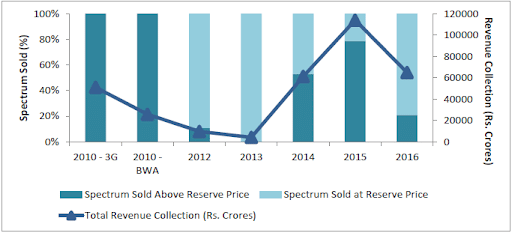
Auction Outcomes in India from 2010-2016
Conclusion
Spectrum, as a scarce resource, necessitates proper management by regulators in order to ensure equitable access and an interference-free environment for various users and services, as well as to introduce new technologies. As a result, the right balance must be struck between regulatory requirements that provide certainty and protect consumers and the need to ensure flexibility for the development of new wireless technologies. Given the dual goals of spectrum auctions – efficient allocation of spectrum to best use and maximisation of government revenue – auctions must be carefully designed.
| Other Relevant Links | |
|---|---|
| Science & Technology Policy in India | Scientific Policy Resolution 1958 |
| Science & Technology Policy of 1983 | Science & Technology Policy of 2003 |
| Science, Technology and Innovation Policy 2013 | New Initiatives Aligned with the National Agenda |
| India and World collaboration in science projects | Technology Vision Document 2035 |
FAQs
Question: What is Spectrum Management?
Answer: Spectrum Management refers to the process of planning, coordinating, and managing the radio frequency spectrum to avoid interference and ensure its efficient use for communication technologies, such as mobile networks and broadcasting.
Question: Why is Spectrum Management important?
Answer: It ensures the efficient allocation and use of radio frequencies, which are a limited resource. Proper spectrum management supports the growth of telecommunications, broadcasting, and other wireless technologies, promoting economic and social development.
Question: What are the challenges in Spectrum Management?
Answer: Key challenges include interference between users, the scarcity of available frequencies, technological advancements, and the need for international coordination. Balancing the demands of different industries, like broadcasting and mobile networks, is also difficult.
Question: What role does the government play in Spectrum Management?
Answer: Governments regulate and allocate radio frequencies, ensuring fair distribution among various users. They establish policies, grant licenses, and enforce laws to prevent interference and maximize spectrum efficiency for national development.
Question: What are some examples of Spectrum Management techniques?
Answer: Techniques include frequency allocation, spectrum auction, and dynamic spectrum access. These methods ensure that the spectrum is used effectively and that new technologies can be accommodated without causing harmful interference.
MCQs
1. What is the primary goal of Spectrum Management?
A) To increase the number of frequency bands
B) To prevent interference between communication services
C) To restrict the use of mobile networks
D) To ensure only government-controlled access to the spectrum
Answer: (B) See the Explanation
Explanation: The primary goal of Spectrum Management is to prevent interference between communication services by ensuring that different services operate on different frequencies, making the best use of limited spectrum resources.
2. Which of the following is a key challenge in Spectrum Management?
A) Excess availability of radio frequencies
B) Difficulty in coordinating international standards
C) Over-regulation by private companies
D) Abundance of spectrum usage rights
Answer: (B) See the Explanation
Explanation: A key challenge in Spectrum Management is the difficulty in coordinating international standards, as radio frequencies do not follow national borders, and cross-border interference needs to be minimized through international agreements.
3. What is a Spectrum Auction?
A) A process for selling radio frequencies to the highest bidder
B) A method for allocating frequencies to different government departments
C) A way to randomly assign frequencies to users
D) A technique to reserve frequencies for emergency services
Answer: (A) See the Explanation
Explanation: A Spectrum Auction is a process in which governments sell radio frequencies to the highest bidder. This process is often used to allocate spectrum rights to telecommunications companies and broadcasters.
4. Who regulates Spectrum Management in most countries?
A) International Telecommunication Union (ITU)
B) World Trade Organization (WTO)
C) National Government Agencies
D) Telecommunication Companies
Answer: (C) See the Explanation
Explanation: In most countries, Spectrum Management is regulated by national government agencies. These agencies allocate spectrum, issue licenses, and enforce laws to ensure efficient and interference-free use of the spectrum.
5. What is Dynamic Spectrum Access (DSA)?
A) A method to fix the allocation of frequencies
B) A way to monitor spectrum usage in real-time
C) A technique that allows flexible use of spectrum based on demand
D) A policy to privatize spectrum rights
Answer: (C) See the Explanation
Explanation: Dynamic Spectrum Access (DSA) is a technique that allows flexible, real-time use of the radio frequency spectrum based on demand. It helps maximize spectrum efficiency by enabling opportunistic access to unused frequencies.
GS Mains Questions and Model Answers
Q1: Explain the significance of Spectrum Management in the context of the Indian telecommunications sector.
Answer: Spectrum Management is crucial for the development of India's telecommunications sector. The growing demand for mobile services, internet connectivity, and broadband services requires careful allocation and management of the radio spectrum. The government’s initiatives, such as spectrum auctions, have facilitated efficient spectrum use. However, issues such as spectrum scarcity, interference, and the need for new technologies like 5G require improved management. Effective spectrum management enables faster network expansion, better service quality, and greater competition in the telecommunications market, which is essential for both economic growth and social inclusion.
Q2: Discuss the role of international cooperation in Spectrum Management. Why is it important?
Answer: International cooperation in Spectrum Management is essential because radio frequencies do not adhere to national borders. The management of the spectrum needs global coordination to prevent interference between countries, especially in the case of satellite communications and cross-border telecommunication services. Organizations like the International Telecommunication Union (ITU) play a crucial role in establishing international standards and agreements to allocate and harmonize spectrum usage. Without such cooperation, inefficient spectrum usage and harmful interference could severely disrupt global communication systems and technological advancements.
Q3: Analyze the challenges and opportunities presented by the auction of spectrum frequencies in India.
Answer: The auction of spectrum frequencies in India presents both challenges and opportunities. One challenge is the high cost of acquiring spectrum, which can limit the ability of smaller players to enter the market, leading to monopolies or oligopolies. Additionally, spectrum scarcity and interference can reduce the efficiency of mobile networks. However, the auction system also offers opportunities by allowing transparent and market-driven allocation of spectrum. It provides the government with significant revenue and ensures that frequencies are allocated to the highest-value users. The key to success is balancing the auction process with policies that encourage competition, innovation, and affordable services for consumers.
Previous Year Questions on Spectrum Management
1. UPSC CSE Prelims 2020:
Question: What is the purpose of Spectrum Auctions?
A) To generate revenue for the government
B) To allocate spectrum to private telecom operators
C) To prevent interference in wireless communications
D) All of the above
Answer: (D)
Explanation: Spectrum Auctions serve multiple purposes, including generating government revenue, allocating spectrum to private telecom operators, and preventing interference in wireless communications by ensuring that frequencies are used effectively.
2. UPSC CSE Mains 2019 (GS Paper 3):
Question: How does effective Spectrum Management contribute to the technological and economic development of a nation?
Answer: Effective Spectrum Management ensures the efficient use of radio frequencies, allowing for the growth of communication technologies, such as mobile networks, broadcasting, and wireless internet. This facilitates the development of information technology, promotes economic growth, and enhances global competitiveness. Additionally, it contributes to the expansion of services like 5G, which are critical for industrial automation, healthcare advancements, and smart cities, thus having a profound impact on national development.
Download the PREPP App and attempt FREE IAS Exam Mock Tests and get complete study material!

Full Test - 04: UPSC CSE Prelims CSAT (Paper-II)
Full Test - 03: UPSC CSE Prelims CSAT (Paper-II)
UPSC CSE Prelims 2026 GS Paper 1 Question Paper (24-May-2026)
UPSC CSE Prelims 2026 CSAT Paper 2 Question Paper (24-May-2026)

17 February 2025 | The Hindu Must Read Articles | Current Affairs

16 February 2026 | The Hindu Must Read Articles | Current Affairs

13 February 2026 | The Hindu Must Read Articles | Current Affairs









Comments