Space Junk – Science & Technology Notes
Space junk or space debris is the accumulation of artificial objects in orbit around the Earth that have outlived their usefulness or are no longer in use. Non-functional spacecraft, abandoned launch vehicle stages, mission-related debris, and fragmentation debris are examples of these objects. In this article, we will discuss in detail regarding Space Junk which will be helpful for UPSC exam preparation.
Table of Contents
What is Space Junk?
- In its broadest sense, space junk refers to both natural micrometeoroid and artificial orbital debris components of the space environment.
- According to the European Space Agency, there are currently over 7,500 pieces of space junk in orbit that are at least 4 inches wide.
- This free-floating space debris poses a risk to operational satellites, and colliding with it can render the satellites inoperable.
- Donald Kessler, a scientist at the National Aeronautics and Space Administration (NASA), coined the term "Kessler Syndrome" to describe this condition in 1978.
- According to the report, if there is too much space junk in orbit, it could start a chain reaction in which more and more objects collide and create new space junk, eventually rendering Earth's orbit useless - a Domino Effect.
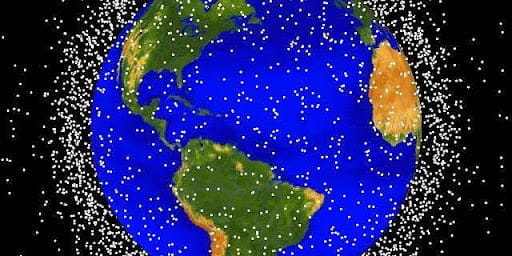
Space Junk / Space Debris
| Other Relevant Links | |
|---|---|
| Space Organisations | Space race/Space junk |
| South Asia Satellite: Significance | Solar Mission- ADITYA |
| Spitzer Space Telescope | Chandra X-Ray Observatory |
| Multi Application Solar Telescope | Thirty Metre Telescope |
| Resourcesat-2A | Astrosat |
| Sunspot | Magnetars |
| Neutron stars | Air-breathing propulsion system |
| Graveyard Orbit | Supercluster of galaxies known as “Saraswati” |
Concerns Regarding Space Junk
- The increasing number of rocket launches and payloads carried in recent years has exacerbated the space junk problem, particularly since private companies such as SpaceX launched thousands of satellites to provide Internet access.
- Over 2,160 objects were launched into space in 2022, approximately 300 more than in 2021 and 900 more than in 2020.
- The number of satellites orbiting Earth is expected to increase to 60,000 by 2030, from 9,000 now, and the amount of untracked debris is a source of concern.
- NASA is tracking approximately 27,000 pieces of "space junk," but over 100 trillion untracked pieces of old satellites circle the planet.
- While satellite launches are responsible for the increase in rocket bodies orbiting Earth, fragmented debris is mostly the result of collisions and Anti-Satellite (ASAT) missile tests.
- The fragmented junk presents a greater challenge because it is difficult to track debris smaller than 10 centimetres.
- The current Outer Space Treaty is hampered by shifting geopolitics, technology, and commercial interests.
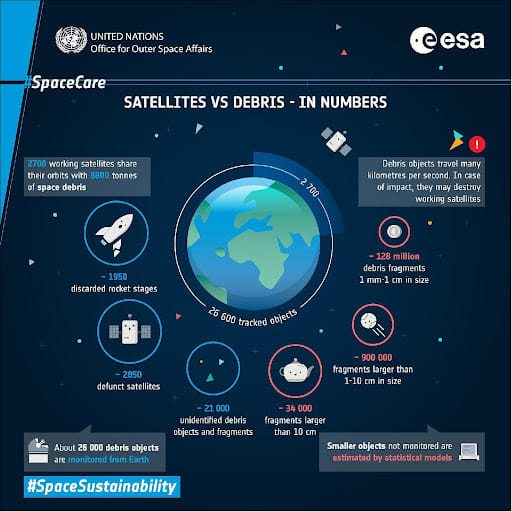
Space Junk by Numbers
Causes of Space Junk
- Satellites have a finite useful life, and when their batteries run out or they malfunction, they are left floating around in space.
- Astronauts occasionally lose equipment or other items while on spacewalks.
- Several rocket stages are lost in low orbits and crash land on Earth shortly after launch. The higher ones, however, are left to drift in space and occasionally explode because they contain fuel remnants. These explosions produce thousands of fragments.
- Both the Soviet Union and the United States tested anti-satellite weapons in the 1960s and 1970s. One of these weapons, such as India's Mission Shakti, was used by the US in 1985 to destroy a one-ton satellite (Sol wind).
- Some waste is naturally produced by collisions of micrometeoroids, which are dust-sized fragments of asteroids and comets.
Key incidents where space debris caused damage
|
Impact of Space Junk
- Floating Space Debris: It is a potential hazard for operational satellites, and colliding with them can render the satellites inoperable.
- Orbital Slot Reduction: The accumulation of space debris in specific orbital regions can reduce the availability of desirable orbital slots for future missions.
- Space Situational Awareness: As the amount of space debris increases, it becomes more difficult for satellite operators and space agencies to track and predict the orbits of objects in space.
- Satellite and space station operations are hampered: Increased collision and damage risk to operational satellites and the International Space Station (ISS) will have an effect on their performance.
- Impact on Earth's atmosphere: Some of the debris in low Earth orbit will gradually lose altitude and burn up in the Earth's atmosphere.
- Impact on the natural environment of the Earth: Larger debris may strike Earth and harm the environment on rare occasions. The Altai region of eastern Siberia, for example, is covered in Russian Proton rocket debris.
- Titanium, steel, ceramics, and other high-melting-point materials, as well as large or densely constructed objects, can withstand atmospheric re-entry and impact the earth's surface.
- Affect navigation and communication systems: Collisions with navigation and communication satellites have an impact on its performance.
- Impact on astronauts' lives: Space debris may endanger astronauts aboard the International Space Station.
Measures Taken to Curb Space Junk
At India Level
- ISRO established the System for Safe and Sustainable Operations Management (IS4OM) in 2022 to continuously monitor objects that could collide, predict the evolution of space debris, and mitigate the risk posed by space debris.
- In order to avoid collisions with other space objects, ISRO performed 21 collision avoidance manoeuvres on Indian operational space assets in 2022.
- ISRO has also established a Space Debris Research Centre to monitor and mitigate the threat of space debris.
- 'Project NETRA' is also a space-based early warning system for detecting debris and other threats to Indian satellites.
What is Project NETRA?
|
At Global Level
- The Inter-Agency Space Debris Coordination Committee (IADC) was established in 1993 as an international governmental forum to coordinate efforts among spacefaring nations to address the issue of space debris.
- The United Nations established the Committee on the Peaceful Uses of Outer Space (COPUOS) to create guidelines for the long-term sustainability of outer space activities, including space debris mitigation.
- The European Space Agency (ESA) has launched the Clean Space initiative, which aims to reduce space debris while also promoting sustainable space activities.
- Remove Debris mission: The purpose of this satellite research project was to demonstrate various space debris removal techniques. The Surrey Space Centre at the University of Surrey oversaw the mission, and Surrey Satellite Technology Ltd. built the satellite platform (SSTL).
- Kounotori Experiment: It is a Japanese experiment that uses an innovative technique to remove space debris from Earth's orbit.
- Debris Elimination and Reentry (DER) programme by NASA: It aims to reduce the threat of re-entering debris and to slow the growth of space debris.
- Guidelines for Space Debris Mitigation from the Inter-Agency Space Debris Coordination Committee (IADC): The IADC guidelines offer a set of best practises for reducing space debris generation and mitigating the impact of existing debris on operational spacecraft and infrastructure.
- Space Debris Capture Experiment: This is an experiment conducted by the Japanese Aerospace Exploration Agency (JAXA) to demonstrate the feasibility of capturing space debris using a device mounted on a spacecraft and to research the characteristics of space debris.
- Cleanup Mission: The China National Space Administration's (CNSA) aims to demonstrate the feasibility of cleaning up space debris using a combination of active and passive methods.
- Space Debris Removal System (SDRS): The Russian Space Agency (Roscosmos) has proposed a mission to demonstrate the feasibility of removing space debris from orbit.
Way Forward
- Improved Space Debris Tracking and Monitoring: Improving the ability to track and monitor space debris can help reduce the risks it poses to operational satellites and human space missions.
- Reusable Launch Vehicles: Using reusable launch vehicles rather than single-use rockets can help reduce the amount of new debris produced by launches.
- Improvements in materials and design: Using more durable materials and designing satellites for eventual de-orbiting can reduce the amount of debris generated in the long run.
- Extended Producer Responsibility Space Treaty: To keep space debris out of Earth's orbit, a legally binding agreement is required.
- The treaty should ensure that satellite manufacturers and users accept responsibility for their satellites and debris, and that collective international legislation is enforced through fines and other incentives to hold countries and companies accountable.
- Incentivization: Countries that use Earth's orbit should commit to global cooperation, and companies should be rewarded for cleaning up orbits and including de-orbiting functions in satellites.
Conclusion
The issue of space debris emphasises the importance of continuing efforts to mitigate and prevent the growth of debris in orbit in order to ensure the long-term viability and safety of outer space for future generations. The removal of space debris is critical for the safe and sustainable use of outer space. To ensure the continued growth and exploration of space, the international community should prioritise efforts to remove debris.
| Other Relevant Links | |
|---|---|
| Science & Technology Policy in India | Scientific Policy Resolution 1958 |
| Science & Technology Policy of 1983 | Science & Technology Policy of 2003 |
| Science, Technology and Innovation Policy 2013 | New Initiatives Aligned with the National Agenda |
| India and World collaboration in science projects | Technology Vision Document 2035 |
FAQs
Question: What is space junk?
Answer: Space junk refers to defunct satellites, spent rocket stages, and other debris left by human activities in Earth's orbit. It poses risks to operational spacecraft and satellites.
Question: Why is space junk a growing concern?
Answer: Space junk is a growing concern because it can collide with operational satellites, spacecraft, and even the International Space Station (ISS), causing significant damage and hindering space exploration.
Question: How can space junk be managed?
Answer: Space junk can be managed through active debris removal technologies, better tracking systems, and implementing stricter regulations on satellite end-of-life disposal.
Question: What impact does space junk have on satellite operations?
Answer: Space junk can damage or destroy satellites, interfere with satellite communications, and increase the cost of launching and maintaining space missions due to the risk of collisions.
Question: What is the potential solution to space junk?
Answer: Potential solutions include developing technologies for capturing and de-orbiting debris, such as using robotic arms or lasers to remove defunct satellites and other debris from space.
MCQs
1. What is the primary source of space junk?
A) Asteroids
B) Solar radiation
C) Human activities in space
D) Cometary dust
Answer: (C) See the Explanation
Explanation: Space junk primarily results from human activities in space, including defunct satellites, spent rocket stages, and fragments from collisions between objects in Earth's orbit.
2. Which of the following is NOT a potential solution to space junk?
A) Active debris removal technologies
B) Satellite collision avoidance systems
C) Space-based nuclear weapons
D) Stricter regulations on satellite disposal
Answer: (C) See the Explanation
Explanation: Space-based nuclear weapons are not considered a solution to space junk. Solutions focus on debris removal, tracking systems, and better satellite disposal practices.
3. What is the major risk of space junk in Earth's orbit?
A) Increased solar radiation
B) Interference with satellite operations
C) Impact on space weather
D) Loss of gravitational pull
Answer: (B) See the Explanation
Explanation: The primary risk of space junk is its potential to collide with operational satellites, causing damage and disruptions to satellite communications and other space missions.
4. Which of the following technologies is being explored to manage space junk?
A) Magnetic fields
B) Robotic arms and lasers
C) Artificial intelligence
D) Gravitational force generators
Answer: (B) See the Explanation
Explanation: Technologies like robotic arms and lasers are being explored to actively capture and remove space debris from Earth's orbit to prevent collisions with operational satellites.
5. How does space junk impact space exploration?
A) It increases the cost of space missions
B) It improves satellite performance
C) It boosts space exploration speed
D) It has no impact on space missions
Answer: (A) See the Explanation
Explanation: Space junk increases the cost of space missions due to the need for enhanced shielding, collision avoidance systems, and the risk of damaging valuable space equipment.
GS Mains Questions and Model Answers
Q1: Discuss the challenges posed by space junk to space missions and how they can be mitigated.
Answer: Space junk poses significant challenges to space missions, such as the risk of collisions with operational satellites and spacecraft, which can lead to costly damage or mission failure. The proliferation of space debris increases the likelihood of such collisions, especially with the growing number of satellites being launched. To mitigate these challenges, it is crucial to implement active debris removal technologies, such as robotic arms, lasers, and space tugs to de-orbit defunct satellites. Additionally, enhancing tracking and collision avoidance systems, and enforcing regulations on satellite disposal at the end of their operational life can help minimize the accumulation of space junk. Furthermore, international cooperation and stricter space governance are vital in addressing the global nature of space debris management.
Q2: Explain the environmental implications of space junk and its long-term effects on Earth's orbital environment.
Answer: The environmental implications of space junk are profound, as debris in Earth's orbit poses a threat to both current and future space missions. The accumulation of space junk can lead to a situation where Earth’s orbital environment becomes highly polluted, complicating satellite launches and space exploration. Small fragments of debris traveling at high speeds can damage operational satellites, and even pose a risk to the International Space Station (ISS). The long-term effects could include a rise in costs for space missions, reduced access to space, and an increased risk of "Kessler Syndrome," where collisions generate more debris, exponentially increasing the threat of space pollution. This makes effective space debris management an urgent issue to prevent irreversible damage to Earth's orbital environment.
Q3: How can international collaboration help address the issue of space junk?
Answer: International collaboration is essential to address the issue of space junk due to the global nature of the problem. Space debris does not belong to any one country, and its impact is felt by all spacefaring nations. Collaborative efforts can lead to shared responsibility in tracking space junk, developing technologies for debris removal, and establishing international regulations on satellite end-of-life disposal. Joint ventures between countries and private companies can facilitate the development of debris-capturing technologies. Additionally, a global framework for debris management, perhaps through the United Nations or space agencies like NASA, can enforce uniform standards and protocols to prevent further accumulation of space debris. Such cooperation ensures that the management of space junk is both effective and equitable across borders.
Previous Year Questions on Space Junk
1. UPSC CSE Mains 2021 (GS Paper 3):
Question: "Discuss the challenges posed by space junk and suggest measures to manage the growing debris in Earth's orbit."
Answer: Space junk poses risks to satellite operations, space exploration, and the safety of astronauts. The growing volume of debris in Earth's orbit threatens future space missions and increases costs. Measures to manage space junk include active debris removal technologies such as robotic arms, laser systems, and space tugs. Additionally, international cooperation and improved tracking systems are essential to prevent further accumulation of space debris and mitigate its impact on operational spacecraft.
2. UPSC CSE Mains 2019 (GS Paper 3):
Question: "What is the significance of managing space junk, and how can international cooperation help in its mitigation?"
Answer: Managing space junk is critical for the safety of satellites, space stations, and other space missions. With increasing space debris, the risk of collisions grows, potentially leading to catastrophic damage. International cooperation can help by enabling shared responsibility for space debris management, developing debris-removal technologies, and setting up global space traffic management protocols. Such collaboration is necessary for effective mitigation and to ensure sustainable space exploration.
Download the PREPP App and attempt FREE IAS Exam Mock Tests and get complete study material!

Full Test - 04: UPSC CSE Prelims CSAT (Paper-II)
Full Test - 03: UPSC CSE Prelims CSAT (Paper-II)
UPSC CSE Prelims 2026 GS Paper 1 Question Paper (24-May-2026)
UPSC CSE Prelims 2026 CSAT Paper 2 Question Paper (24-May-2026)

17 February 2025 | The Hindu Must Read Articles | Current Affairs

16 February 2026 | The Hindu Must Read Articles | Current Affairs

13 February 2026 | The Hindu Must Read Articles | Current Affairs









Comments