South Asia Satellite: Significance – Science & Technology Notes
The South Asia Satellite, also known as GSAT-9, is a communication and meteorology satellite launched by the Indian Space Research Organisation (ISRO) to serve the South Asian region. It was launched on May 5, 2017, with the primary aim of enhancing regional cooperation and addressing the developmental needs of South Asian countries. In this article, we will discuss in detail regarding the significance of South Asia Satellite which will be helpful for UPSC exam preparation.
Table of Contents
What is South Asia Satellite?
- The Geostationary Communication Satellite-9 (GSAT-9) was launched on May 5 from the Sriharikota spaceport, off the coast of Andhra Pradesh, on board a GSLV-F09 rocket built and funded entirely by India.
- The satellite, dubbed "India's technology largesse from the sky to the peoples of the region," will be a boon to the region's progress.
- Pakistan is not a part of the project because it refused India's "invaluable gift." Following Pakistan's refusal, the proposal to name it "SAARC Satellite" was changed to "South Asia Satellite."
- The satellite's footprint, which stretches across South Asia, is intended for use by neighbours.
- The 2,230-kg communication spacecraft will support effective communication, broadcasting, and Internet services in a geographically challenging, economically lagging region with limited technological resources.
- The satellite has 12 Ku band transponders that the six countries can use to improve communication.
- Each South Asian country will be given one transponder through which it will be able to broadcast its own programming in addition to "South Asian programming" in general.
- The countries will be required to build their own ground infrastructure. India is eager to offer assistance and know-how.
| Other Relevant Links | |
|---|---|
| Space Organisations | Space race/Space junk |
| Solar Mission- ADITYA | Spitzer Space Telescope |
| Chandra X-Ray Observatory | Multi Application Solar Telescope |
| Thirty Metre Telescope | Resourcesat-2A |
| Astrosat | Sunspot |
| Magnetars | Neutron stars |
| Air-breathing propulsion system | Space Junk |
| Graveyard Orbit | Supercluster of galaxies known as “Saraswati” |
Significance of South Asia Satellite
- The successful launch of India's first South Asia Satellite (SAS) to improve communication and disaster response among its six neighbours has "opened up new horizons of engagement" in the region and helped it carve out a unique place in space diplomacy.
- It will also strengthen ties between Afghanistan, Bangladesh, Bhutan, India, the Maldives, Nepal, and Sri Lanka.
- The SAS, also known as GSAT-9, is a geosynchronous communications and weather satellite.
- It will provide significant DTH (direct-to-home) capability to each participating country, in addition to connecting the countries for disaster information transfer.
- It will aid in better governance, better banking and education in remote areas, more predictable weather forecasting and efficient natural resource mapping, connecting people with top-tier medical services via telemedicine, and responding quickly to natural disasters.
- Its advantages also include improved IT connectivity and increased people-to-people contact.
- The region is prone to earthquakes, cyclones, floods, and tsunamis. During disasters, a South Asia satellite will help the countries coordinate rescue efforts and maintain a secure line of communication.
- Launching and operating the South Asia Satellite showcases India's technological expertise in the space domain. It positions India as a regional leader in space applications and satellite services, bolstering its standing in the international space community.
Applications of South Asia Satellite
- Telecommunication and Broadcasting: The satellite enables telecommunication and broadcasting services, facilitating improved connectivity and media dissemination across the region.
- Disaster Management: The satellite's Earth observation capabilities assist in monitoring natural disasters, providing real-time data and imagery to aid in disaster management and response efforts.
- Weather Forecasting: The satellite supports meteorological applications, allowing for more accurate weather forecasting and climate monitoring, which is essential for agriculture, disaster preparedness, and resource management.
- Agriculture and Forestry: The satellite's remote sensing data helps in assessing crop health, soil moisture, and forest cover, aiding farmers and policymakers in making informed decisions related to agriculture and forestry.
- Environmental Monitoring: The satellite contributes to environmental monitoring, including water resource management, deforestation tracking, and pollution assessment, promoting sustainable development practices.
- Education and Telemedicine: The satellite's internet connectivity fosters e-education initiatives, providing access to quality educational resources in remote areas. It also supports telemedicine services, enabling healthcare consultations and assistance in remote regions.
- National Security and Border Surveillance: The satellite aids in enhancing security and surveillance capabilities, contributing to border monitoring and national security efforts.
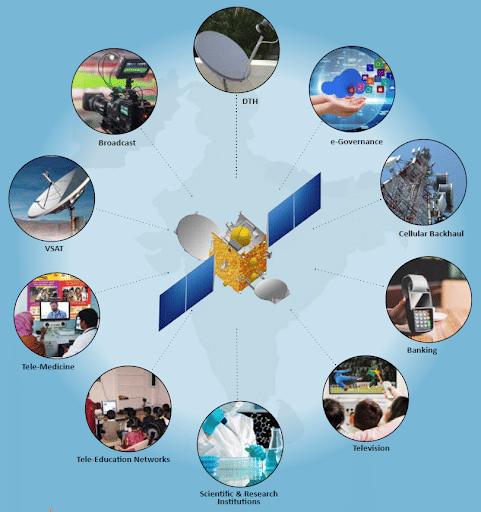
Various applications of South Asia Satellite
Conclusion
The South Asia Satellite is a testament to India's commitment to using space technology for regional development and cooperation. By offering its capabilities to its neighbouring countries, India demonstrates its willingness to collaborate and share the benefits of space technology to uplift the entire South Asian region. The satellite's applications in disaster management, telecommunications, agriculture, and other crucial areas play a vital role in promoting sustainable development and addressing the challenges faced by the member countries of SAARC.
| Other Relevant Links | |
|---|---|
| Science & Technology Policy in India | Scientific Policy Resolution 1958 |
| Science & Technology Policy of 1983 | Science & Technology Policy of 2003 |
| Science, Technology and Innovation Policy 2013 | New Initiatives Aligned with the National Agenda |
| India and World collaboration in science projects | Technology Vision Document 2035 |
FAQs
Question: What is the South Asia Satellite?
Answer: The South Asia Satellite, also known as GSAT-9, is an Indian communication satellite launched by ISRO to provide services in the South Asian region, aiming to promote regional cooperation and development.
Question: When was the South Asia Satellite launched?
Answer: The South Asia Satellite was launched on May 5, 2017, by the Indian Space Research Organisation (ISRO) using a GSLV-F09 rocket from Sriharikota.
Question: What is the purpose of the South Asia Satellite?
Answer: The satellite aims to provide communication, television, and telemedicine services to South Asian countries, enhancing cooperation in various fields like disaster management, education, and health.
Question: Which countries benefit from the South Asia Satellite?
Answer: The South Asia Satellite benefits Afghanistan, Bangladesh, Bhutan, Nepal, the Maldives, Pakistan, and Sri Lanka, offering them a wide range of satellite-based services.
Question: What is the significance of the South Asia Satellite for India?
Answer: The satellite enhances India's diplomatic ties with its South Asian neighbors, promotes regional cooperation, and establishes India as a regional leader in space technology and satellite communication.
MCQs
1. What is the primary objective of the South Asia Satellite (GSAT-9)?
A) To provide broadband internet to South Asian countries
B) To enhance disaster management and communication in South Asia
C) To provide GPS services
D) To monitor climate change in South Asia
Answer: (B) See the Explanation
Explanation: The primary objective of the South Asia Satellite is to enhance communication, disaster management, and provide television, telemedicine, and other satellite-based services to South Asian countries.
2. Which organization launched the South Asia Satellite?
A) NASA
B) ISRO
C) ESA
D) Roscosmos
Answer: (B) See the Explanation
Explanation: The South Asia Satellite was launched by the Indian Space Research Organisation (ISRO) on May 5, 2017, using a GSLV rocket.
3. How many countries are covered under the South Asia Satellite?
A) 5
B) 7
C) 8
D) 10
Answer: (B) See the Explanation
Explanation: The South Asia Satellite covers seven countries in South Asia: Afghanistan, Bangladesh, Bhutan, Nepal, the Maldives, Pakistan, and Sri Lanka.
4. In which year was the South Asia Satellite launched?
A) 2015
B) 2016
C) 2017
D) 2018
Answer: (C) See the Explanation
Explanation: The South Asia Satellite was launched on May 5, 2017, by the Indian Space Research Organisation (ISRO).
5. Which satellite was used for the South Asia Satellite mission?
A) GSAT-7
B) GSAT-9
C) GSAT-10
D) GSAT-12
Answer: (B) See the Explanation
Explanation: The South Asia Satellite is officially known as GSAT-9, and it was launched by ISRO to provide services to South Asian countries.
GS Mains Questions and Model Answers
Q1: Discuss the significance of the South Asia Satellite in fostering regional cooperation and diplomacy in South Asia.
Answer: The South Asia Satellite (GSAT-9) has played a pivotal role in fostering regional cooperation in South Asia. By providing satellite-based communication services to seven countries, it promotes mutual development in areas like disaster management, education, healthcare, and telecommunications. The satellite enhances India's leadership in space technology and strengthens its diplomatic ties with neighboring countries. It is a key element of India's "Neighborhood First" policy, signaling a commitment to helping its neighbors through technological cooperation. The initiative also enhances connectivity among South Asian countries, contributing to peace, security, and socio-economic development in the region.
Q2: How does the South Asia Satellite contribute to the development of the South Asian region?
Answer: The South Asia Satellite contributes to the development of the South Asian region by providing crucial communication infrastructure to the countries in the region. It offers services like television broadcasting, telemedicine, disaster management, and emergency communication, which help improve the quality of life. Additionally, it promotes educational outreach and access to vital healthcare information. The satellite bridges the digital divide, especially in rural and underserved areas, fostering inclusive growth. The provision of such satellite-based services enhances the socio-economic development of South Asian countries, particularly in critical sectors like healthcare and education.
Q3: Evaluate the challenges faced by the South Asia Satellite initiative and suggest measures to address them.
Answer: While the South Asia Satellite has been a milestone in regional cooperation, challenges remain in its implementation. One of the primary issues is the reluctance of some neighboring countries, particularly Pakistan, to fully participate in the initiative, which limits the satellite’s potential to serve the entire region. Another challenge is the need for continuous technical support and infrastructure development in some South Asian countries to effectively use the satellite’s services. To address these challenges, there should be greater diplomatic efforts to encourage participation from all countries in the region. Additionally, ISRO can collaborate with local governments to improve infrastructure and provide technical training to ensure the satellite’s services are fully utilized.
Previous Year Questions on South Asia Satellite
1. UPSC CSE Mains 2018 (GS Paper 2):
Question: "The South Asia Satellite is a significant step in India’s foreign policy to strengthen ties with its neighbors. Discuss its objectives and impact on regional cooperation."
Answer: The South Asia Satellite (GSAT-9) enhances India's role in regional cooperation by providing satellite-based services such as disaster management, telemedicine, and education. The initiative demonstrates India’s commitment to helping its neighbors, especially in areas of communication and technology. It fosters closer ties with countries like Nepal, Bhutan, and Afghanistan, while promoting socio-economic development. The satellite has enhanced India’s leadership in space technology and regional diplomacy by providing essential services, thus strengthening its foreign policy initiatives.
2. UPSC CSE Mains 2019 (GS Paper 2):
Question: "Assess the role of South Asia Satellite in India’s Neighborhood First policy and its impact on the socio-economic development of South Asian countries."
Answer: The South Asia Satellite aligns with India’s Neighborhood First policy by promoting regional integration and cooperation. It provides essential services to South Asian countries, especially in areas of disaster management, education, and healthcare. The satellite strengthens India’s diplomatic relations with its neighbors, ensuring that they benefit from India’s advancements in space technology. This initiative has a long-term impact on the socio-economic development of South Asian countries by facilitating access to information, improving communication, and fostering collaborative growth.
Download the PREPP App and attempt FREE IAS Exam Mock Tests and get complete study material!

Full Test - 04: UPSC CSE Prelims CSAT (Paper-II)
Full Test - 03: UPSC CSE Prelims CSAT (Paper-II)
UPSC CSE Prelims 2026 GS Paper 1 Question Paper (24-May-2026)
UPSC CSE Prelims 2026 CSAT Paper 2 Question Paper (24-May-2026)

17 February 2025 | The Hindu Must Read Articles | Current Affairs

16 February 2026 | The Hindu Must Read Articles | Current Affairs

13 February 2026 | The Hindu Must Read Articles | Current Affairs









Comments