Solar Mission: Aditya-L1 – Science & Technology Notes
Aditya-L1 is India's first space-based mission to investigate the Sun. According to the Indian Space Research Organisation (ISRO), the spacecraft will be placed in a halo orbit around the Sun-Earth system's first Lagrange (L1) point, which is approximately 1.5 million kilometres from Earth. In this article, we will discuss in detail regarding Solar Mission - Aditya L1 which will be helpful for UPSC exam preparation.
Table of Contents
What is Aditya L1 Mission?
- Aditya L1 will be India's first space-based mission to study the Sun.
- The spacecraft will be placed in a halo orbit around the Sun-Earth system's Lagrange point 1 (L1), which is approximately 1.5 million kilometres away from Earth.
- A satellite in halo orbit around the L1 point has the significant advantage of continuously viewing the Sun with no occultation/eclipses.
- This will give us a better chance of observing solar activity and its impact on space weather in real time.
- The spacecraft carries seven payloads that will use electromagnetic, particle, and magnetic field detectors to study the photosphere, chromosphere, and the Sun's outermost layers (the corona).
- Four payloads directly observe the Sun from the special vantage point L1, while the remaining three payloads conduct in-situ particle and field studies at the Lagrange point L1, providing important scientific studies of the propagatory effect of solar dynamics in the interplanetary medium.
- The Aditya L1 payload suits are expected to provide critical information for understanding the problem of coronal heating, coronal mass ejection, pre-flare and flare activities and their characteristics, dynamics of space weather, particle and field propagation, and so on.
| Type | Payload | Capability |
|---|---|---|
| Remote Sensing Payloads | Visible Emission Line Coronagraph (VELC) | Corona/Imaging & Spectroscopy |
| Solar Ultraviolet Imaging Telescope (SUIT) | Photosphere and Chromosphere Imaging- Narrow & Broadband | |
| Solar Low Energy X-ray Spectrometer (SoLEXS) | Soft X-ray spectrometer: Sun-as-a-star observation | |
| High Energy L1 Orbiting X-ray Spectrometer (HEL1OS) | Hard X-ray spectrometer: Sun-as-a-star observation | |
| In-situ Payloads | Aditya Solar wind Particle Experiment (ASPEX) | Solar wind/Particle Analyzer Protons & Heavier Ions with directions |
| Plasma Analyser Package For Aditya (PAPA) | Solar wind/Particle Analyzer Electrons & Heavier Ions with directions | |
| Advanced Tri-axial High Resolution Digital Magnetometers | In-situ magnetic field (Bx, By and Bz). |
| Other Relevant Links | |
|---|---|
| Space Organisations | Space race/Space junk |
| South Asia Satellite: Significance | Spitzer Space Telescope |
| Chandra X-Ray Observatory | Multi Application Solar Telescope |
| Thirty Metre Telescope | Resourcesat-2A |
| Astrosat | Sunspot |
| Magnetars | Neutron stars |
| Air-breathing propulsion system | Space Junk |
| Graveyard Orbit | Supercluster of galaxies known as “Saraswati” |
Aditya-L1 Mission – Objectives
The major objectives of Aditya-L1 mission are:
- Recognising Coronal Heating and Solar Wind Acceleration.
- Understanding the initiation of CMEs, flares, and near-Earth space weather.
- To comprehend the solar atmosphere's coupling and dynamics.
- To comprehend the distribution of solar wind and temperature anisotropy.
What is Unique about Aditya-L1 Mission?
- For the first time, a solar disc in the near UV band has been spatially resolved.
- CME dynamics close to the solar disc (from 1.05 solar radius), providing information in the CME acceleration regime that is not consistently observed.
- For optimised observations and data volume, on-board intelligence detects CMEs and solar flares.
- Using multi-direction observations, we can determine the directional and energy anisotropy of the solar wind.
Lagrange Points
- The Lagrange Points are the positions in space where a small object tends to stay if placed in a two-body gravitational system.
- These points in space for two-body systems such as the Sun and Earth can be used by spacecraft to remain in these positions while using less fuel.
- Technically, the gravitational pull of the two large bodies equals the centripetal force required for a small object to move with them at Lagrange point.
- There are five Lagrange points in a two-body gravitational system, denoted as L1, L2, L3, L4, and L5. The figure depicts the Lagrange points for the Sun-Earth system.
- The Lagrange point L1 is located between the Sun-Earth line. L1's distance from Earth is about 1% of the Earth-Sun distance.
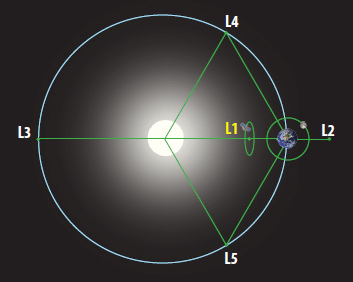
Lagrange Points of Sun-Earth System
Trajectory of Aditya-L1
- The Aditya-L1 mission will be launched by an ISRO PSLV rocket from Sriharikota's Sathish Dhawan Space Centre SHAR (SDSC SHAR).
- The spacecraft will first be placed in low-Earth orbit. The orbit will then be made more elliptical, and the spacecraft will be launched towards the Lagrange point L1 using on-board propulsion.
- As the spacecraft approaches L1, it will leave the Earth's gravitational Sphere of Influence (SOI).
- After leaving SOI, the cruise phase will begin, and the spacecraft will be injected into a large halo orbit around L1.
- Aditya-L1's total travel time from launch to L1 would be approximately four months.
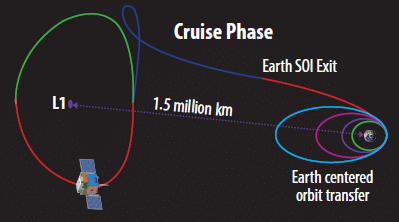
Aditya-L1 trajectory from Earth to L1
Challenges Related to Aditya-L1 Mission
- The Sun's average distance from Earth (approximately 15 crore kms, compared to only 3.84 lakh kms to the Moon). This enormous distance presents a scientific challenge.
- Due to the risks involved, payloads in previous ISRO missions remained mostly stationary in space; however, Aditya L1 will have some moving components, increasing the chances of collision.
- Other issues include extremely high temperatures and radiation in the solar atmosphere. Aditya L1 will, however, stay much further away, and the heat is not expected to be a major issue for the instruments on board.
What is the need to study the Sun?
- The sun emits radiation/light at almost all wavelengths, as well as energetic particles and a magnetic field.
- The Earth's atmosphere, as well as its magnetic field, act as a protective shield, blocking a variety of harmful wavelength radiations, particles, and fields.
- Because various radiations do not reach the Earth's surface, instruments from the Earth will be unable to detect them, and solar studies based on these radiations will be impossible to conduct.
- Such studies, however, can be carried out by making observations from outside the Earth's atmosphere, i.e., from space.
- Similarly, to understand how solar wind particles and the Sun's magnetic field travel through interplanetary space, measurements must be taken from a location far from the influence of the Earth's magnetic field.
Other Solar Missions
Aside from ISRO's Aditya L1 Mission, which is a sun-specific mission, many other countries have launched similar programmes.
- NASA’s Parker Solar Probe – This mission is to study the source of the solar wind's acceleration and to trace how energy and heat move through the Sun's corona.
- NASA's Living With a Star – This programme investigates various aspects of the Sun-Earth system.
- NASA’s Helios 2 – In 1976, the Helios 2 solar probe, a collaboration between NASA and the former West German space agency, came within 43 million kilometres of the Sun's surface.
Conclusion
Since the sun is the closest star, it can be studied in greater depth than other stars. It will aid in our understanding of stars in our Milky Way and other galaxies. The sun is extremely dynamic, exhibiting several eruptive phenomena and releasing enormous amounts of energy. This mission will comprehend explosive solar phenomena that may cause disturbances in space near the Earth.
| Other Relevant Links | |
|---|---|
| Science & Technology Policy in India | Scientific Policy Resolution 1958 |
| Science & Technology Policy of 1983 | Science & Technology Policy of 2003 |
| Science, Technology and Innovation Policy 2013 | New Initiatives Aligned with the National Agenda |
| India and World collaboration in science projects | Technology Vision Document 2035 |
FAQs
Question: What is the purpose of the Aditya L1 mission?
Answer: The Aditya L1 mission aims to study the Sun's outermost layer, the corona, and its impact on space weather. It seeks to enhance understanding of solar radiation and its influence on Earth's climate and technology, aiding in space weather forecasting and mitigating risks to satellite infrastructure.
Question: Why is the study of solar radiation important for Earth?
Answer: Solar radiation affects Earth's climate, weather systems, and technological infrastructure. The study of solar radiation is essential for understanding space weather phenomena, such as solar flares and coronal mass ejections, which can disrupt satellite communication, navigation systems, and power grids on Earth.
Question: What are the key objectives of the Aditya L1 mission?
Answer: The key objectives of Aditya L1 include studying the solar corona, observing solar wind behavior, investigating the Sun’s impact on Earth’s magnetosphere, and providing insights into space weather dynamics. The mission will also study the effect of solar radiation on Earth's upper atmosphere and space-based technology.
Question: How does the Aditya L1 mission contribute to space weather forecasting?
Answer: By studying the Sun's activity and solar wind, the Aditya L1 mission will improve space weather forecasting. The mission will monitor solar flare events and coronal mass ejections, providing early warnings for potential disruptions to satellite communication, GPS systems, and power grids caused by solar storms.
Question: Where is the Aditya L1 spacecraft positioned for its observations?
Answer: Aditya L1 will be placed at the Lagrangian point L1, which is approximately 1.5 million kilometers from Earth. This position allows the spacecraft to continuously observe the Sun without being affected by the Earth’s shadow, providing uninterrupted data on solar activity.
MCQs
1. What is the primary objective of the Aditya L1 mission?
A) Study the Moon's surface
B) Study the Sun's corona and solar wind
C) Investigate Martian geology
D) Analyze deep space radiation
Answer: (B) See the Explanation
Explanation: The Aditya L1 mission’s primary objective is to study the Sun's outermost layer, the corona, and the behavior of solar wind. This will help scientists understand space weather and its effects on Earth’s atmosphere and satellite systems.
2. At which location will the Aditya L1 spacecraft be positioned?
A) On Earth's surface
B) At the Moon's orbit
C) At Lagrangian point L1
D) Near Mars
Answer: (C) See the Explanation
Explanation: The Aditya L1 spacecraft will be positioned at the Lagrangian point L1, located about 1.5 million kilometers from Earth. This position enables the spacecraft to observe the Sun continuously, without being obstructed by Earth’s shadow, providing real-time data.
3. What is the significance of studying solar wind in the context of space weather?
A) It provides insights into the Sun’s temperature.
B) It helps predict solar storms that can affect Earth’s infrastructure.
C) It aids in understanding lunar cycles.
D) It focuses on understanding interplanetary dust.
Answer: (B) See the Explanation
Explanation: Studying solar wind is crucial for predicting solar storms, such as coronal mass ejections, which can affect satellite communication, GPS systems, and power grids on Earth. The Aditya L1 mission will help monitor solar wind and its potential impact on Earth’s space environment.
4. What phenomenon does the Aditya L1 mission primarily aim to investigate?
A) Solar eclipses
B) Solar radiation and its effect on Earth
C) Sunspots on the Sun’s surface
D) Solar system formation
Answer: (B) See the Explanation
Explanation: The Aditya L1 mission is focused on studying solar radiation and the effects of solar wind and solar flares on Earth. These phenomena have significant implications for space weather and technology, including communications, satellite operations, and climate patterns on Earth.
5. Which of the following is NOT a goal of the Aditya L1 mission?
A) Study the Sun’s corona
B) Investigate solar wind dynamics
C) Monitor space debris
D) Improve space weather forecasting
Answer: (C) See the Explanation
Explanation: Monitoring space debris is not a goal of the Aditya L1 mission. The mission’s primary focus is to study the Sun’s corona, solar wind, and space weather phenomena, which are important for understanding the impact of solar activity on Earth’s technological systems.
GS Mains Questions and Model Answers
Q1: Analyze the importance of the Aditya L1 mission in the context of India’s space program and its global significance.
Answer: The Aditya L1 mission is a landmark in India’s space program, positioning the country as a global leader in solar research. Its study of the Sun’s corona and solar wind has far-reaching implications for space weather forecasting and Earth’s technological infrastructure. By enhancing our understanding of solar activity, India can improve satellite operations, mitigate space weather risks, and contribute to global research in heliophysics. This mission underscores India’s growing role in space science and its commitment to contributing valuable data to the international scientific community.
Q2: How does the study of solar radiation help mitigate the impact of space weather on Earth’s infrastructure?
Answer: The study of solar radiation, especially through missions like Aditya L1, is critical for predicting space weather events such as solar flares and coronal mass ejections. These events can disrupt Earth’s satellite communication, GPS systems, and power grids. By understanding solar activity and monitoring solar wind, scientists can issue early warnings, allowing for better preparation and protection of critical infrastructure. This proactive approach reduces the potential damage caused by space weather phenomena and ensures the resilience of technological systems.
Q3: Discuss the scientific objectives of the Aditya L1 mission and its potential impact on space weather research.
Answer: The Aditya L1 mission has several key scientific objectives, including studying the Sun’s corona, solar wind behavior, and the interactions between solar radiation and Earth’s magnetosphere. It aims to provide real-time data on solar activity, which is crucial for improving space weather predictions. By understanding solar storms and their effects on Earth, the mission will contribute to the development of space weather forecasting systems that can protect satellite communications, navigation systems, and other space-based technologies. The mission represents a significant advancement in space weather research and its impact on Earth’s technological infrastructure.
Previous Year Questions on Aditya L1 Mission
UPSC CSE 2021
Question: “Explain the significance of solar missions such as Aditya L1 in advancing our understanding of space weather and its impact on Earth ’s infrastructure.”
Answer: The question asks about the importance of solar missions like Aditya L1 in understanding solar activity and space weather. The answer should focus on how these missions help predict solar storms, their potential impact on satellite communication, GPS systems, and power grids, and how they contribute to global space science.
UPSC CSE 2022
Question: “Describe the key objectives of the Aditya L1 mission and its role in the study of solar radiation.”
Answer: This question is focused on the objectives of the Aditya L1 mission. The answer should explain the mission's goals, such as studying the Sun’s corona and solar wind, monitoring space weather, and improving forecasting systems for solar events that affect Earth's technological infrastructure.
Download the PREPP App and attempt FREE IAS Exam Mock Tests and get complete study material!
UPSC IAS : CSAT - Mini Live Test

Live Test : UPSC CSE Prelims CSAT (Paper-II) (Oct 20 - 23)
Full Test - 04: UPSC CSE Prelims CSAT (Paper-II)
Full Test - 03: UPSC CSE Prelims CSAT (Paper-II)
UPSC CSE Prelims 2026 GS Paper 1 Question Paper (24-May-2026)
UPSC CSE Prelims 2026 CSAT Paper 2 Question Paper (24-May-2026)

17 February 2025 | The Hindu Must Read Articles | Current Affairs

16 February 2026 | The Hindu Must Read Articles | Current Affairs

13 February 2026 | The Hindu Must Read Articles | Current Affairs









Comments