Shrinking Biodiversity: 69% Drop In Wildlife Populations In Nearly 5 Decades, Shows Living Planet Report (UPSC Current Affairs)
Relevance: GS3 - Environmental Conservation, Environmental Pollution and Degradation, Environmental Impact Assessment.
(Source: Indian Express)
Click here for Daily Current Affairs
Why in the news?
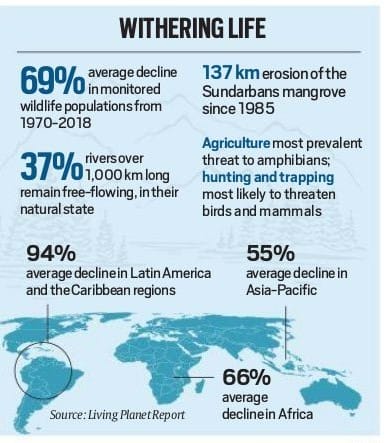
According to the most recent Living Planet Report 2022, published by the World Wildlife Fund (WWF) on Thursday, monitored wildlife populations, including mammals, birds, amphibians, reptiles, and fish, have seen a decline in population by 69% between 1970 and 2018. India is no different, either.
What are the findings of the Living Planet Report 2022?
Global Scenario
- The Report states that from 1968 to 2018, there had been an average 69% reduction in recorded wildlife populations.
- The report noted that between 1970 and 2018:
- Latin America and the Caribbean regions, with an average decrease of 94%, have experienced the highest decline of monitored animal populations globally.
- Africa saw a 66% decline in the same.
- The Asia Pacific saw a 55% decline.
- New Species: With 838 new species and a little over 11,000 new populations, this year's report recorded 32,000 species populations of 5,230 species.
- Fish: The number of fish species that have been added to the Living Planet Report has significantly increased (481).
- Freshwater populations have decreased the most, according to the WWF, with an average reduction of 83% between 1970 and 2018.
- Corals: According to the IUCN Red List, amphibians are the species that are most in danger, followed by corals and an ancient group of seed plants called cycads.
- Warming of 1.5 degrees Celsius will result in a loss of 70–90% of warm water corals, with about 50% already perished.
- Following the sea level rise, the little Australian rodent known as the Bramble Cay melomys was declared extinct.
- Mangroves: Despite their significance, mangroves are still being cleared for coastal development, aquaculture, and agriculture at a pace of 0.13% annually.
- For instance, 137 km of the mangrove forest in the Sundarbans have been lost to erosion since 1985.
- According to a study, there are still areas where mangroves are being lost, particularly in Myanmar.
Scenario in India
- From 1970- 2018, the population of 17 different species of freshwater turtles as well as honeybees has decreased across the nation.
- In terms of biodiversity loss, the Himalayan region and the Western Ghats are some of the most vulnerable locations in the nation, according to the report. If temperatures rise, there will likely be an even greater loss of species in these areas.
- According to the report, initiatives like the recent cheetah translocation are beneficial for the preservation of species, and India has experienced success with initiatives like Project Tiger, or (projects for) the one-horned rhino and lions. The preservation of these species has a ripple effect on all other species that live in that habitat.
Reasons for the decrease in wildlife populations
- As per report, the main causes of the decline in wildlife populations are pollution, disease, invasive species, habitat loss and degradation, exploitation, agriculture and climate change.
- The biggest threat to nature today is changes in land-use pattern, which has destroyed or fragmented the natural habitats of plant and animal species on land, in freshwater, and in the sea.
- Climate change, however, is projected to overtake other factors in the next decades as the primary cause of biodiversity loss if we are unable to keep warming to 1.5°C.
Living Planet Report
- It is released by WWF every two years.
- It is a thorough investigation into trends in the state of the planet and global biodiversity.
- Through the Living Planet Index (LPI), the study provides a thorough picture of the state of the natural world.
- Living Planet Index (LPI): Based on the trends in the populations of vertebrate species in terrestrial, freshwater, and marine habitats, it is a gauge of the state of biological diversity around the planet.
World Wildlife Fund for Nature
- It is the largest conservation organization in the World and operates in more than 100 nations.
- Its headquarter is in Gland, Switzerland, where it was founded in 1961.
- Aim: Its goal is to protect the environment and lessen the most serious risks to the variety of life on Earth.
- Objectives
- preserving biological diversity worldwide
- ensuring sustainable use of natural resources that can be replenished
- encouraging a decrease in pollution and excessive consumerism
- WWF works in close partnership with people all over the world to create and implement creative solutions that safeguard local populations, wildlife, and the environments in which they reside.
- The following Reports and Initiatives are taken by WWF:
- Living Planet Report: Since 1998, the WWF has released the Living Planet Report, which is based on the Living Planet Index and an assessment of ecological footprint.
- Earth Hour: The event, which takes place every year on the final Saturday in March, calls on people, groups, and organizations to switch off all electric lights for one hour between 8:00 and 9:00 p.m. as a show of support for the environment.
- c(MSC): Independent, non-profit Marine Stewardship Council sets a guideline for sustainable fishing
- Debt-for-nature swaps: It is a financial arrangement in which a portion of the foreign debt owed by a developing country is cancelled in return for regional expenditures in environmental protection programs.
(*Click this link to read prelims specific weekly current affairs articles)
Some Important FAQ
Question: What does a WWF do?
Answer:
WWF is the largest conservation organization. It works to conserve endangered species, protect endangered spaces, and address global threats to the planet such as climate change.
Question: What is Earth Hour?
Answer:
Earth Hour is a worldwide grassroots movement that unites people to take action on environmental issues and safeguard the environment, led by WWF. Earth Hour was notably launched as a lights-out event in Sydney, Australia, in 2007. It quickly gained widespread mainstream support.
Question: What is the Marine Stewardship Council?
Answer:
A nonprofit group called the Marine Stewardship Council works to establish criteria for ethical fishing. A group of Conformity Assessment Bodies evaluates fisheries that want to show that they are properly managed and sustainable in comparison to the MSC's requirements.
MCQ
Question: Living Planet Report, sometimes seen in the news, is released by?
(a) International Union for Conservation of Nature (IUCN)
(b) World Wildlife Fund for Nature
(c) UNESCO
(d) Conservation International
Answer: (b) See the Explanation
Living Planet Report
- It is released by WWF every two years.
- It is a thorough investigation into trends in the state of the planet and global biodiversity.
Therefore, option(b) is the correct answer.
Download the PREPP App and attempt FREE IAS Exam Mock Tests and get complete study material!

Full Test - 04: UPSC CSE Prelims CSAT (Paper-II)
Full Test - 03: UPSC CSE Prelims CSAT (Paper-II)
UPSC CSE Prelims 2026 GS Paper 1 Question Paper (24-May-2026)
UPSC CSE Prelims 2026 CSAT Paper 2 Question Paper (24-May-2026)

17 February 2025 | The Hindu Must Read Articles | Current Affairs

16 February 2026 | The Hindu Must Read Articles | Current Affairs

13 February 2026 | The Hindu Must Read Articles | Current Affairs









Comments