Shared Blame: On Chennai and Cyclone Michaung
Primary Source: The Hindu
Click here for Daily Current Affairs
Why in the news?
Chennai experienced heavy rainfall from Cyclone Michaung causing significant disruption. This situation has raised questions about the city's preparedness and infrastructure.
Table of Contents
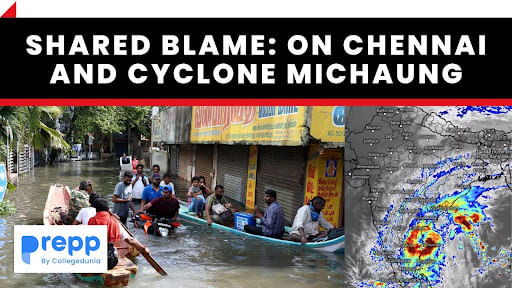
About Cyclone Michaung
- Originating in the Bay of Bengal, Michaung intensified into a super-cyclonic storm, indicating that it reached a very high intensity in terms of wind speeds and atmospheric pressure.
- The cyclone caused significant rainfall in Chennai, with some areas recording more than 120 mm and others over 250 mm of rain in a single day. This level of rainfall suggests a substantial impact in terms of flooding and associated damage.
- The cyclone impacted Chennai around December 4, with heavy rains starting late on December 3.
- On December 5, the cyclone struck near Bapatla in Andhra Pradesh, unleashing winds reaching 110 kilometers per hour. It inflicted extensive destruction across Andhra Pradesh and Tamil Nadu.
- The cyclone brought torrential rains, resulting in floods and power disruptions. It led to the death of at least 12 individuals and the evacuation of approximately 9,450 people.
- The name Michaung, given by Myanmar, symbolizes 'strength and resilience'.
- Compared to a previous flood event in 2015, the impact of Cyclone Michaung indicates that while the city had made some improvements in disaster preparedness and response, challenges remained, particularly in terms of infrastructure and urban planning.
What are Cyclones?
- Cyclones are large-scale air masses that rotate around a strong center of low atmospheric pressure.
- They are characterized by inward spiraling winds that rotate counterclockwise in the Northern Hemisphere and clockwise in the Southern Hemisphere.
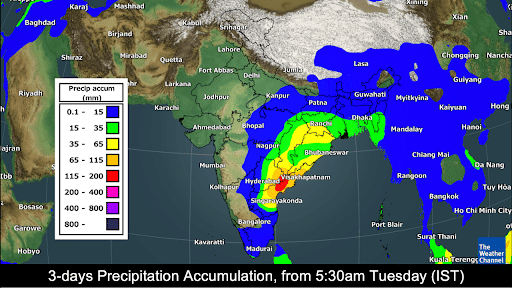
Favourable Conditions for Formation of Cyclones
- Warm Ocean Water: Sea surface temperatures must be around 26°C or higher. This warmth provides the necessary energy for the cyclone to form.
- Atmospheric Instability: Warm, moist air rising from the ocean surface leads to the formation of cumulus clouds, which can grow into a cyclone under the right conditions.
- Moisture in the Atmosphere: High humidity, especially in the lower and middle levels of the troposphere, aids in the development of clouds and thunderstorms within the cyclone.
- Low Wind Shear: Low levels of wind shear (changes in wind speed and direction with height) are essential. High wind shear can disrupt the cyclone's structure.
- A Pre-existing Weather Disturbance: A cyclone often forms from a pre-existing disturbance in the atmosphere, like a tropical wave, which provides an initial structure for storm development.
- Coriolis Effect: This is necessary to create the spin in the cyclone. It becomes effective at least 5° away from the equator.
- Distance from the Equator: Cyclones typically form at least 5° away from the Equator since the Coriolis effect is too weak near the Equator to create the cyclonic rotation.
Impact of Cyclone Michaung
- On December 4, Chennai recorded over 120 mm of rain in most areas, with some exceeding 250 mm, marking the heaviest rainfall in seven decades.
- Power was shut off as a precaution against electrocution risks due to loose cables in waterlogged areas. This action highlighted the need for better maintenance and investment in the power infrastructure.
- The cyclone caused extensive physical damage. Trees were uprooted, roads were waterlogged, overhead cables were damaged, and stormwater drains were clogged.
- This led to significant disruption, including the cancellation of trains, closure of the airport, and reports of people being stranded.
Factors Which Worsened the Situation
- Infrastructure Challenges: The necessity to shut off power in the city as a precaution against the risk of electrocution due to loose cables in dirty water indicates inadequate investment in the maintenance and repair of the power infrastructure.
- Furthermore, the city's ability to handle such storms has been compromised by decades of unplanned construction and defiance of zoning regulations.
- Preparedness Issues: While there was an improvement compared to the city's response to a similar situation in 2015, thanks to better warnings and more resilient civilian infrastructure, the overall preparedness still faced challenges.
- The progress in addressing these issues has been slower than necessary.
- Additionally, the chronic issue of public indiscipline, such as littering, has contributed to these challenges.
- Response Difficulties: There were instances of trees being toppled, water stagnation on roads, loose overhead cables, and storm water drains choked with plastic trash.
- This resulted in the cancellation of many trains, the closure of the airport, and reports of people being stranded.
- These conditions reflect the inadequacy of the city's current infrastructure and emergency response systems to effectively deal with such natural calamities.
- Climate Change: Due to climate change warmer seas are leading to stronger cyclones. This exacerbates the challenges for a city like Chennai, which is already struggling with infrastructure and preparedness issues.
Cyclone Michaung vs 2015 Floods – A Comparison and Progress
| Aspect | Cyclone Michaung (2023) | 2015 Floods |
|---|---|---|
| Intensity and Impact of Rainfall | - Extraordinary volume of rainfall with more than 120 mm in most areas and exceeding 250 mm in some places in a single day. - Described as the heaviest rainfall in seven decades. | - Significant rainfall, but implied to be more in volume in a single day compared to Cyclone Michaung. |
| City's Preparedness and Response | - Improved preparedness and response compared to 2015. - Better warnings, more resilient infrastructure, and learning from past experiences. | - Less effective response and preparedness, indicating a lack of experience in handling such extreme weather events. |
| Infrastructure and Precautionary Measures | - Challenges such as power shut off for safety, water stagnation, loose cables, and choked drains. - Reflects ongoing issues with infrastructure despite improvements. | - Presumed more severe infrastructure challenges due to less effective response and lesser preparedness at the time. |
| Long-Term Urban Planning and Climate Change | - Highlights challenges posed by climate change. - Issues with unplanned construction, zoning defiance, and public indiscipline impacting the city's storm response. | - Similar challenges noted, indicating that these issues were persistent and not adequately addressed between 2015 and 2023. |
| Social and Humanitarian Response | - Emphasis on the need for better treatment of sanitation workers, highlighting a lesson not learned from the 2015 floods. | - Lack of significant improvement in the treatment of sanitation workers since the 2015 floods, as implied by the need for such improvements following Cyclone Michaung. |
What Measures Should be Taken?
- Infrastructure Upgrade and Maintenance: The state of power infrastructure, as indicated by the precautionary power shutdown, suggests a need for significant upgrades and regular maintenance. Investing in resilient infrastructure that can withstand extreme weather events is essential.
- Effective Waste Management: The choking of stormwater drains with plastic trash emphasizes the need for effective waste management systems. This includes enhancing public awareness about littering, implementing stringent waste disposal regulations, and improving waste collection and recycling processes.
- Urban Planning and Zoning Compliance: Decades of unplanned construction and defiance of zoning laws have compromised the city's ability to respond to storms. Strict enforcement of zoning laws and thoughtful urban planning that takes into account flood risks and environmental impact are crucial.
- Climate Change Mitigation and Adaptation: Recognizing the role of climate change in intensifying natural disasters, there should be a focus on both mitigation (reducing greenhouse gas emissions) and adaptation strategies (preparing for the impacts of climate change).
- Public Awareness and Discipline: Encouraging public discipline, especially in areas like littering, is necessary. Public awareness campaigns can play a significant role in changing behaviors that adversely affect the city's resilience to natural disasters.
- Emergency Response and Preparedness: Improving the city's emergency response capabilities, including better warning systems, evacuation plans, and emergency shelters, is vital.
- Support and Recognition for Sanitation Workers: There is a need to treat sanitation workers, who are often from marginalized communities, with respect and dignity. This includes fair wages, safe working conditions, and recognition of their essential role in maintaining the city's health and safety.
- Collaboration and Participation: A collaborative approach involving government, private sector, civil society, and local communities is necessary for effective disaster management.
- Regular Review and Improvement: Ccontinuous monitoring, review, and improvement of disaster management policies and practices are essential.
Government Initiatives
|
Conclusion
In the aftermath of Cyclone Michaung, Chennai should improve its treatment of sanitation workers (mostly Dalits and Adivasis), a step it failed to take after the 2015 disaster. While natural disasters are unavoidable, Chennai has an opportunity to learn from past mistakes and improve its disaster response and urban planning strategies.
(*Click this link to read prelims specific weekly current affairs articles)
FAQs
Question: What are cyclones?
Answer:
Cyclones are large-scale air masses that rotate around a strong center of low atmospheric pressure. They are characterized by inward spiraling winds that rotate counterclockwise in the Northern Hemisphere and clockwise in the Southern Hemisphere.
Question: What was the impact of Cyclone Michaung on Chennai in terms of rainfall and infrastructure?
Answer:
Cyclone Michaung brought significant rainfall to Chennai, with most areas recording over 120 mm, and some over 250 mm, in a single day. This immense volume of water led to widespread infrastructure challenges, including power shut-offs, tree toppling, road waterlogging, disrupted transportation services, and choked storm water drains.
Question: Which country has named Cyclone Michaung?
Answer:
The name Michaung, given by Myanmar, symbolizes 'strength and resilience'.
UPSC Mains Practice Question:
|
MCQs
Question: Consider the following statements: (UPSC 2020)
- Jet streams occur in the Northern Hemisphere only.
- Only some cyclones develop an eye.
- The temperature inside the eye of a cyclone is nearly 10°C lesser than that of the surroundings.
Which of the statements given above is/are correct?
(a) 1 only
(b) 2 and 3 only
(c) 2 only
(d) 1 and 3 only
Answer: (c) See the Explanation
Both the Northern and Southern Hemispheres are home to jet streams. Hence, statement 1 is incorrect.
While most mature storms have well-developed eyes, extra-tropical cyclones may not necessarily have any. Storms that are strengthening quickly can form a very tiny, round, transparent eye, often known as a pinhole eye. Hence, statement 2 is correct.
Inside the tropical cyclone's eye, the temperature is warmer rather than lower.
The storm is caused by the temperature rising. Hence, statement 3 is incorrect.
Therefore, option (c) is the correct answer.
Question: In the South Atlantic and South-Eastern Pacific regions in tropical latitudes, cyclone does not originate. What is the reason? (UPSC 2015)
(a) Sea surface temperatures are low
(b) Inter-Tropical Convergence Zone seldom occurs
(c) Coriolis force is too weak
(d) Absence of land in those regions
Answer: (b) See the Explanation
Following are some of the reasons for lack of cyclones in South Atlantic and South-Eastern Pacific regions:
- Sea surface temperatures are slightly lower than those required for tropical cyclone formation.
- Vertical wind shear levels are climatologically high across that basin all year, even in summer.
- Vorticity: There are no pre-existing centers of rotation in the area.
- Tropical waves are not present.
- The Intertropical Convergence Zone (ITZC), which swings north in the northern summer and south in the southern summer, typically remains at or near the equator.
- The tropospheric vertical wind shear is far too severe, and no inter-tropical convergence zone (ITCZ) exists over the ocean.
- It is extremely difficult to develop tropical cyclones without an ITCZ to supply synoptic vorticity and convergence, resulting in large-scale spin and thunderstorm activity, as well as significant wind shear.
- ITCZ does not move southward over the South Atlantic or South Pacific region; instead, it remains at or close to the equator. Consequently, one of the main reasons there aren't any cyclones in these areas is that the ITCZ does not extend over them.
Therefore, option (b) is the correct answer.
Download the PREPP App and attempt FREE IAS Exam Mock Tests and get complete study material!

Full Test - 04: UPSC CSE Prelims CSAT (Paper-II)
Full Test - 03: UPSC CSE Prelims CSAT (Paper-II)
UPSC CSE Prelims 2026 GS Paper 1 Question Paper (24-May-2026)
UPSC CSE Prelims 2026 CSAT Paper 2 Question Paper (24-May-2026)

17 February 2025 | The Hindu Must Read Articles | Current Affairs

16 February 2026 | The Hindu Must Read Articles | Current Affairs

13 February 2026 | The Hindu Must Read Articles | Current Affairs









Comments