Selective Confidentiality in Electoral Bonds May Not Suffice: SC
Primary Source: The Hindu
Click here for Daily Current Affairs
Prepp Prelims Booster: Electoral Bonds, Election Commission
Prepp Mains Booster: Appointment to various Constitutional Posts, Powers, FunctionsandResponsibilities of various Constitutional Bodies
Why in the news?
- The Supreme Court has criticized the electoral bonds scheme for providing only "selective confidentiality."
- Concerns were raised about the potential for the ruling party to discover donors to opposition parties, putting them at risk of being targeted by state investigative agencies.
Table of Contents
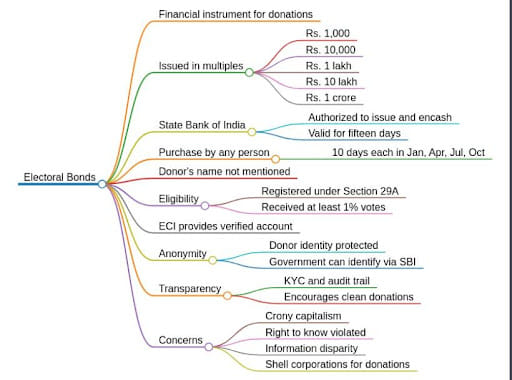
What are Electoral Bonds?
|
Supreme Court's Observations
- The scheme offers "selective confidentiality" which does not protect the identities of donors to opposition parties from the ruling party.
- The ruling party could potentially have ways to uncover the identities of the opposition's donors, putting them at a disadvantage.
- There is a concern that the ruling party might not face the same scrutiny regarding its own donors, leading to an uneven playing field between the ruling and opposition parties.
- The Court was not convinced that the State Bank of India, or any bank, had a statutory obligation to maintain donor confidentiality, questioning the presumption that banks will keep this information confidential by default.
- Chief Justice D.Y. Chandrachud expressed that the problem with the scheme is its opacity and the lack of a level playing field for political parties.
What is the Government's Defense?
- The confidentiality of the donors' identities is a key element of the electoral bonds scheme, which is intended to protect donors from potential reprisals.
- Maintaining donor anonymity is essential to prevent political contributions from reverting to the earlier practices where black money featured prominently.
- Prior to the introduction of electoral bonds, contributors were converting legitimate funds into black money to keep political donations anonymous and avoid retribution from rival parties.
- The Government implied that the scheme was designed to clean up the process of political donations, by reducing the flow of unaccounted cash into the political system.
- The scheme was portrayed as a step towards transparency and accountability, albeit with the emphasis on protecting donor identities to encourage legitimate funding.
What are Concerns Regarding Transparency?
- Lack of Transparency for Opposition: The scheme allows the ruling party to potentially access information about the donors to the opposition while keeping their own donors concealed, which could discourage fair political competition.
- Uneven Playing Field: The selective confidentiality might give the ruling party an unfair advantage by having knowledge of the opposition's funding sources without the opposition having reciprocal information.
- Statutory Obligations: Chief Justice D.Y. Chandrachud raised questions about the obligations of the State Bank of India, questioning whether there is a statutory duty to ensure the confidentiality of donor identities, which is presumed to be guaranteed by the bank's role as a trustee.
- Scheme's Opacity: The scheme was criticized for being opaque, suggesting that it hides the flow of money in politics rather than making it more transparent.
Way Forward
Enhancing Transparency
- Establish a statutory framework that mandates transparency and confidentiality in political donations.
- Create or amend laws to require political parties and donors to disclose contributions over a certain threshold.
- Strengthen auditing requirements for political parties and implement robust reporting mechanisms.
Balancing Confidentiality with Accountability
- Design mechanisms that protect donor identities from public disclosure while making them available to an independent regulatory body.
- Set limits on the amount that can be donated anonymously to prevent undue influence by a single or a group of donors.
Strengthening Democratic Institutions
- Establish or empower an independent electoral commission to oversee the electoral bond transactions and ensure adherence to legal requirements.
- Engage in a broader reform of political finance to address not just electoral bonds but also other forms of political contributions.
Judicial Review and Legislative Action
- Continue judicial scrutiny of the electoral bonds scheme to ensure it aligns with constitutional principles and democratic fairness.
- Encourage legislative debate and expert consultations to rethink and redesign the scheme in light of the criticisms.
Public Engagement
- Promote civic education campaigns to inform the public about the importance of transparency in political funding.
- Involve civil society, legal experts, and other stakeholders in discussions about improving the electoral financing system.
Conclusion
The Supreme Court pointed out the lack of transparency and fairness in the electoral bonds scheme, suggesting it provides the ruling party with an unfair advantage over the opposition. The Court suggested the need for a more transparent and accountable system that does not suffer from opacity and offers a level playing field for all political parties.
(*Click this link to read prelims specific weekly current affairs articles)
FAQs
Question: What are electoral bonds?
Answer:
Electoral bonds are a financial instrument introduced by the Government of India with the intent of making political donations more transparent and to ensure the flow of clean money to political parties. An electoral bond is like a promissory note that can be bought by any Indian citizen or company incorporated in India from specified branches of the State Bank of India.
Question: What are the constitutional provisions related to electoral bonds?
Answer:
The constitutional provisions related to electoral bonds are:
- Article 19(1)(a): This article guarantees the freedom of speech and expression to all citizens. In the context of electoral bonds, it has been argued that this freedom includes the right to make political donations anonymously.
- Article 19(2): It allows the government to impose "reasonable restrictions" on the exercise of the right to freedom of speech and expression in the interests of the sovereignty and integrity of India, the security of the State, friendly relations with foreign states, public order, decency, or morality, or in relation to contempt of court, defamation, or incitement to an offence.
Question: What is the eligibility criteria for receiving funds through electoral bonds?
Answer:
Only political parties registered under Section 29A of the Representation of the People Act, 1951, and which secured not less than 1% of the votes polled in the last general election to the House of the People or the Legislative Assembly, are eligible to receive donations through electoral bonds.
UPSC Mains Practice Question:
|
MCQs
Question: Consider the following statements: (UPSC 2017)
- The Election Commission of India is a five-member body.
- Union Ministry of Home Affairs decides the election schedule for the conduct of both general elections and by-elections.
- Election Commission resolves the disputes relating to splits/mergers of recognized political parties.
Which of the statements given above is/are correct?
(a) 1 and 2 only
(b) 2 only
(c) 2 and 3 only
(d) 3 only
Answer: (d) See the Explanation
The Election Commission of India is an autonomous constitutional organization in India that is in charge of overseeing Union and State election processes. The body is in charge of elections to India's Lok Sabha, Rajya Sabha, and State Legislative Assemblies, as well as the positions of President and Vice President.
Articles 324 to 329 of the constitution address the commission's and member's powers, functions, tenure, eligibility, and so on. The election commission consists of three members: one Chief Election Commissioner and two Election Commissioners. Hence, statement 1 is incorrect.
Functions of election commission include:
- The election commission determines the election calendar for both general elections and bye-elections. Hence, statement 2 is incorrect.
- It also resolves issues involving splits/mergers of recognized political parties. Hence, statement 3 is correct.
- It compiles the voting roll and issues the Electronic Photo Identity Card (EPIC).
- It recognizes political parties and assigns electoral symbols to them, as well as resolving election-related disputes.
- It publishes the Model Code of Conduct for Political Parties and Candidates in Elections.
- It establishes campaign spending limitations for all political parties.
Therefore, option (d) is the correct answer.
Question: Consider the following statements: (UPSC 2020)
- According to the Constitution of India, a person who is eligible to vote can be made a minister in a state for six months even if he/she is not a member of that state.
- According to the Representation of People Act,1951, a person convicted of a criminal offence and sentenced to imprisonment for five years is permanently disqualified from contesting an election even after his release from prison.
Which of the statements given above is/are correct?
(a) 1 only
(b) 2 only
(c) Both 1 and 2
(d) Neither 1 nor 2
Answer: (d) See the Explanation
Every citizen who is 18 years old on the qualifying date (January 1 of the year in this case) is eligible to vote, unless disqualified.
A person who is not an MLA can become a minister if he is elected to the State Legislature within six months of his appointment. While the voting age is 18, a person cannot become an MLA until they are 25 years old. Hence, statement 1 is incorrect.
Section 8 of the RPA of 1951 specifies the reasons for disqualification upon conviction of various offenses. From the date of conviction until the time specified, the guilty candidate is ineligible to serve in either house of Parliament or the State Legislature. This is not a permanent situation. Hence, statement 2 is incorrect.
Therefore, option (d) is the correct answer.
Question: Which one of the following Schedules of the Constitution of India contains provisions regarding anti-defection? (UPSC 2014)
(a) Second Schedule
(b) Fifth Schedule
(c) Eighth Schedule
(d) Tenth Schedule
Answer: (d) See the Explanation
The Tenth Schedule is often referred to as Anti-Defection Act. It was inserted into the Constitution by the 52nd Amendment Act of 1985, and it provides for the disqualification of elected members for defecting to another political party.
According to the 91st CAA, 2003, at least two-thirds of the members of a party must be in favour of a "merger" for it to be legal. Disqualification due to defection is decided by the Speaker or the Chairman of the appropriate Legislative chamber.
Therefore, option (d) is the correct answer.
Download the PREPP App and attempt FREE IAS Exam Mock Tests and get complete study material!

Full Test - 04: UPSC CSE Prelims CSAT (Paper-II)
Full Test - 03: UPSC CSE Prelims CSAT (Paper-II)
UPSC CSE Prelims 2026 GS Paper 1 Question Paper (24-May-2026)
UPSC CSE Prelims 2026 CSAT Paper 2 Question Paper (24-May-2026)

17 February 2025 | The Hindu Must Read Articles | Current Affairs

16 February 2026 | The Hindu Must Read Articles | Current Affairs

13 February 2026 | The Hindu Must Read Articles | Current Affairs









Comments