Scramjet Engine – Science & Technology Notes
A scramjet (supersonic-combustion ramjet) is a ramjet engine with airflow that is supersonic, or faster than the speed of sound. Vehicles powered by scramjets are expected to reach speeds of at least Mach 15. Scramjet technology is extremely difficult to develop, and only three other countries (the United States, Russia, and China) have been successful in doing so before India. In this article, we will discuss in detail regarding Scramjet Engine which will be helpful for UPSC exam preparation.
Table of Contents
- Jet Engines
- Scramjet Engine
- Design Principles of a Scramjet Engine
- Working of a Scramjet Engine
- Technical Challenges Related to Scramjet Engines
- Advantages of a Scramjet Engine
- Disadvantages of a Scramjet Engine
- Difference between a Jet Engine and Rocket Engine
- India and Scramjet Technology
- Conclusion
- FAQs
- MCQs
What are Jet Engines?
- Jet engines are combustion engines that use jet propulsion to generate thrust (or movement).
- These engines are used in high-speed applications such as jet aeroplanes, fighter jets, missiles, and drones.
- Jet engines are also modified for use in high-performance automobiles and power plants.
- A basic jet engine operates on the same principles as a gas turbine.
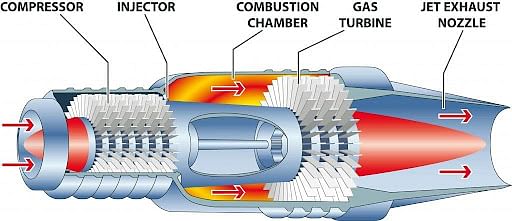
Basic Jet Engine
| Other Relevant Links | |
|---|---|
| GSLV and Various Engine | Recent National and International Space Missions |
| Cryogenic rockets | GSLV Mk III-D1 OR GSAT-19 Mission |
| ISRO’s World Record PSLV C37 Launch: | Global Positioning System |
| Galileo | GLONASS |
| IRNSS | GAGAN |
| Chandrayaan – I & II | Mars Orbiter Mission |
What is a Scramjet Engine?
- Ramjet and scramjet engines are jet engine variants that do away with the rotary compressor and turbine found in standard jet engines. To generate thrust, the two models rely on the natural ramming of air.
- Ramjets and scramjets work by converting the significant kinetic energy of the incoming hypersonic (speed greater than Mach 5) or supersonic air into pressure energy.
- As a result, ramjets and scramjets require assistance during their initial take-off until the plane reaches a certain speed.
- Both types work efficiently only when the surrounding air is moving at supersonic speeds, starting at Mach 3.
- A scramjet (supersonic combustion ramjet) is an air-breathing jet engine variant in which combustion occurs in supersonic airflow.
- A scramjet, like a ramjet, relies on high vehicle speed to forcefully compress and decelerate incoming air before combustion (hence the name), but unlike a ramjet, which decelerates the air to subsonic velocities before combustion, airflow in a scramjet is supersonic throughout the engine.
- This enables the scramjet to operate efficiently at extremely high speeds: theoretical projections place a scramjet's top speed between Mach 12 and Mach 24.
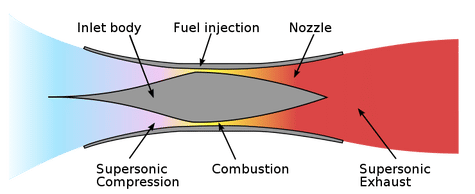
Scramjet Engine
Design Principles of a Scramjet Engine
- Scramjet engines are a type of jet engine that generate thrust through the combustion of fuel and an oxidizer.
- Scramjet-powered aircraft, like conventional jet engines, carry the fuel on board and obtain the oxidizer through the ingestion of atmospheric oxygen (as opposed to rockets, which carry both fuel and an oxidising agent).
- This constraint confines scramjets to suborbital atmospheric propulsion where the oxygen content of the air is sufficient to sustain combustion.
- The scramjet is made up of three basic components, which are as follows:
- Converging inlet - Incoming air is compressed and decelerated at a converging inlet.
- Combustor – It is here that gaseous fuel burns with atmospheric oxygen to generate heat.
- Diverging nozzle – It is here that heated air is accelerated to generate thrust.
Working of a Scramjet Engine
- A scramjet, unlike a typical jet engine, such as a turbojet or turbofan engine, does not use rotating, fan-like components to compress the air; instead, the aircraft's achievable speed as it moves through the atmosphere causes the air to compress within the inlet. As a result, a scramjet has no moving parts.
- Scramjets can only operate at near-hypersonic speeds due to the nature of their design.
- Scramjets rely on the high kinetic energy of a hypersonic flow to compress incoming air to operational conditions because they lack mechanical compressors.
- The incoming airflow in scramjets is not slowed to subsonic levels and maintains supersonic speeds. This is accomplished by using a diffuser that gradually diverges.
- Scramjet combustion chambers are also modified to operate at supersonic speeds, whereas ramjet combustion chambers only operate at subsonic speeds.
- The propelling nozzle is also modified to increase the speed of the exhaust jet. As a result, scramjets produce more thrust than ramjets. Scramjets can thus fly at higher speeds than ramjets.
Technical Challenges Related to Scramjet Engines
- While scramjets are conceptually straightforward, actual implementation is hampered by extreme technical challenges.
- Within the atmosphere, hypersonic flight generates enormous drag, and temperatures on the aircraft and within the engine can be much higher than the surrounding air.
- Maintaining combustion in a supersonic flow is more difficult because the fuel must be injected, mixed, ignited, and burned in milliseconds.
- While scramjet technology has been in development since the 1950s, scramjets have only recently achieved powered flight.
Advantages of a Scramjet Engine
- The Scramjet engine does not require oxygen.
- Manufacturing is simplified because there are no rotating parts.
- Scramjet engines have a greater specific impulse (change in momentum per unit of propellant) than rocket engines.
- Higher speeds could mean less expensive access to space in the future.
- The use of a Scramjet would help to reduce the weight of the launch vehicle while increasing its speed.
Disadvantages of a Scramjet Engine
- A scramjet cannot produce efficient thrust unless it is accelerated to high speeds, typically around Mach 5, though depending on the design, it may function as a ramjet at low speeds.
- Scramjet designs are tested using either extremely expensive hypersonic test chambers or expensive launch vehicles, both of which result in high instrumentation costs.
- Inadequate stealth technology.
- Initial propulsion requirements are extremely high.
Difference between a Jet Engine and Rocket Engine
| Jet Engines | Rocket Engines |
|---|---|
| Jet engines are air-breathing engines that obtain their oxygen from the surrounding atmosphere. | For the combustion process, rocket engines have their own source of oxygen. |
| A compressor is used in jet engines to pressurise the combustion chamber. | Rocket engines directly feed pressurised oxygen into the combustion chamber. |
| Depending on the desired output, jet engines are frequently throttled back and forth. | For maximum efficiency, rocket engines are typically operated at a constant thrust range. |
| Jet engines cannot function outside of the atmosphere. | Rockets can operate in both the atmosphere and the vacuum of space. |
| Aeroplanes are the primary users of jet engines. | Spacecraft are the primary users of rocket engines. |
| When compared to rocket engines, they produce significantly less thrust. | The power of rocket engines can be scaled as needed. |
India and Scramjet Technology
- India began working on Scramjet technology a long time ago, and we conducted ground testing in 2006 that validated the engine's design.
- India is now the fourth country to claim the successful testing of the Scramjet Engine.
- Russia was the first country to claim a scramjet flight test in 1991, and the US and European Space Agencies soon followed.
- ISRO's reusable launch vehicle (RLV) can benefit from the Scramjet engine.
- ISRO's Scramjet engine runs on hydrogen as fuel and oxygen from the atmosphere as an oxidizer. This results in a much lighter, more efficient, and cost-effective system.
- On board the Rohini 560 sounding rocket (Research Rocket), the scramjet engine was tested.
- ISRO designed and developed the RH 560 Advanced Technology Vehicle (ATV) in two stages to test scramjet engines.
- ATV is the ISRO's heaviest (3 tonnes) sounding rocket developed to date.
- ISRO's reusable launch vehicle platform, Avatar (Aerobic Vehicle for Transatmospheric Hypersonic Aerospace TrAnspoRtation), is capable of carrying out satellite launches like normal aircraft, takes off vertically, and lands back on a runway. Its thrust is provided by ramjets and scramjets.
- Each of these engines will be used at different points during the flight, with scramjets being used at hypersonic speeds.
Conclusion
In a nutshell, the development of Scramjet engines is a significant step forward in ISRO's pursuit of future space transportation systems. Air breathing propulsion is a solution for reusable launch vehicles that require a powered long return cruise flight. In addition, DRDO has been working on developing the Brahmos II Cruise Missile using the same scramjet technology. This necessitates the rapid development of ramjet or scramjet technologies, which will enable India to carry out advanced space missions in the future.
| Other Relevant Links | |
|---|---|
| Science & Technology Policy in India | Scientific Policy Resolution 1958 |
| Science & Technology Policy of 1983 | Science & Technology Policy of 2003 |
| Science, Technology and Innovation Policy 2013 | New Initiatives Aligned with the National Agenda |
| India and World collaboration in science projects | Technology Vision Document 2035 |
FAQs
Question: What is a scramjet engine?
Answer: A scramjet (supersonic combustion ramjet) engine is an air-breathing engine that operates at hypersonic speeds, using supersonic airflow through its combustion chamber to ignite fuel, enabling sustained flight at high speeds.
Question: How does a scramjet engine differ from a conventional jet engine?
Answer: A scramjet engine differs from a conventional jet engine by operating at hypersonic speeds (Mach 5 and above) and utilizing supersonic combustion, while traditional jet engines work at subsonic or transonic speeds and rely on subsonic combustion.
Question: What are the primary advantages of a scramjet engine?
Answer: The primary advantages of a scramjet engine are its ability to operate at very high speeds (Mach 5 and above), high efficiency at hypersonic velocities, and the fact that it doesn't require heavy oxidizers, relying instead on atmospheric oxygen.
Question: What speeds are required for a scramjet engine to function effectively?
Answer: A scramjet engine requires speeds of Mach 5 (about 6,174 km/h) or higher to operate effectively, as the engine relies on supersonic airflow to combust fuel within the engine's combustion chamber.
Question: What are the challenges associated with scramjet engine development?
Answer: The key challenges include achieving stable combustion at hypersonic speeds, managing extreme heat generated during flight, and designing materials that can withstand the intense conditions of high-speed flight.
MCQs
1. What is the primary advantage of a scramjet engine?
A) It can operate at supersonic speeds using external fuel
B) It operates at hypersonic speeds without requiring heavy oxidizers
C) It operates at subsonic speeds
D) It is capable of generating its own oxygen supply
Answer: (B) See the Explanation
Explanation: The primary advantage of a scramjet engine is that it operates at hypersonic speeds without the need for heavy oxidizers, using atmospheric oxygen for combustion.
2. Which of the following is true regarding the operation of a scramjet engine?
A) It uses a subsonic combustion process
B) It operates efficiently at Mach 2
C) It requires speeds above Mach 5 to function effectively
D) It generates its own oxygen supply for combustion
Answer: (C) See the Explanation
Explanation: Scramjet engines require speeds above Mach 5 to operate effectively, as they rely on supersonic airflow to combust fuel within the engine.
3. What is the key difference between a scramjet engine and a ramjet engine?
A) Scramjets operate at lower speeds than ramjets
B) Ramjets rely on supersonic combustion
C) Scramjets operate at hypersonic speeds with supersonic combustion
D) Ramjets require oxidizers, while scramjets do not
Answer: (C) See the Explanation
Explanation: The key difference is that scramjets operate at hypersonic speeds (Mach 5 and above) with supersonic combustion, while ramjets operate at subsonic or transonic speeds with subsonic combustion.
4. Which of the following speeds is necessary for a scramjet to operate effectively?
A) Mach 2
B) Mach 3
C) Mach 5
D) Mach 10
Answer: (C) See the Explanation
Explanation: A scramjet engine requires speeds of Mach 5 (about 6,174 km/h) or higher to function effectively, utilizing the high-speed air flow for efficient combustion.
5. What are the challenges in developing scramjet engines?
A) Achieving stable combustion at subsonic speeds
B) Managing extreme heat and ensuring stable combustion at hypersonic speeds
C) Reducing the engine's weight
D) Operating at low altitudes
Answer: (B) See the Explanation
Explanation: The key challenges in developing scramjet engines include achieving stable combustion at hypersonic speeds and managing the extreme heat generated during flight.
GS Mains Questions and Model Answers
Q1: Discuss the working principle and advantages of scramjet engines in modern aerospace applications.
Answer: Scramjet engines are air-breathing engines that operate efficiently at hypersonic speeds (Mach 5 and above). They function by utilizing supersonic airflow to ignite fuel within the combustion chamber, without the need for heavy oxidizers. The key advantages of scramjet technology include its ability to achieve high speeds with minimal fuel consumption, reduced reliance on oxidizers, and high efficiency at hypersonic velocities. Scramjets hold potential for use in future space launch systems, hypersonic aircraft, and advanced missiles. However, challenges like maintaining stable combustion, material durability at extreme temperatures, and fuel management remain critical for their widespread use.
Q2: Analyze the role of scramjet technology in advancing space exploration and military aerospace capabilities.
Answer: Scramjet technology offers significant advantages in both space exploration and military aerospace capabilities due to its ability to operate at hypersonic speeds. In space exploration, scramjets could enable more efficient access to space by replacing traditional rocket boosters for certain phases of flight. They can potentially lower the cost of launching payloads into space by reducing the need for large amounts of fuel. In military applications, scramjets can lead to the development of high-speed aircraft and weapons systems that can travel long distances rapidly, evading interception. While scramjet technology offers promising capabilities, overcoming the technical challenges of combustion stability and material science remains a major hurdle.
Q3: Explain the technical challenges in the development of scramjet engines and the potential solutions to overcome them.
Answer: The development of scramjet engines faces significant technical challenges, primarily due to the extreme conditions at hypersonic speeds. These challenges include achieving stable combustion at such speeds, managing the heat generated by high-speed air flows, and ensuring that the engine components can withstand the intense thermal stresses. Additionally, scramjets require advanced materials that can endure high temperatures without degrading. Solutions to these challenges include the development of heat-resistant alloys, advanced cooling techniques, and the refinement of combustion control mechanisms to stabilize the airflow within the engine. Researchers are also working on improving the aerodynamics and efficiency of the engine design to make scramjets a practical solution for future aerospace applications.
Previous Year Questions on Scramjet Engine
1. UPSC CSE Prelims 2021:
Question: Which of the following best describes the operation of a scramjet engine?
A) It operates at subsonic speeds using liquid oxygen
B) It uses a hypersonic combustion process to achieve efficient flight
C) It is used primarily for launching rockets into space
D) It uses a traditional combustion process with external oxidizers
Answer: (B)
Explanation: A scramjet engine operates using a hypersonic combustion process, which allows for efficient flight at speeds above Mach 5. It uses atmospheric oxygen for combustion without requiring external oxidizers.
2. UPSC CSE Mains 2019:
Question: Explain the concept of hypersonic speeds and the role of scramjet engines in achieving these speeds.
Answer: Hypersonic speeds refer to speeds greater than Mach 5 (5 times the speed of sound). Scramjet engines are designed to operate efficiently at these speeds, using supersonic combustion. At hypersonic velocities, the engine relies on the high-speed airflow to ignite fuel, reducing the need for heavy oxidizers. This enables sustained flight at extremely high speeds, opening up possibilities for faster space exploration and advanced military applications.
Download the PREPP App and attempt FREE IAS Exam Mock Tests and get complete study material!

Full Test - 04: UPSC CSE Prelims CSAT (Paper-II)
Full Test - 03: UPSC CSE Prelims CSAT (Paper-II)
UPSC CSE Prelims 2026 GS Paper 1 Question Paper (24-May-2026)
UPSC CSE Prelims 2026 CSAT Paper 2 Question Paper (24-May-2026)

17 February 2025 | The Hindu Must Read Articles | Current Affairs

16 February 2026 | The Hindu Must Read Articles | Current Affairs

13 February 2026 | The Hindu Must Read Articles | Current Affairs









Comments