SC Refuses to Vacate Order on Temple Priests in Tamil Nadu
Primary Source: The Hindu
Click here for Daily Current Affairs
Why in the news?
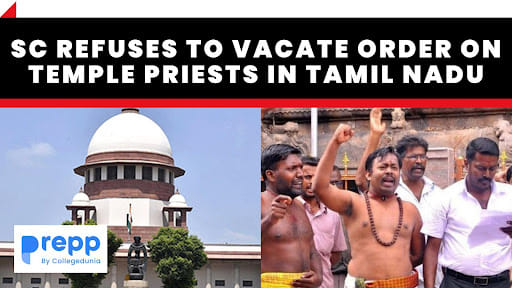
- Recently, the Supreme Court gave its decision not to vacate its interim order regarding the appointment of Temple Priests in Tamil Nadu.
- This decision maintains the status quo set regarding the Archakaship in temples that follow the Agamas.
Table of Contents
What are Agamas?
What is Archakaship?
|
What is the Supreme Court's Interim Order?
- The interim order was based on petitions claiming the Tamil Nadu government was appointing "nonbelievers" as Archakas contrary to Agamic rules.
- The Supreme Court's interim order was to maintain the status quo regarding the appointment of Archakas (priests) in Agamic temples in Tamil Nadu.
- This means that the state government cannot appoint "non-believers" as Archakas, and it must continue to follow the traditional procedures for selecting and appointing Archakas as prescribed by the Agamas.
- The court also ordered the government to continue training Archakas according to the Agamas and to ensure that the requirements of the Agamas are met in all Agamic temples.
What is the State Government's Stance?
- The government argued that the status quo affects the filling of 2,405 vacancies for Archakaship.
- It was emphasized that the stay hinders the training and induction of individuals who have completed courses from the Archaka training school, thus affecting temple rituals.
- The government's actions were not in conflict with the Agamas and were instead focused on improving temple administration.
- The government had the right to appoint and transfer Archakas as a part of its secular function of managing temples.
- The government contended that it was following the Agamas' principles and had established an Archaka training school to ensure priests were adequately qualified.
- The government emphasized its commitment to maintaining the sanctity of temples and respecting the religious practices of Hindus.
What were the Petitioners' Arguments?
- The petitions, including one by the All India Adi Saiva Sivacharyargal Seva Association, seek to quash government directives that contradict the Agamas.
- The government's attempts to appoint and transfer Archakas were an attempt to take over the running of the Agamic temples.
- The government's actions were in violation of the Agamas,which require priests to be qualified and initiated into the Hindu faith.
- The government's actions were a threat to the sanctity of the Agamic temples and the rights of Hindus to have their religious practices respected.
Conclusion
The Supreme Court's refusal to modify its interim order on Archakaship appointments has temporarily halted the Tamil Nadu government's actions, indicating a significant deference to traditional practices outlined in the Agamas. The matter remains unresolved and is set for a hearing in January 2024, leaving the issue of balancing secular administrative functions and religious traditions in temple management in Tamil Nadu in a state of uncertainty.
(*Click this link to read prelims specific weekly current affairs articles)
FAQs
Question: What are Agamas?
Answer:
Agamas are a collection of Hindu scriptures that are considered to be sacred texts for Shaivism and Vaishnavism, two of the major branches of Hinduism. The Agamas contain detailed instructions on rituals, ceremonies, and practices related to worship of Shiva and Vishnu, respectively. They also provide guidance on the construction of temples, the initiation of priests, and the performance of various pujas (rituals).
Question: What is Archakaship?
Answer:
Archakaship refers to the role of a priest or worship leader in a Hindu temple. Archakas perform pujas, ceremonies, and rituals according to the Agamas. They are also responsible for maintaining the sanctity of the temple and ensuring that worship is conducted properly.
MCQs
Question: With reference to the cultural history of India, consider the following pairs: (UPSC 2020)
- Parivrajaka — Renunciant and Wanderer
- Shramana — Priest with a high status
- Upasaka — Lay follower of Buddhism
Which of the pairs given above are correctly matched?
(a) 1 and 2 only
(b) 1 and 3 only
(c) 2 and 3 only
(d) 1, 2 and 3
Answer: (b) See the Explanation
Parivrajaka are renunciant and wanderers. Hence, pair 1 is correct.
Shramana refers to ancient India's ascetics and renouncers. The shramans included ascetics, monks, and lay followers of numerous sects, including Buddhist, Jaina, Ajivika, and others. Hence, pair 2 is incorrect.
Upasaka is a Buddhist lay follower. Hence, pair 3 is correct.
Therefore, option (b) is the correct answer.
Question: Consider the following statement regarding Agamas:
- They are considered to be sacred texts for Shaivism and Vaishnavism.
- The Agamas contain detailed instructions on rituals, ceremonies, and practices related to worship of Shiva and Vishnu.
- They provide guidance on the construction of temples, the initiation of priests, and the performance of various pujas (rituals).
How many of the above statements are correct?
(a) Only one
(b) Only two
(c) Only three
(d) None
Answer: (c) See the Explanation
Agamas are a collection of Hindu scriptures that are considered to be sacred texts for Shaivism and Vaishnavism, two of the major branches of Hinduism. Hence, statement 1 is correct.
The Agamas contain detailed instructions on rituals, ceremonies, and practices related to worship of Shiva and Vishnu, respectively. Hence, statement 2 is correct.
They also provide guidance on the construction of temples, the initiation of priests, and the performance of various pujas (rituals). Hence, statement 3 is correct.
Therefore, option (c) is the correct answer.
Download the PREPP App and attempt FREE IAS Exam Mock Tests and get complete study material!

Full Test - 04: UPSC CSE Prelims CSAT (Paper-II)
Full Test - 03: UPSC CSE Prelims CSAT (Paper-II)
UPSC CSE Prelims 2026 GS Paper 1 Question Paper (24-May-2026)
UPSC CSE Prelims 2026 CSAT Paper 2 Question Paper (24-May-2026)

17 February 2025 | The Hindu Must Read Articles | Current Affairs

16 February 2026 | The Hindu Must Read Articles | Current Affairs

13 February 2026 | The Hindu Must Read Articles | Current Affairs









Comments