Revised Criminal Reform Bills in Parliament - What has changed, and why
Primary Source: The Indian Express
Click here for Daily Current Affairs
Why in the news?
- The Centre has introduced three revised criminal reform Bills in the Lok Sabha, replacing previous versions.
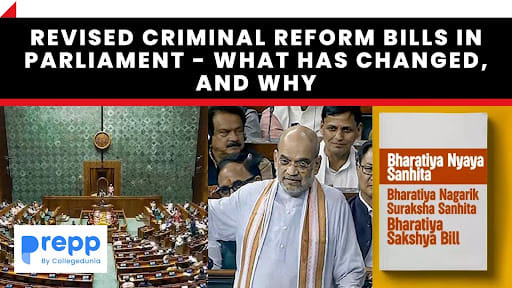
- The revised criminal reform Bills aim to replace the Indian Penal Code, the Code of Criminal Procedure, and the Indian Evidence Act with Bharatiya Nyaya Sanhita (BNS), Bharatiya Nagarik Suraksha Sanhita (BNSS), and Bharatiya Sakshya Bill, respectively.
Table of Contents
What are the new Bills?
- The government has introduced a trio of new Bills in the Lok Sabha, aimed at fundamentally revamping India's criminal justice system.
- These Bills are designated to supplant the Indian Penal Code (IPC) from 1860, the Code of Criminal Procedure (CrPC) from 1973, and the Indian Evidence Act of 1872.
- The IPC will be replaced by the Bharatiya Nyaya Sanhita, 2023.
- The CrPC will be replaced by the Bharatiya Nagarik Suraksha Sanhita, 2023.
- The Indian Evidence Act will be replaced by the Bharatiya Sakshya Bill, 2023.
Need for the New Bills
- Colonial Roots: For over 160 years, since 1860, India’s criminal justice system has operated under British-era laws. These laws, crafted in the colonial period, use outdated language and principles that may no longer align with contemporary societal norms and values.
- Technological Evolution: The swift progression of technology has added new layers to the nature of crime, the gathering of evidence, and investigative procedures.
- Legal Complexity and Clarification: Over the years, the legal system has grown increasingly intricate, causing confusion for legal professionals, law enforcement bodies, and the public. By making the laws more straightforward and orderly, it's possible to improve their transparency and comprehensibility.
- Modernizing Evidence Practices: The Indian Evidence Act, established before the rise of modern forensic science and digital tools, is due for an update.
- Calls for Legal Reforms: Numerous reports have emphasized the necessity of overhauling the nation's criminal laws.
- The Parliamentary Standing Committee on Home Affairs, in its 146th report, advocated for a thorough reassessment of India's criminal justice framework.
- Additionally, this committee had previously underscored the urgency of criminal law reforms in its 111th and 128th reports.
Key Changes in the Bills
1) Handcuffs Usage
- Previous Provision: Clause 43(3) of BNSS allowed handcuffs for serious offences, including economic offences.
- Committee's Suggestion: Recommended excluding “economic offences” from the handcuff provision.
- Changes in New Bill: The recommendation was incorporated, removing “economic offences” and focusing on offences against the state.
2) Mercy Petitions
- Previous Provision: Clause 473(1) detailed the process for mercy petitions by death sentence convicts.
- Committee's Suggestion: Proposed a quasi-judicial board for commutation and remission matters and a specified time frame for hearing mercy petitions.
- Changes in New Bill: The new Bill modifies the provision, removing the option to forward petitions to the Home Department and broadening the unappealable scope of the Governor's orders.
3) Preventive Detention Powers
- Previous Provision: Clause 172(2) granted police expanded powers for preventive action without a clear time limit.
- Committee's Suggestion: Suggested specifying the detention period and clarifying terms to avoid ambiguity.
- Changes in New Bill: Added a 24-hour time limit for detention and replaced “judicial magistrate” with “Magistrate.”
4) Community Service
- Previous Provision: Included community service as a punishment but lacked a clear definition.
- Changes in New Bill: The new Bill defines “community service” and adds it as punishment for certain offences.
Conclusion
The new bills reflect a more nuanced approach to criminal law, incorporating committee recommendations for clarity and fairness. These reforms indicate a shift in India's legal framework, essential for understanding contemporary legal and governance issues.
(*Click this link to read prelims specific weekly current affairs articles)
FAQs
Question: What is Bharatiya Nyaya Sanhita (BNS)?
Answer:
The Bharatiya Nyaya Sanhita (BNS) is a proposed legal statute in India that is intended to replace the existing Indian Penal Code (IPC). It seeks to introduce a legal framework that is more in tune with the current societal norms, human rights standards, and technological advancements.
Question: What is commutation?
Answer:
Commutation involves changing the type of punishment given to a lesser form. For example, a death sentence may be commuted to life imprisonment.
Question: What are the names of the new bills introduced to replace the Indian Penal Code (IPC), the Code of Criminal Procedure (CrPC), and the Indian Evidence Act?
Answer:
The new bills introduced are the Bharatiya Nyaya Sanhita (BNS), 2023, to replace the IPC; Bharatiya Nagarik Suraksha Sanhita (BNSS), 2023, for the CrPC; and Bharatiya Sakshya (BS) Bill, 2023, for the Indian Evidence Act.
UPSC Mains Practice Question:
|
MCQs
Question: For which one of the following reforms was a Commission set up under the Chairmanship of Veerappa Moily by the Government of India? (UPSC 2008)
(a)Police Reforms
(b)Tax Reforms
(c)Reforms in Technical Education
(d)Administrative Reforms
Answer: (d) See the Explanation
The Second Administrative Reforms Commission (ARC) was established as a Commission of Inquiry on August 31, 2005, under the Chairmanship of Shri Veerappa Moily, to prepare a detailed blueprint for restructuring the public administrative system.
Therefore, option (d) is the correct answer.
Question: The Bharatiya Nyaya Sanhita (BNS), 2023, is intended to replace which existing law?
(a) The Indian Penal Code (IPC), 1860
(b) The Code of Criminal Procedure, 1973
(c) The Indian Evidence Act, 1872
(d) The Indian Constitution
Answer: (a) See the Explanation
The BNS, 2023, is specifically introduced to replace the IPC, 1860, as part of the criminal law reform initiative.
Therefore, option (a) is the correct answer.
Question: Consider the following statements regarding the Bharatiya Nyaya Sanhita (BNS):
- The BNS proposes the complete abolition of the death penalty in all circumstances.
- It redefines 'life imprisonment' as imprisonment for the remainder of the convict's natural life.
Which of the statements given above is/are correct?
(a) 1 only
(b) 2 only
(c) Both 1 and 2
(d) Neither 1 nor 2
Answer: (b) See the Explanation
The Bharatiya Nyaya Sanhita (BNS) is a proposed criminal statute in India. The BNS does not propose the complete abolition of the death penalty in all circumstances. The parliamentary committee did not recommend abolishing the death penalty and left the matter for the government to consider. Hence, statement 1 is incorrect.
The BNS redefines 'life imprisonment' as imprisonment for the remainder of the convict's natural life, providing a significant alternative to the death penalty and emphasizing the aspect of reform and punishment over mere retribution. Hence, statement 2 is correct.
Therefore, option (b) is the correct answer.
Download the PREPP App and attempt FREE IAS Exam Mock Tests and get complete study material!

Full Test - 04: UPSC CSE Prelims CSAT (Paper-II)
Full Test - 03: UPSC CSE Prelims CSAT (Paper-II)
UPSC CSE Prelims 2026 GS Paper 1 Question Paper (24-May-2026)
UPSC CSE Prelims 2026 CSAT Paper 2 Question Paper (24-May-2026)

17 February 2025 | The Hindu Must Read Articles | Current Affairs

16 February 2026 | The Hindu Must Read Articles | Current Affairs

13 February 2026 | The Hindu Must Read Articles | Current Affairs









Comments